
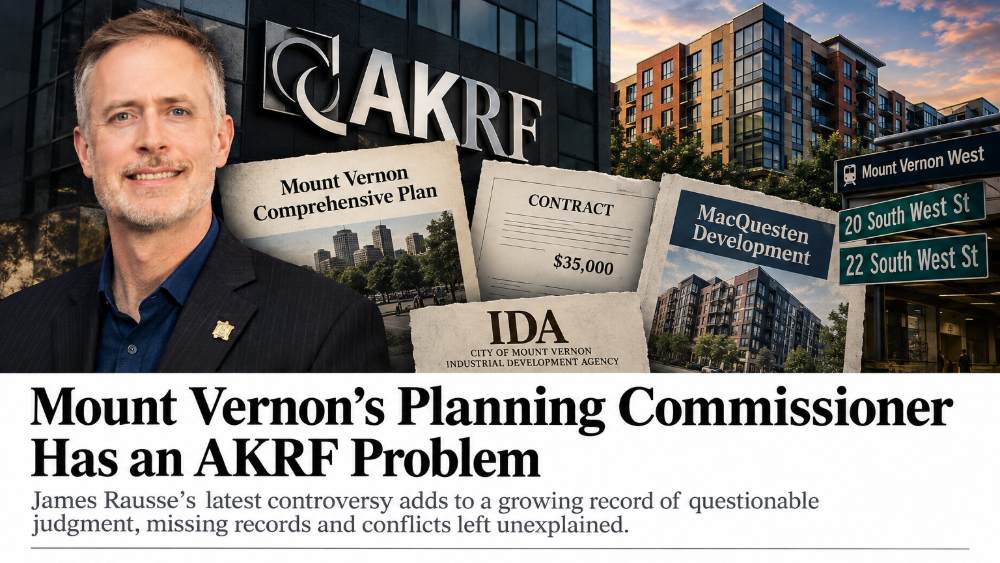
Mount Vernon Planning Commissioner, James Rausse, has a remarkable ability to preside over controversy without ever appearing to be accountable for it.
The Comprehensive Plan he oversaw is being challenged in court over allegations that the City failed to comply with state environmental and public-participation requirements.
Weeks after that lawsuit was filed, Rausse helped present the same Plan at a Hofstra Law CLE as a case study involving community outreach, public hearings and SEQRA compliance — the very issues being litigated.
His department then ran the procurement for Mount Vernon’s $955,000 zoning rewrite, a process that has produced missing records, unanswered questions, and a City that still cannot produce a complete paper trail showing how one of the most consequential contracts in Mount Vernon was evaluated.
Now there is AKRF. And this one goes directly to the integrity of the planning process Rausse oversees.
AKRF helped prepare Mount Vernon’s Comprehensive Plan while also working for a private developer pursuing a major project in Mount Vernon West.
That developer already has another project next door receiving benefits from the Mount Vernon Industrial Development Agency (IDA).
And now the IDA, itself poorly run, ethically challenged, and administered through Rausse’s Planning Department — has hired AKRF too.
AKRF Wasn’t Just the City’s Consultant
AKRF was part of the consulting team that worked on Mount Vernon’s Comprehensive Plan, the document that will shape where and how development occurs throughout the City.
Rausse knew exactly who AKRF was.
When the Comprehensive Plan process began, he publicly praised AKRF and Hudson Valley Pattern for Progress as “stellar partners.”
But AKRF had another Mount Vernon client.
MacQuesten Development.
MacQuesten is developing Station Plaza at 20 South West Street, immediately adjacent to the Mount Vernon West Metro-North station. The City’s March 2026 project materials identify MacQuesten Development LLC as the owner and AKRF as part of the project team.
This is not some random parcel on the other side of town.
It sits in the Mount Vernon West Transit Oriented Development Hub District — an area where decisions about density, building height, parking requirements, zoning and transit-oriented development can dramatically affect the value and development potential of private property.
Those are precisely the kinds of policies addressed by a Comprehensive Plan.
So while AKRF was helping Mount Vernon plan its development future, it was also working for a private developer with a direct financial interest in that future.
That overlap warranted scrutiny on its own and should have gotten someone’s attention.
Especially Rausse’s. And MacQuesten’s relationship with the City makes it considerably more complicated.
Follow the Developer to Get to the Money
MacQuesten’s relationship with Mount Vernon does not begin at 20 South West Street.
Immediately next door, at 22 South West Street, MacQuesten developed a 189-unit residential project that receives benefits through the Mount Vernon Industrial Development Agency.
State Authorities Budget Office records identify MacQuesten Takeover Partners LLC as the applicant for the project and report tax exemptions and PILOT payments associated with it.
The Mount Vernon IDA’s 2026 records continue to list 22 South West Street among its PILOT projects.
In August, the agency authorized a contract of up to $35,000 with AKRF for consulting involving revitalization, Opportunity Zones, Urban Renewal Agency expansion and investment attraction.
Unlawful? Standing alone — probably not. But anyone responsible for protecting the integrity of this process should have recognized the appearance of a conflict from a mile away.
So Where Are the Guardrails?
The questions are obvious.
Did AKRF disclose its private work for MacQuesten before the IDA hired it?
Did Rausse disclose that relationship to the IDA Board?
Was the Board told that an important consultant on the City’s Comprehensive Plan was also working for a private developer in Mount Vernon West?
Did counsel conduct a conflict review?
Were any written restrictions imposed?
Was AKRF screened from matters involving MacQuesten, Station Plaza, 22 South West Street or other matters in which its private client had an interest?
And if those safeguards exist, where are they?
These are not questions that should arise months later because residents happened to connect the dots themselves.
Identifying overlapping interests is supposed to be part of the government’s job.
But this is Mount Vernon…
You Really Cannot Make This Part Up
The August 13 IDA agenda makes the situation even harder to understand.
Among the policy updates scheduled for discussion that day was one titled:
On the same agenda:
The IDA was literally considering consultant conflicts while also considering whether to hire a consultant working for a private Mount Vernon developer.
Perhaps that relationship was discussed.
Perhaps everyone was fully informed.
Perhaps counsel reviewed it and concluded that there was no conflict.
Because if the City’s conflict controls worked exactly as they were supposed to, there should be no difficulty demonstrating that.
Right?
And Here We Are Again
That demand for documentation should sound familiar.
Rausse’s department is already at the center of another procurement controversy involving a much larger number: $955,000.
That is what Mount Vernon agreed to pay Interboro Partners to rewrite the City’s zoning code and prepare the related environmental review.
MVCIP has previously detailed the holes in that process: four firms responded to the RFP, but only three appeared in the rankings produced through FOIL; the RFP contemplated five reviewers, but only four were identified; the City says no minutes were maintained for key portions of the evaluation and interview process; and Interboro’s $955,000 proposal was $135,000 higher than the second-ranked firm’s even though only 1.9 points separated them.
After repeated requests for additional documentation, the City said it had “no additional responsive records” addressing several of the outstanding questions.
So, once again, a major decision coming through Rausse’s Planning Department has left residents trying to reconstruct what happened from an incomplete government record.
Then There Are the Developers’ Promises
According to former Planning Department commissioner Vince Ferrandino, there is another part of Rausse’s record that deserves scrutiny: what happens after developers get their approvals.
According to Ferrandino, required Community Benefits Agreements have not been implemented and enforced for three high-profile projects: The Opal at 115 South MacQuesten Parkway, Q-West Towers, and One Prospect Tower downtown.
Ferrandino has repeatedly raised the issue with Rausse, the Mayor, the Comptroller, and the City Council, without getting the obligations enforced. And he has the email exchanges to back up his claims.
He also says the developers behind the three projects have contributed to the Patterson-Howard administration or Rise Up PAC.
Campaign contributions do not prove that anyone received favorable treatment. But when developers who have supported the City’s political leadership are allegedly not being held to conditions imposed on their projects, the appropriate response is not to shrug. It is to produce the agreements and show the public whether they have been enforced.
What exactly did each developer promise? What was required as a condition of approval? What has been delivered? What remains outstanding?
And if developers failed to comply, what did Rausse’s Planning Department do about it?
Rausse Takes a Victory Lap
Then there is the Comprehensive Plan itself.
Rausse oversaw the planning process that produced it.
Residents are now asking a Supreme Court judge to throw it out, alleging that the City failed to take the “hard look” required by SEQRA, failed to adequately analyze the consequences of the development framework it was adopting, and failed to provide the public participation required by law.
The City disputes those claims. The court will decide them.
But Rausse apparently saw little reason to wait for that decision before taking a victory lap.
Weeks after the lawsuit was filed, he participated in Hofstra Law’s “Land Use Lessons from the Field,” where Mount Vernon’s Comprehensive Plan was presented in connection with community outreach, public hearings and SEQRA compliance.
One of his fellow panelists was an attorney from Zarin & Steinmetz — the firm defending the City against the lawsuit challenging those very things — and who the city has paid millions of dollars for other questionable work involving planning and zoning (that firm is the subject of another unfulfilled FOIL request and a future MVCIP story).
When someone raised the pending litigation in a comment on Rausse’s LinkedIn post about the event, the comment was removed and comments were disabled.
We called it “parallel-universe shadow theater” then.
It looks worse in context now.
Because AKRF was one of the consultants involved in the very Comprehensive Plan Rausse was showcasing.
And while Rausse was presenting Mount Vernon’s planning process as something other professionals could learn from, AKRF’s public and private roles presented a question his department should have been equipped to recognize.
And Apparently, City Hall Isn’t His Only Job
There is another layer to the questions surrounding Rausse: how he is spending his time while serving as Mount Vernon’s full-time Planning Commissioner.
Rausse has a $15,500 co-teaching job at Columbia University and is away from City Hall on Fridays to teach a planning studio focused, remarkably enough, on “Mount Vernon Open Space.” Almost as ironic as his “Land Use Lessons from the Field,” given the state of Mount Vernon’s “Open Spaces” — trash, rats, and homelessness in the parks; unkept green spaces; and polluted streams.
Columbia’s course materials confirm that Rausse co-taught a studio titled “Creating Open Space in Mount Vernon,” with Friday classes scheduled from 1 to 5 p.m. — when, presumably, he should be earning his salary.
There is nothing inherently improper about a public official teaching a university course.
But public records bear out that Rausse is seldom present for City meetings after 5 p.m., routinely leaves for his commute before the end of the workday, and now spends Fridays teaching at Columbia. This begs the question whether Rausse is putting in the minimum hours required for a City position paying more than $150,000 a year plus benefits. The state of the Planning Department and its inability to produce even basic records about a million dollar project says not.
But that is a question the City can answer.
Was the Columbia job disclosed and approved? Does Rausse use leave time on Fridays? Does he have an alternative work schedule? How many hours is the Planning Commissioner required to work, and how is that requirement monitored?
And Columbia is not Rausse’s only reported outside professional activity.
He is also “Principal & Host” of POV, “a private urban planning, development and media firm aimed at assisting municipalities and not-for-profits in at-risk communities.”
Its specialty, according to Ferrandino?
Public participation in planning.
Yes. Public participation.
The same Planning Commissioner whose Comprehensive Plan is being challenged in court, in part over allegations that Mount Vernon failed to provide the public participation required by law, reportedly operates a private consulting business specializing in the subject.
The irony writes itself.
But the ethics questions do not.
Has Rausse disclosed POV Consulting to the City? Who are its clients? Has the City reviewed those clients for conflicts with matters before the Planning Department, IDA or Urban Renewal Agency? Are there restrictions on the work he may perform privately while serving as Planning Commissioner?
Again: perhaps everything has been disclosed and approved.
Then show us. But the City refuses.
And Then There Is Where He Lives
Ferrandino also says Rausse lives in Queens and commutes there from Mount Vernon.
If Rausse is subject to Mount Vernon’s residency requirements, that raises a remarkably simple question:
There may be a lawful explanation. Rausse may be exempt from the requirement. He may have received a waiver. The provision may not apply to his particular appointment.
Fine. Produce the applicable law and the exemption. But the City refuses.
Residency requirements exist for a reason. They are intended to ensure that senior public officials have a stake in the communities they govern — that they live with the consequences of the decisions they make, use the services they oversee, and experience the city beyond the view from an office window.
That matters particularly for a Planning Commissioner. Rausse helps make decisions that will shape Mount Vernon’s neighborhoods for decades: what gets built, where it gets built, how dense development becomes, and what residents are expected to live next to after the developers and consultants have moved on.
A Planning Commissioner who goes home every night to Queens does not live with those consequences. Mount Vernon residents do.
What should not be acceptable is for a senior City official to simply operate outside a residency requirement while everyone pretends not to notice.
And if Ferrandino’s account is accurate, the Mayor cannot plausibly claim that nobody raised the issue. He has raised these concerns repeatedly with different City officials, to no avail.
The Pattern is the Point
There is a temptation in Mount Vernon government to treat every controversy as an isolated event.
One missing record.
One consultant relationship.
One unenforced development obligation.
One outside job.
One residency question.
One lawsuit.
Put enough “ones” together and eventually they become a record.
Rausse is not a bystander to these events. He is Mount Vernon’s Planning Commissioner. His department helped oversee the Comprehensive Plan. His department is overseeing the zoning rewrite. His department administers the IDA. His department is involved in major development approvals whose promised community benefits have gone unenforced.
The consultants and developers at issue operate within processes his department oversees.
And land-use decisions made through that apparatus create enormous financial value for private developers and property owners.
That is why the standard should be extraordinarily high.
Not “we don’t know that anyone broke the law.” Not “maybe there is an explanation.” Not “FOIL doesn’t require us to answer questions.”
The standard should be a Planning Department so carefully managed, so thoroughly documented, so transparent and so insulated from conflicting interests that residents do not have to become forensic investigators to figure out how decisions were made, whether developers fulfilled their obligations, or whether the Commissioner himself is complying with the rules governing his position.
That is not what Mount Vernon is getting.
How Many Red Flags Does It Take?
Consider the record now.
A Comprehensive Plan under judicial challenge over the process Rausse oversaw.
Rausse publicly presenting that Plan as a case study in good planning practice while the legality of that process remained before a judge.
A consultant involved in preparing that Plan also working for a private developer pursuing a major project in one of Mount Vernon’s most development-sensitive areas.
That developer already benefiting from an IDA project next door.
The IDA administered through Rausse’s department subsequently hiring the same consultant.
The kabuki theater of the IDA discussing “Conflict of Interest for Consultants” on the same agenda.
A separate $955,000 zoning procurement coming out of Rausse’s department with substantial gaps in the public record explaining how the decision was made.
Required community benefits on three major development projects unenforced despite repeated complaints to City officials.
A Planning Commissioner with a Friday teaching assignment at Columbia (when he should be earning the salary we pay him) and a reported private planning consultancy on the side.
And an allegation that he lives in Sunnyside, Queens, despite City residency requirements that may apply to his position.
If any of matters may have legitimate explanations, Rausse should start providing them. Because the issue is no longer one consultant, one contract, or one planning dispute.
It is whether the person overseeing Mount Vernon’s land-use apparatus has demonstrated the integrity, transparency, attention to conflicts, and adherence to public obligations that residents are entitled to expect from the person holding that power.
And there is one person who ultimately owns that decision.
Mayor Shawyn Patterson-Howard.
She appointed Rausse. He runs her Planning Department. All of these concerns have been brought directly to her attention. And the controversies continue to accumulate.
Mount Vernon is now moving toward a zoning rewrite that could determine where enormous development value is created, how densely property can be built and, inevitably, who stands to profit.
The Mayor does not need to any resident’s word for any of this.
She can review the records. She can determine whether the Community Benefits Agreements were enforced. She can determine what Rausse disclosed about his outside employment and consulting business. She can determine whether he complies with the City’s residency requirements. She can determine what safeguards were imposed around AKRF.
And she can explain why a $955,000 procurement conducted through his department has left so many basic questions unanswered.
At some point, failing to ask those questions becomes its own answer.