

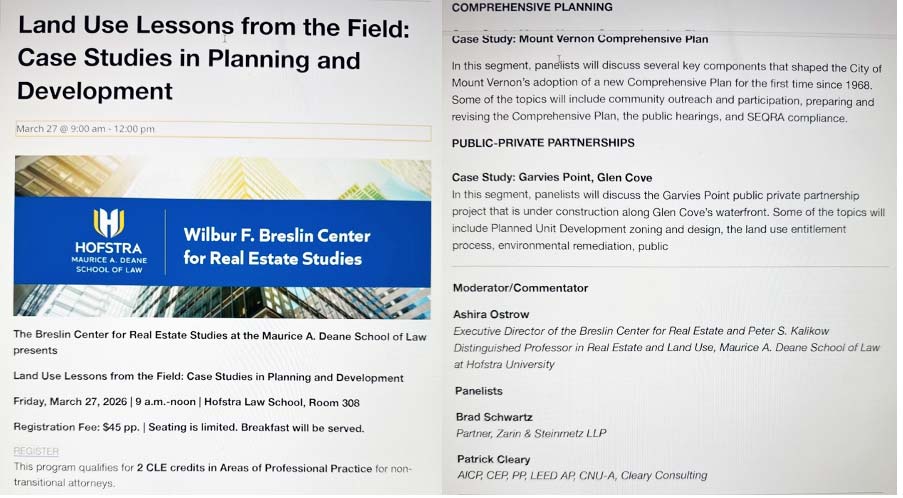
At a recent Hofstra Law CLE program—”Land Use Lessons from the Field”—panelists walked through the City’s Comprehensive Plan, including community outreach, public hearings, and SEQRA compliance.
That framing is striking.
Because those are the very issues now being challenged in court.
The Same Plan. The Same Issues. A Different Story.
The Comprehensive Plan presented at Hofstra is currently the subject of an Article 78 proceeding in Westchester County Supreme Court, filed on March 16, 2026.
The claims go directly to process:
- whether public notice was adequate
- whether the City took the required “hard look” under SEQRA
- whether the administrative record supports what the City says it did
In other words, the exact topics presented as a “case study” are the ones now being litigated.
Who Was Presenting—and Sponsoring—Matters
The event featured Mount Vernon’s Planning Commissioner. It also featured Brad Schwartz of Zarin & Steinmetz.
And it was sponsored by Zarin & Steinmetz—the same firm and attorney serving as counsel of record for the City in the litigation challenging the Plan.
So the City, and the lawyers defending it in court, were presenting the Plan as a model—while that model is being tested before a judge.
This Isn’t About Whether They Can Speak
Of course they can.
But litigation posture matters.
When a matter is actively before a court, the usual instinct—especially for counsel—is restraint. Let the record speak. Let the court decide.
What happened here was the opposite.
The Plan was presented as a completed success, including on the very issues now under challenge—apparently without acknowledgment that those issues remain unresolved and are currently being litigated.
When the pending litigation was raised in the comments to the Planning Commissioner’s LinkedIn post, the comment was removed and comments were then disabled. While it is not known what was said at Hofstra, that response suggests the litigation was not part of the discussion.
What That Signals
At a minimum, it raises questions about judgment.
Because presenting a disputed process as settled—while that process is under review—signals a level of confidence in the outcome that the court has not yet endorsed.
And more than that, it creates a disconnect:
- One version of events is being defended in court
- Another is being promoted publicly, as if the dispute does not exist
That is not how a neutral case study works.
The Bottom Line
Mount Vernon’s Comprehensive Plan is not a finished story.
It is being litigated—on the very issues that were presented as examples of how the process works.
Until that is resolved, presenting it as a model of community outreach, public hearings, and SEQRA compliance is not just premature.
It is parallel-universe shadow theater.