

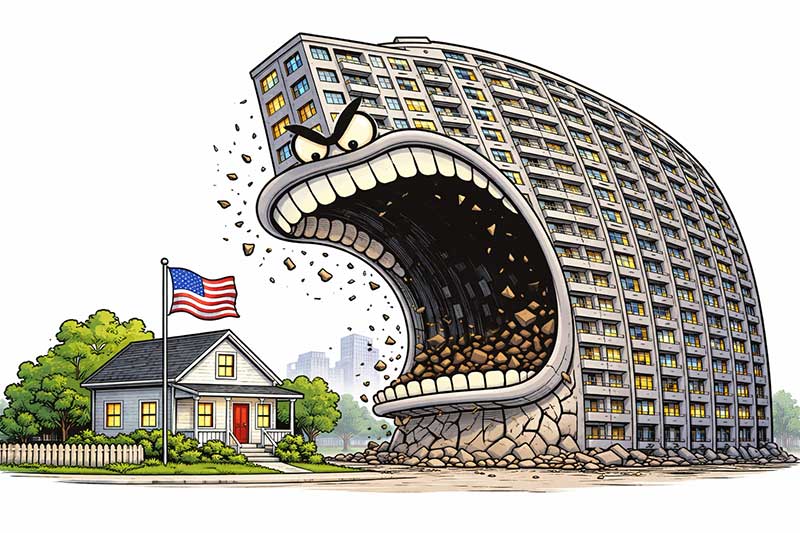
Mount Vernon recently adopted a Comprehensive Plan intended to guide growth, density, infrastructure, and neighborhood impacts across the City. That plan necessarily presumes two things: basic competence by the City departments and boards charged with administering land-use laws, and the integrity of the zoning and planning records on which future decisions are supposed to rely.
But what happens when those assumptions fail—when the officials responsible for zoning and planning do not do their jobs, and the “official” records instead appear sloppy, incomplete, or altered after the fact?
214 Gramatan happens.
The 214 Gramatan project is a large apartment building constructed practically on top of the private residence owned by Dina Periello. What was reviewed and approved on paper bears little resemblance to what was ultimately built. And when the project was later scrutinized through FOIL requests, the City’s zoning file revealed discrepancies that raise serious questions about whether the record was retrofitted to justify an unlawful structure rather than to reflect what was actually approved.
When 214 Gramatan happens, the problem is no longer confined to one property or one neighbor. The integrity of not just a single project, but the planning framework the City now claims to follow, is called into question.
The Records Appear Altered
Please review the attached documents, particularly the “214 Gramatan ZBA Application,” signed by Sal Saleh as owner and Tom Abillama as architect. This document was produced in response to FOIL requests and appears to be the only zoning application on file for this project.
Several key fields in this application show clear signs of alteration. On page 1, the entry for “Existing Site Area,” and on page 4, the entries for “Size of principal building,” “Number of dwelling units on site,” and the number of parking spaces before and after approval are all missing the standard printed line beneath the entry. In each instance, the figures are handwritten in a style that is arguably different from surrounding entries. One parking entry also appears to show that a prior figure was removed and replaced, with remnants of the original number still visible beneath the handwritten “26” and above the printed line. These anomalies do not appear elsewhere in the application.
These are not minor details. Site area, building size, and number of dwelling units are core facts the Zoning Board relies on to evaluate density, scale, and the extent of zoning relief being requested. They are foundational to the Board’s authority and decision-making.
The importance of these altered figures is underscored by the Zoning Board’s September 19, 2017, Findings of Fact. Those Findings repeatedly describe and analyze a project consisting of 36 dwelling units. They do not mention a 53-unit building, nor do they discuss the site-area figures that now appear on the application.
The first time the record reflects consideration of a substantially larger project is in the March 2019 Amended Findings of Fact. Yet the City’s files contain no amended zoning application, no dated revision, and no explanation of when the application data was changed or how those changes were presented to the Board. The file contains only the seemingly altered application, with signatures dated nearly three years earlier.
In other words, the only zoning application currently on file does not correspond to the project the Zoning Board actually reviewed and approved in 2017.
The presence of handwritten changes to the most consequential parts of the application—combined with the absence of any contemporaneous findings addressing those figures—raises serious questions about the integrity of the administrative record. At a minimum, the application and the Board’s findings do not match.
Residents are entitled to know when these changes were made, who made them, and why the official application now reflects numbers that were never the subject of the Board’s original review. Without that information, there is no basis to conclude that the zoning approvals were grounded in a complete, accurate, and transparent record—and no credible basis to offer assurances about the “integrity” of this project.
The Project Fundamentally Changed – But the Application and Review Process Did Not
The contrast between the September 2017 Findings of Fact and the March 2019 Amended Findings exposes a basic contradiction in the City’s own record. The project was treated as if it posed no environmental issues, even as City agencies were raising concerns about traffic, parking, sewer capacity, and shadow impacts—and, in some cases, calling for further investigation. Despite those unresolved issues, the Zoning Board closed out environmental review in 2017 by issuing what’s called a “Negative Declaration,” and never revisited it.
That decision is troubling on its own, but it becomes far more problematic in light of what followed. The Amended Findings were adopted after a substantial change in the project’s scale, intensity, and density. Even assuming—purely for argument’s sake—that the expanded project could be justified on zoning grounds, SEQRA does not permit environmental review to be frozen in time.
A Negative Declaration issued for an earlier version of a project cannot simply be carried forward after a material increase in size and density without revisiting environmental impacts. Yet there is no indication that the ZBA revisited SEQRA at all in connection with the amended approval. There is no supplemental environmental review, no discussion of whether the changes constituted a substantive change under SEQRA regulations, and no explanation for why the earlier Negative Declaration remained valid. The Amended Findings acknowledge a materially different project but are silent as to its environmental consequences.
You don’t need expert reports to see the problem.
The private home next door has been severely impacted—physically, functionally, and in terms of light, air, and livability. That reality makes the conclusion that this project posed “no significant adverse environmental impacts” ring hollow. If a neighboring home can be so profoundly affected, the claim that no deeper review was required was not just wrong—it was reckless.
At best, this reflects a City that failed to take a hard look. At worst, it suggests a willingness to preserve a paper finding long after reality made it indefensible.
Taken together:
- Altered application entries
- Escalating project scope
- No amended application matching the final build
- No additional substantive review
- No change to the SEQRA determination
…the question is unavoidable: how far did the City and/or the developers go to paper over zoning and environmental violations after the fact?
District Attorney Cacace should answer that question.
———————————————
Supporting Documents: