

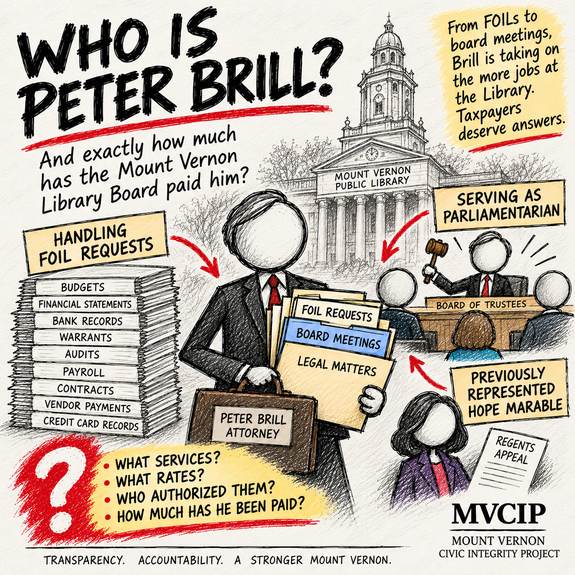
The Mount Vernon Public Library apparently cannot conduct a Board meeting or respond to a request for financial records without calling in its attorney, Peter Brill.
On October 22, Board President Kim Harper informed trustees that attorney Peter E. Brill would attend the October 28 meeting as parliamentarian. This decision was not announced publicly, nor made in consultation with the full board. Trustee Jonathan Michael Davis immediately challenged the decision:
“So why are we paying Brill hundreds of dollars per hour for a service that WLS would provide for free????”
It’s a fair question, particularly because this is not the first time the Library has turned to Brill for work that ordinarily should not require an attorney.
On September 9, we submitted a Freedom of Information Law (FOIL) request seeking records documenting the Library’s expenditure of public funds from January 2020 to the present. The request covered budgets, financial statements, bank records, warrants, audits, payroll, contracts, vendor payments and credit-card expenditures.
These are records a publicly funded institution should maintain as a matter of routine.
The Library failed to acknowledge the request within the five business days required by law. When we followed up on September 18, FOIL Officer Willy Valentin explained that he had only just been brought into the correspondence.
Later that day, Valentin announced that Brill would take over.
“Given the broad scope of the financial records requested, the library’s legal counsel, Peter Brill (copied here), will be managing the review and production of these records going forward.”
Valentin further promised that Brill would reach out directly regarding a production schedule.
More than a month later, Brill has not made contact, provided a schedule, or produced a single document.
The Library has until October 30 to provide records or a further status update under the timetable it announced. But we specifically offered to accept documents on a rolling basis, beginning with readily available financial records. Nothing has been produced.
So what, exactly, has the Library accomplished by assigning its attorney to this task? And how much is it paying him to accomplish it?
FOIL requests are an ordinary responsibility of public institutions. Attorneys may be needed to resolve genuine legal questions, but reviewing routine financial records for disclosure should not require turning the entire process over to outside counsel. Nor does involving an attorney make otherwise public records confidential.
Peter Brill: Parliamentarian?
A parliamentarian advises a governing body on meeting procedures, including motions, debate and voting. The purpose is to ensure that members can participate fairly and that decisions are made according to the rules.
According to Davis, the Westchester Library System would provide that assistance free of charge.
Harper’s announcement offered no explanation for choosing Brill instead, what he would be paid, or whether the Board approved the expenditure.
There is also a question of independence. A parliamentarian is supposed to provide impartial procedural guidance, including when the Board president’s rulings are challenged. Brill is already the Library’s attorney. But his relationship with the Library’s leadership goes further than that.
Brill personally represented former Board President Hope Marable in an appeal before the New York State Commissioner of Education seeking Marable’s removal from the Board over allegations that included election interference. Marable later sought another term and, in May 2026, lost her Board seat to Davis in a landslide.
None of that establishes that Brill cannot act impartially as parliamentarian. But it makes the choice of Brill — rather than the free parliamentary assistance Davis says is available through WLS — even more deserving of an explanation. He is not simply an outside parliamentarian being brought in to neutrally advise the Board. He is the Library’s existing attorney and previously served as counsel to its former Board president.
How will his impartiality be assured when disputes arise between Harper and trustees who challenge her decisions?
That question matters given the Board’s history under Harper.
The Library has already attracted scrutiny from the Board of Regents over its governance failures. Davis, elected by voters in May, has encountered resistance as he presses for accountability and challenges the Board’s conduct.
Bringing in the Library’s attorney to referee Board proceedings does little to inspire confidence that Harper intends to welcome scrutiny or dissent.
Moreover, making this decision unilaterally is yet another example of Kim Harper, Cynthia Crenshaw, and Cynthia Dickerson behaving as though the Board belongs to them. It does not. They are three members of a five-member governing body, not a ruling faction entitled to make decisions first and inform the other trustees afterward. Their persistent refusal to recognize that basic distinction is not merely disrespectful to their fellow trustees, it is a fundamental failure to understand how a public board is supposed to govern. And it is a closed fist to the faces of every Mount Vernon resident.
The Financial Implications Extend Beyond a Single Meeting
Brill is now: shadow FOIL officer, parliamentarian, and library counsel.
That makes the question posed by this story even more basic: How much public money has the Library paid Peter Brill, and for what? Specifically, what services were authorized, by who, and at what cost to Mount Vernon taxpayers? Did taxpayers foot the bill for Brill’s representation of Marable? If so, who decided that?
There is an irony here that should not be lost on anyone.
The Library is potentially spending additional public money on an attorney to manage a request for records showing how it spends public money. And after six weeks, it has produced nothing.
Meanwhile, the same attorney is being brought in to help a Board president run a meeting, despite the availability of free assistance identified by a fellow trustee.
The problem is not that the Library has legal counsel. Public institutions sometimes need lawyers. The problem is a Board that appears increasingly dependent on one — the same one — to perform basic administrative and governance functions, without explaining the necessity or cost.
Mount Vernon taxpayers fund a Library, a Director, a FOIL Officer and an elected Board of Trustees. They are entitled to expect those officials to perform their responsibilities — and to know how much of their money is being spent on an attorney to do it for them.
If the Library needs an attorney to answer a records request and another paid engagement with that same attorney to conduct a Board meeting, perhaps the problem isn’t a lack of legal assistance. Perhaps it’s a lack of competent leadership.