


Mount Vernon’s Planning Board is one of the most influential bodies in City government. It reviews and approves development across the city—and through that process, it shapes:
- What gets built
- Where it gets built
- And how large, dense, and viable those projects ultimately become.
Those decisions shape neighborhoods, property values, infrastructure, and quality of life.
And at the center of that system sits one person: Darryl Selsey, Chair of the Planning Board.
The Public Role
On paper, the job is straightforward. The Planning Board reviews:
- Site plans
- Subdivisions
- Special permits
Its responsibility is to apply the law, evaluate impacts, and protect the integrity of the process. It is supposed to be neutral. Independent. Focused on the public interest.
But this is Mount Vernon.
The Private Role
At the same time Darryl Selsey heads what is supposed to be a neutral, independent government body focused on the public interest, he is also the head of a real estate brokerage. By his own description he is: “an expert real estate agent . . . providing homebuyers and sellers with professional, responsive and attentive real estate services.”
That is his business. That is how he earns a living. And that business is directly tied to:
- Property values
- Development potential
- Land use decisions
The very things the Planning Board controls.
Where the Lines Blur
That overlap is not theoretical. It has already been raised—formally and publicly.
At a November 5, 2025, Planning Board meeting, two letters were read into the record alleging that the Chair had undisclosed business relationships with a developer whose project was before the Board—specifically, the subdivision application for 55 Pondfield Parkway.
Those allegations included:
- Acting as a broker on properties tied to the developer.
- Listing and marketing those properties.
- Participating in transactions while the developer’s application was under review.
- Interfering in the environmental review of the 55 Pondfield.
For more than a year, the Chair remained involved in that application before ultimately recusing himself—only after the issue was raised publicly multiple times, by multiple people—and while still maintaining that he had “no conflict.”
Before he recused, Selsey actively advocated in favor of the applicant, including efforts to limit the scope of environmental review by the Board’s retained engineering consultant, LaBella Associates.
Still, this probably wouldn’t be a story if 55 Pondfield stood in isolation. It does not. Residents point to a pattern of transactions involving the Chair, his firm, and applicants appearing before the Planning Board, most notably, Mad Real Properties, the owners of 55 Pondfield.
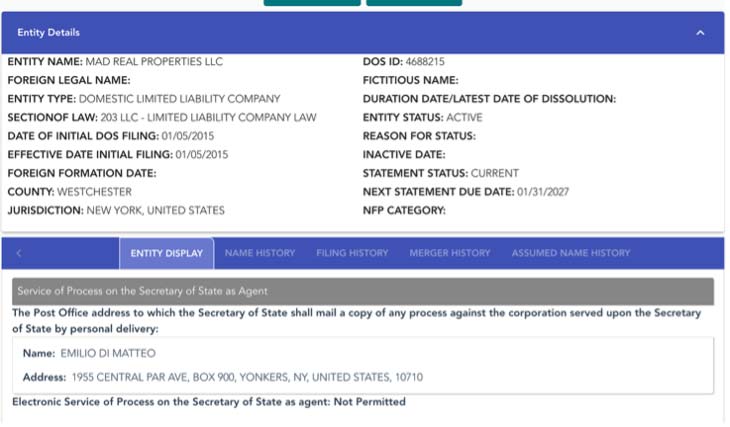
According to New York State records, Mad Real Properties has been actively registered in New York since 2015 and list Emilio Di Matteo as the contact for service of process. Although the records do not specify, in the LLC context, the person listed for service of process is generally an owner, managing member, or someone else with operational control.
Before 55 Pondfield, Chair Selsey had a long history with Di Matteo and Mad Real, including:
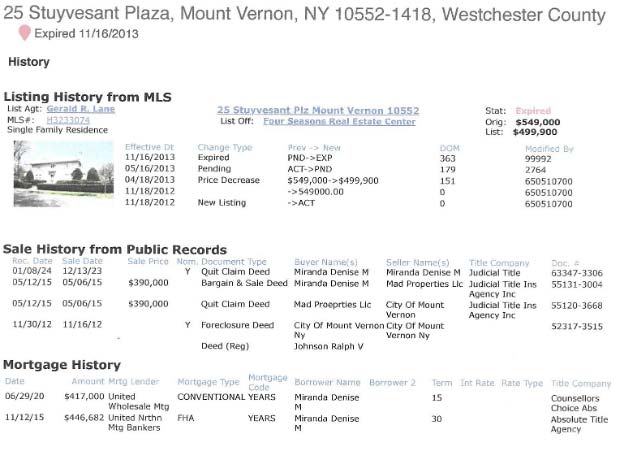
25 Stuyvesant Plaza: This property was foreclosed by the City in 2012 for nonpayment of taxes. On May 6, 2015, it was sold at auction for $390,000 via quitclaim deed to “Mad Properties LLC.” On that same day, Mad Properties conveyed the property to Denise Miranda for the same price, $390,000, via bargain and sale deed. Public voting records list both Darryl Selsey and Denise Miranda as residents of 25 Stuyvesant Plaza.
At no time during the Planning Board proceedings for 55 Pondfield did Chair Selsey disclose the 25 Stuyvesant transaction. And it was the failure to disclose this particular relationship that was the subject of the letters read into the record at the November 5, 2025, Planning Board meeting.
135 North High Street: In 2018, with Selsey serving as Planning Board Chair, an applicant obtained site plan approval for a six-story, 30-unit building after securing use and area variances from the Zoning Board. The property had previously been limited to a one- or two-family home. With those approvals, allowable density increased roughly thirtyfold, significantly enhancing the property’s value.
In mid-2023, the still-vacant property was listed for $1.2 million by Selsey’s real estate agency, with Selsey acting as the seller’s agent.
At no time during the Planning Board proceedings for 55 Pondfield did Chair Selsey disclose the 135 North High Street transaction.

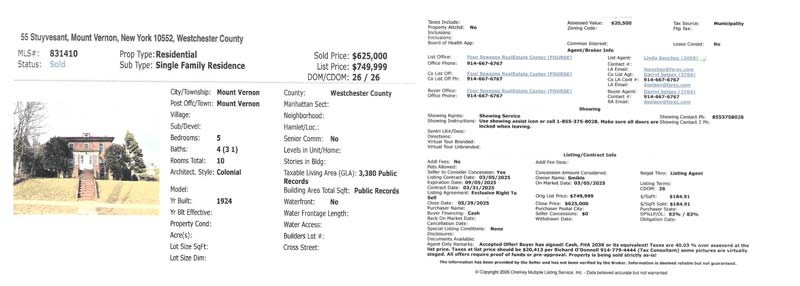
55 Stuyvesant Plaza: This property was listed and sold by Selsey’s firm to Mad Properties LLC on May 29, 2025, for $625,000, while 55 Pondfield was under review by the Planning Board. Records reflect that Selsey’s firm acted as both buyer’s and seller’s agent in the transaction.
At no time during the Planning Board proceedings for 55 Pondfield did Chair Selsey disclose the 55 Stuyvesant transaction.
35 Columbia Place: This property, owned by Mad Real, was listed for sale by Selsey’s firm for $1,199,000 pursuant to an exclusive right-to-sell agreement.
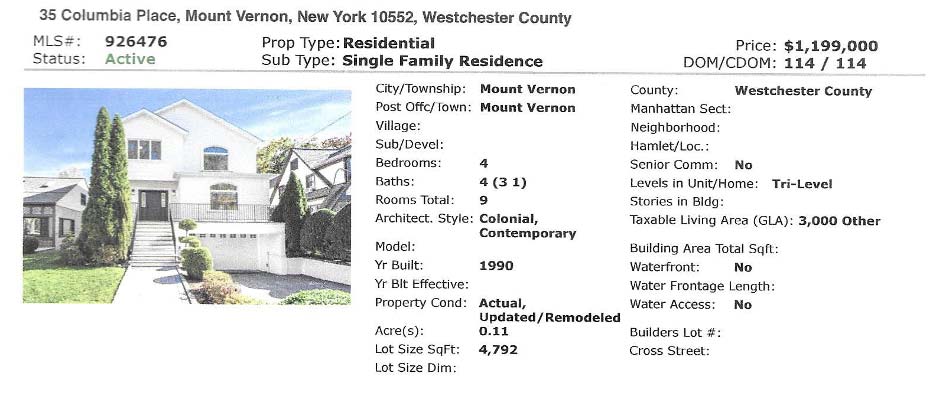
The listing was placed on October 30, 2025, again, while the 55 Pondfield application was still before the Planning Board.
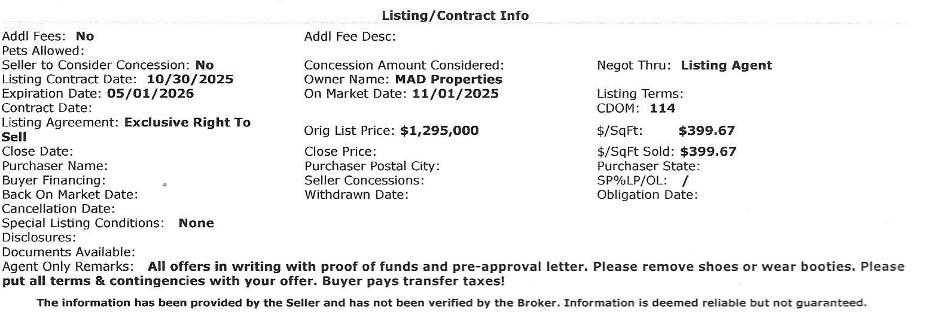
A February 2026 site visit reflects that the property is now “pending” sale through Selsey’s firm.
At no time during the Planning Board proceedings for 55 Pondfield did Chair Selsey disclose the 35 Columbia Place transaction.
The Ethical Through Line
Acting as a broker in a transaction involving a party with an active application before the Planning Board—while presiding over that applicant’s matter—raises serious questions about impartiality and adherence to basic ethical obligations.
Public officials are expected to avoid not only actual conflicts of interest, but also situations that create the appearance that official actions could be used for private gain. That principle is not abstract – it is foundational.
As a general rule, public officials are expected to step aside from any matter where their private financial interests intersect with their public duties—especially where their official actions may have contributed to the value at issue.
In fact, some government agencies impose absolute bans – meaning that once a financial relationship exists, the official is barred from participating in any matter involving that party.
Here, Selsey did not simply have peripheral involvement.
In at least one instance, Selsey chaired the board that approved a project that materially affected a property’s value. He then acted as broker in connection with that same property—positioning himself to benefit from the very value created through the Planning Board’s approval—while continuing to serve as Chair.
At a minimum, his involvement should have triggered review by the Law Department or Board of Ethics. But there is no indication that such guidance was sought or that any such review occurred.
The Standard Is Not Complicated
This is not a gray area. If a decision-maker has a financial relationship with someone appearing before their board, the expectation is simple: Disclose it. Step aside.
And when these conflicts do arise, there should be a correction – an ethics review, an investigation, new protocols to prevent future incidents – anything to show the public that ethics matter and the city is not asleep at the wheel – or complicit.
But again, this is Mount Vernon. And in Mount Vernon, the system just moves forward . . . Nothing to see here.
The Real Question
This is not about one project, or even one person. It’s about a system—a structure—that allows, without review, oversight, or correction, a person whose livelihood depends on real estate transactions to chair the board that oversees those same outcomes.
You don’t need to be a world-renowned ethicist to see the problem.
Because even assuming good faith, the structure itself creates perverse incentives. It blurs the line between public duty and private interest in ways that invite both actual conflicts and the appearance of them. And that’s where the real damage occurs.
Because once those lines blur, public trust erodes. Decisions begin to feel pre-determined. Outcomes feel uneven. And residents are left questioning whether the process is working for the city—or just for the people inside it.
So here’s the real question: Why is the system set up in a way that allows this in the first place?
The Structure Isn’t an Accident
This doesn’t happen in a vacuum. It happens because of how Mount Vernon is set up.
The Mayor appoints the boards and, in many cases, control every aspect of them—and then we all are expected to pretend those boards are independent.
Take the IDA. Mayor Shawyn Patterson-Howard serves as Chair. So, the same person who appoints every board member also runs the meetings, sets the agenda, and presides over the votes. That’s not oversight. That’s control. It gets worse.
Two of the voting members—Corporation Counsel Brian Johnson and City Assessor Stephanie Vanderpool—are mayoral appointees in their primary city jobs. They don’t just serve at the Mayor’s pleasure on the IDA. They serve at her pleasure for their livelihoods.
So, when a developer’s PILOT application comes before the IDA the City’s chief legal officer is voting on the deal and the official responsible for property assessments is voting to reduce the taxes her own office would otherwise calculate. Those aren’t edge cases—those are built-in conflicts.
The other voting member is Comptroller Darren Morton, who also serves as treasurer. While he is an independently elected official, he is also a pastor who has personally received a PILOT for his own development project. So, the person responsible for overseeing the finances of the IDA has a direct financial interest in the very deals the IDA approves.
These are not simply flaws in the system – that are the system.
And at the end of the day, when appointments flow from one office, oversight is concentrated in that same office, and decision-makers are not independent of the outcomes, what you end up with is a real estate broker running the Planning Board.
Not by accident. By design.