


For decades, the Bronxville Field Club has occupied a strange and uncomfortable place in Mount Vernon.
It is an exclusive “recreational and social” club whose name, branding, and mailing address suggest it belongs to toney Bronxville. For years, and continuing today, the Club has used a Bronxville post office designation, sparing its members the presumably uncomfortable reality that the Bronxville Field Club sits entirely within the City of Mount Vernon.
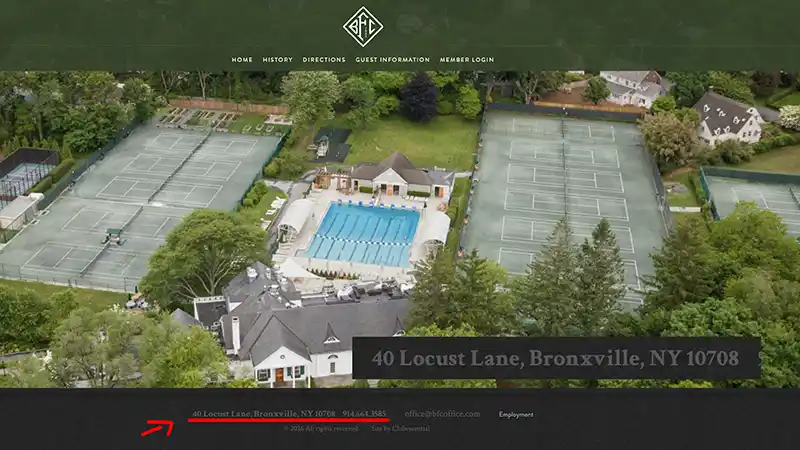
Physically, legally, and environmentally, it is our neighbor. In practice, however, it has rarely acted like one.
Over the years, the Club has been at the center of repeated controversies: stormwater pushed downhill into Mount Vernon neighborhoods, unpermitted infrastructure, land-use disputes, and litigation triggered whenever regulators or residents pushed back.
Again and again, the pattern has been the same: expand first, deal with the consequences later.
So, when residents raised concerns about yet another expansion, and the Planning Board denied the application after reviewing evidence and public testimony, something unusual happened.
For a brief moment, accountability won.
When Pressure Works, and Money Doesn’t
Rather than accept the decision, the Bronxville Field Club responded the way powerful institutions often do when they encounter resistance: it sued.
What followed were months of closed-door negotiations between the City and the Club – negotiations that deliberately excluded the people most affected by the outcome: Mount Vernon residents living adjacent to the Club’s property and downstream from its impacts.
The proposed solution was a quiet global settlement. Multiple lawsuits would vanish. The Club would receive a fast-tracked path forward. And the City would accept a one-time payment of $450,000 in exchange for ending enforcement and abandoning its litigation posture.
All of this happened without public notice, without public hearings, and without resident participation.
Sunlight Changes the Equation
Once the settlement terms became public, the response was immediate.
MVCIP published the agreement in full. Residents mobilized. Emails flooded inboxes. Phones rang. Planning Board members heard directly from the people who live with flooding, runoff, and infrastructure failures – not from lawyers or lobbyists, but from their neighbors.
And something rare happened in Mount Vernon government.
The Planning Board listened. They pulled the item from the agenda, marking in red that it would not be placed on a future agenda.
This didn’t happen because officials suddenly gained new legal insight. It happened because public pressure made it impossible to pretend this was business as usual.
Transparency changed the outcome.
What This Episode Reveals
After the Planning Board removed discussion of the settlement from its agenda, the Club sent the following message to its membership.
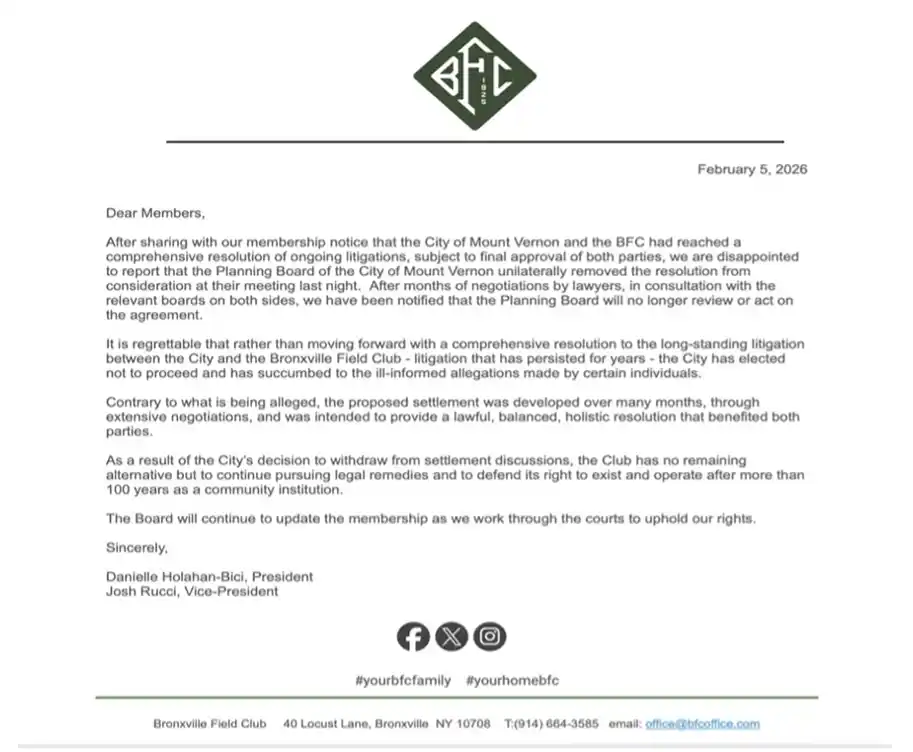
It is telling that, while the Bronxville Field Club was reportedly informing its own stakeholders about the settlement, City Hall was working overtime to keep residents in the dark.
It is also telling that once the deal was exposed to public scrutiny, it could not survive even basic questioning.
Open Meetings Law exists for a reason. Planning Board statutes exist for a reason. They are meant to ensure that decisions affecting neighborhoods, infrastructure, and public trust are made openly, with public participation, not stitched together privately and presented as a fait accompli.
This was not a near miss. It was a case study in how governance fails when officials assume no one is watching.
What MVCIP Sought to Prevent
MVCIP agreed to intervene because this settlement was never about protecting Hunt’s Woods.
It was about shielding City Hall from conflict and shielding the Bronxville Field Club from accountability.
By insisting on transparency, publishing the agreement in full, and centering the voices of downstream neighbors who were deliberately excluded, MVCIP sought to disrupt a backroom deal that traded away public power, narrowed environmental review, and normalized recurring flooding in exchange for a token payment.
The goal was not simply to expose what was being negotiated. It was to reclaim a basic principle: land-use decisions must be driven by evidence, equity, and the lived reality of affected residents, not convenience for officials or certainty for a private club.
Once residents were informed, the response was unified. The deal collapsed under the weight of public scrutiny.
The Real Cost of the Deal Wasn’t $450,000
The true cost of this episode was not the $450,000 payoff. It was the price Mount Vernon paid in squandered resources, lost time, and damaged public trust. The unanswered questions remain.
Public money was spent not to fix flooding or protect neighborhoods, but to negotiate a private retreat – lawyers billing to craft a deal that weakened the City’s own authority. Staff time was diverted from solving real infrastructure problems to managing secrecy, coordinating talking points, and preparing an “executive summary” meant to obscure more than it revealed.
Most damaging of all was the cost to democratic governance. Residents were excluded from decisions that directly affect their homes, safety, and property values, and only learned what was happening because someone inside the process leaked the agreement. That is not how accountable government is supposed to work.
When neighbors have to act as watchdogs, whistleblowers, and de facto investigators just to prevent a backroom surrender of public power, something is fundamentally broken. That reality says far more about Mount Vernon’s governance than any dollar figure ever could.
This Is What Civic Power Looks Like
We often end our communications with the phrase: Power to the People. This out outcome is what we mean by that, and it deserves to be named plainly.
A proposed settlement backed by money, lawyers, and institutional inertia did not collapse on its own. You stopped it.
Residents who paid attention, shared information, asked hard questions, and refused to accept a deal negotiated without them and against their interests. That is what civic power looks like – practiced in real life, in real time, forcing decisions that affect the public to be justified in public.
The settlement was pulled because people showed up. That’s worth remembering the next time someone says residents don’t have a voice in Mount Vernon.
We do, when we use it.