

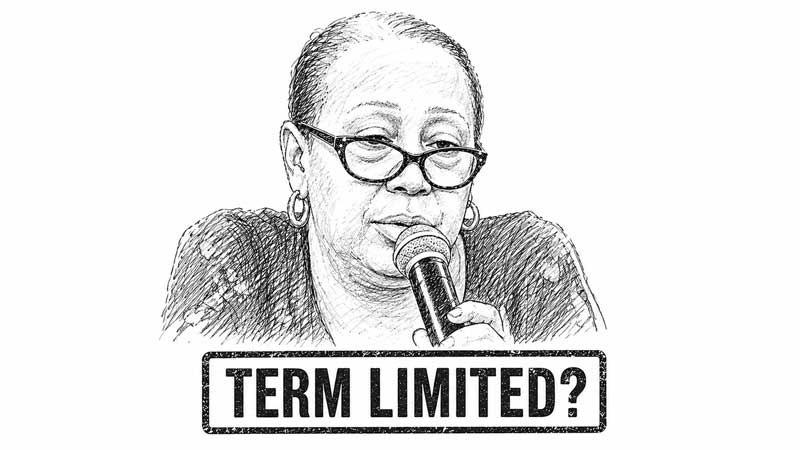
The question is simple. Can Hope Marable, removed from this same library board by the New York State Board of Regents in 2023 for neglect of duty, run for a third consecutive term?
The Mount Vernon Public Library’s bylaws say no. The State Education Department says no. Hope Marable says yes. And the library board she presides over has spent the last week trying to engineer a workaround so that her name appears on the May 19 ballot.
What the State Said
On April 21, 2026, the Office of Counsel for the New York State Education Department wrote to Terry Kirchner, Director of the Westchester Library System, of which the Mount Vernon Public Library is a member. The letter, signed by Counsel & Deputy Commissioner Daniel Morton-Bentley, runs three short paragraphs. The operative paragraph is unambiguous:
“It is the opinion of the Board of Regents and the Department that Ms. Marable served the entirety of the term in which she was removed. To hold otherwise would reward a trustee who was found to have neglected her duty and failed to carry out the educational purposes of the institution.”
The closing instruction reads: “Please apprise the board of this determination.”
This is the agency that interprets New York’s library statutes, oversees library bylaws, and removed Marable from this library board in 2023, ruling now on the question Marable has spent months trying to escape.
It counted. The State said so. In writing.
The Theory the Letter Demolished
Until April 21, Hope Marable’s defense was simple. The Board of Regents removed her in February 2023, before the end of her first term, and so, she argued, she did not “serve” that term in full. The two-consecutive-terms cap in Article IV, Section 4(b) of the Library bylaws therefore did not apply to her, and a third run was open. That theory was the basis for her present candidacy.
The April 21 letter ended it. The State Education Department ruled, in writing, that she “served the entirety of the term in which she was removed.” Resolution #035-26, the library board vote that repealed term limits, did not even try to argue that Marable’s first term was partial. By April 22 that argument was over.
The board needed a new one.
So Resolution #035-26 argued that the term-limit bylaw itself was never lawful. Its WHEREAS clauses claim that Article IV, Section 4(b) of the Library’s bylaws was “derived from” Education Law § 225, that § 225 “does not apply to this Board,” and that the bylaw was therefore “inconsistent with governing law.”
If that were true, the State Education Department’s April 21 letter, written by State Counsel about that exact bylaw, was the place to say so. It didn’t. The State Education Department treated the bylaw as binding, applied it to Marable, and confirmed she has served two full terms.
Put plainly: the legal theory the board ratified at 7 p.m. on April 22 was contradicted by the State, in writing, on letterhead, the day before.
Was the Library Board Vote Even Legal?
No.
Article XII(a) of the Library’s bylaws is explicit: “Amendments to these Bylaws may be proposed at any Board meeting and shall be voted upon at the next regularly scheduled Board meeting.” A vote on a bylaw amendment has to happen at a regular Board meeting.
April 22 was not one. The BoardDocs entry identifies it, in its own header, as a “Finance Working Session,” with the bylaw item categorized under “Policy & Governance Review Discussion.” A bylaw amendment with permanent governance consequences was placed on a working-session agenda alongside finance items, voted on by the assembled trustees, and treated as final.
The board’s only available answer is Resolution #034-26, the two-thirds suspension of Article XII(a). Read its language. It suspends the rule “which requires that proposed amendments be voted upon at the next regularly scheduled meeting, for the purpose of considering and acting upon proposed Bylaw amendments at this meeting of Wednesday, April 22, 2026.”
The board’s own resolution admits, in writing, that April 22 was not the next regularly scheduled meeting. They had to suspend the rule that says the vote has to happen at one. Otherwise, there was nothing to suspend.
That suspension does not work. Article XII(b) authorizes the temporary suspension of a rule “in connection with business at hand.” It does not authorize a board to manufacture a regular Board meeting by declaring one. It cannot be used to defeat the very public-notice purpose of the rule it suspends. The waiting period in XII(a) is the public’s protection. It is the window in which a community sees a bylaw change coming, raises objections, and shows up. Suspending the protection in order to slip an amendment past the public is not a use of XII(b). It is the abuse of XII(b) that XII(a) was written to prevent.
The April 22 vote was illegal.
The bylaw repeal it produced has no force. Article IV, Section 4(b), “No Trustee shall serve more than two (2) consecutive full terms,” is still the law of the Mount Vernon Public Library. It still applies. And the State has now confirmed that it applies to Hope Marable.
The Letter They Hid
The April 21 letter was sent to the Director of the Westchester Library System because that is the channel through which the State Education Department reaches local library boards. WLS provides shared services, technical guidance, and administrative liaison to its member libraries. “Please apprise the board” is not a courtesy phrase; it is the standard instruction the State gives the system through which a local trustee board is supposed to be informed.
The next afternoon the board scheduled the bylaw repeal as Item 6.A on a Finance Working Session agenda, used a two-thirds suspension to compress a proposal and a vote into one sitting, and approved the repeal. The agenda item exists because the letter exists. The vote was the response to the letter.
They did not disclose it. New York Public Officers Law § 103(e) requires public bodies to make records “scheduled to be the subject of discussion” at an open meeting available to the public, to the extent practicable, prior to or at the meeting. The provision was added in 2012 specifically to prevent boards from voting on matters with documents the public never sees. A written State opinion, addressed to the parent library system, on the precise bylaw question being voted that night, fits the description in every respect.
The April 22 BoardDocs entry posted the suspension resolution and the repeal resolution. It did not post, mention, or describe the letter.
That is not an oversight. It is the entire point. A board that disclosed the letter could not credibly hold the vote. So the board held the vote and did not disclose the letter.
Trustee Loretta Thomas
Trustee Loretta Thomas was the only member to vote no on Resolution #035-26. Hers was the right vote on the merits.
Residents are entitled to ask Trustee Thomas a single question: did you have the April 21 letter, or know of its contents, before the April 22 vote? Either answer is informative. If she did, the question becomes why the board’s lone dissenter felt she could not put the letter on the record. If she did not, the question becomes why the rest of the board apparently did, and she alone was kept out of the loop while the workaround was prepared.
Trustee Thomas is in a position to tell the public what she knew and when. She should.
The Sister Problem
The Mount Vernon City School District administers the library trustee election. The District Clerk receives nominating petitions. The Board of Education places candidates on the ballot.
The President of that Board of Education is Dr. Donna Marable, Hope Marable’s sister.
Before April 21, a school district sympathetic to Hope Marable could plausibly call the term-limit question contested. After April 21, that posture collapses.
With a State Education Department opinion in hand stating that the candidate has served two consecutive full terms, there is no honest path for the school district to place Hope Marable on the May 19 ballot.
What Comes Next
A resident has already written to the Mount Vernon City School District Clerk and to the Board of Regents asking that Marable’s nominating petition be rejected.
Two things should happen now.
First, the Mount Vernon City School District should not place Hope Marable on the May 19 ballot. The legal question has been answered.
Second, the Board of Regents should make public, in its own voice, what its Counsel said in writing on April 21. The public is entitled to hear directly from the body whose authority is being defied.
What You Can Do
The petition filing deadline is Wednesday, April 29. The window for the school district to do the right thing closes that day.
Before then, contact the Board of Education. Ask them, on the record, whether Hope Marable will appear on the May 19 ballot, and whether Dr. Donna Marable has recused herself from that decision. Their answers, or their refusal to answer, belong on the public record.
Contact the Library Board. Ask the trustees who voted on April 22 whether they had been told of the State’s April 21 letter before they voted, and why the letter was not posted to BoardDocs alongside the resolutions.
Attend the scheduled ‘Library Town Hall’ on May 4 at 6.30pm. Public comment is on the agenda. Use it.

Talk to your neighbors. The library budget is on the May 19 ballot. So is the trustee election. So are the people who voted on April 22.
Mount Vernon residents deserve public officials who act ethically, follow the law, and represent their interests. The way to get them is to pay attention. Now is the time.