

P
ursuant to the Mount Vernon City Charter, the City Council is supposed to be the public’s check on the powers of the executive, here, the Mayor. The separation of powers between the legislative and executive branches of our government is structural and intentional. The Council adopts the budget, authorizes borrowing and contracts, drafts, approves, and rejects legislation, and demands answers before taxpayer money is committed. Its job is not to oppose the administration for the sake of it, but to exercise independent judgment—to ask hard questions, correct bad proposals and say no when no is warranted. And the Charter provides Council with real tools to use that power. It can override a mayoral veto with a four-fifths vote, it can “investigate all City officers, all departments and all public affairs of the City,” and it has access to every record the city keeps and the authority to subpoena testimony and compel production of documents, backed by civil penalties for noncompliance. Stated differently, the Charter assumed the council would sometimes say no, and it gave them the power to do so without needing anyone’s permission. Every day, councils in cities across the United States use similar authority for the betterment of their communities. Not in Mount Vernon.
In February, we published The Body of “Yes”. We counted every roll-call vote in the City Council’s 2025 minutes: 497 votes, 98 percent approved, and not one piece of legislation defeated when four or more members were present. A council that never says no is not a check on the mayor. It is a rubber stamp that raises a larger question about the two men who now lead the Council—and whose seats voters will decide in 2027.
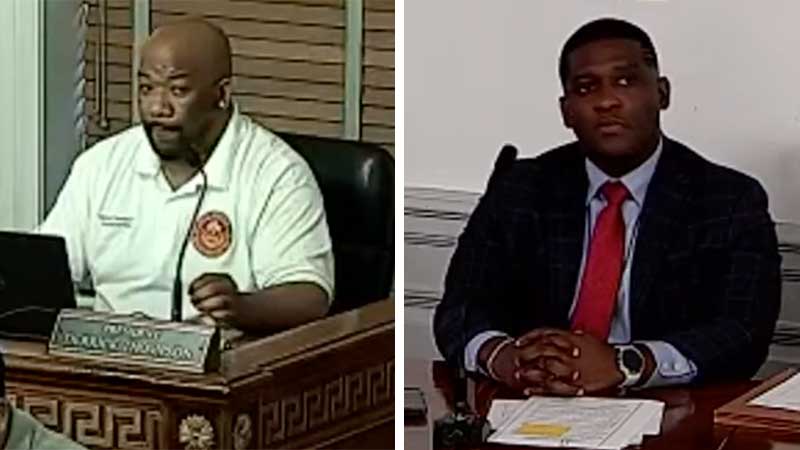
Council President Derrick Thompson and President Pro Tempore Jaevon Boxhill are both running again—both currently fundraising and preparing for the Democratic primary in June 2027. In Mount Vernon, as we wrote earlier this month, the primary effectively decides the election. So now is the perfect time to examine the records of both these men, who will soon ask Mount Vernon voters to keep them in office—and keep paying their salaries.
Thompson and Boxhill won their seats in 2023 on Mayor Shawyn Patterson-Howard’s slate. Her campaign site still has a page called “Meet Shawyn’s Team.” On it, the mayor says she has treated her colleagues in government “as partners and not adversaries,” and that Boxhill and Thompson “are exactly the right choices for City Council.” But have they been?
The answer to that question matters now more than ever because Mount Vernon is in serious financial trouble. The city has recurring deficits, no meaningful reserves, years of overdue audits and financial reports, repeated short-term borrowing to meet its obligations, and four consecutive budgets that exceeded the state property-tax cap. Residents have absorbed steep tax increases while the city continues to struggle with basic services. This is precisely when the Council should be most vigilant—questioning spending, demanding reliable financial information, rejecting retroactive requests and protecting residents from the consequences of the administration’s fiscal failures. Instead, under Thompson and Boxhill, scrutiny has nearly disappeared.
We reviewed every vote the city recorded during their current term—close to a thousand for each man—to answer a simple question: Have Thompson and Boxhill acted as the independent check mandated by the city Charter, or as the partners the mayor asked voters to elect?
The record answers this question. Thompson voted yes 992 times out of 994. Boxhill objected more often, but none of his no votes changed an outcome, and on the biggest money questions of his term, he made the motions. Across 30 months, not one administration request has gone down because of their votes.
Here is the record.
A council that doesn’t say no
Since January 2024, the council has voted on 997 pieces of legislation. Every member present voted yes on 917 of them. That is 92 percent. Only three items were rejected, and two of those failed on a single night in August 2025 when two members were absent.
This year, with Thompson presiding and Boxhill as his second, the Council has voted on 211 items and rejected none.
| Member | Votes cast | Yes | No | Abstain | Yes rate |
|---|---|---|---|---|---|
| Derrick Thompson | 994 | 992 | 1 | 1 | 99.8% |
| Jaevon Boxhill | 996 | 981 | 9 | 6 | 98.5% |
| Cathlin Gleason | 970 | 936 | 20 | 14 | 96.5% |
| Edward Poteat (2024-25) | 642 | 639 | 1 | 2 | 99.5% |
| Danielle Browne (2024-25) | 654 | 623 | 9 | 22 | 95.3% |
| Andre Wallace (2026) | 208 | 196 | 5 | 7 | 94.2% |
| Cynthia Turnquest-Jones (2026) | 211 | 210 | 1 | 0 | 99.5% |
Andre Wallace, who joined the council in January, cast 12 no votes and abstentions in six months. Thompson cast two in two and a half years.
The debate is missing too. Before each vote, the clerk records whether any member spoke to the item, under the heading “On the question.” In 2024, that line recorded discussion on 63 items. In 2025, on six. In 2026, under Thompson, on none. Members can raise questions at work sessions before the formal meeting, but the formal meeting is where the vote happens and the public record gets made. This year, every time the clerk filled in that line, it read the same: “On the question: none.”
Derrick Thompson: 992 yes votes out of 994
Thompson’s one no vote was on a street-closure permit for the Wakanda Celebration, which every member in the room voted down. His one abstention, on a county contract last November, is probably not his at all. The official tally gives it to Thompson, but the clerk’s note a few lines higher on the same page says it was Boxhill, who had abstained on the same contract twice before because he works on it at the county. If the note is right, Thompson has not voted against anything that passed in his entire current term.
When the minutes do record Thompson speaking, he is usually clearing the way. In September 2024, Boxhill questioned whether it was safe to let Con Edison drill a test borehole at the Doles Recreation Center. Thompson’s answer, per the minutes: “about the size a thumb. Thermal energy is safer.” In August 2025, Gleason refused to approve a public safety official’s trip after he had already taken it. Thompson asked her: “Deputy Chief Addison spoke with council, do you still want to vote ‘nay’?”
Thompson has not been the member asking the administration hard questions. He has been the one making sure its items get through.
Jaevon Boxhill: objections on the record, never on the scoreboard
Boxhill came to the Council with the résumé to be its toughest financial questioner. According to the mayor’s own campaign page, he was Mount Vernon’s 1st Deputy Comptroller and now works as a senior budget analyst for Westchester County.
He does object. At his first regular meeting he pressed on whether the administration had been consulted on a new employee review policy, and voted no. On the Con Edison borehole he said: “I’m not a scientist but is that possible. I find it hard to believe.” In March he voted against a rezoning step for Grace Baptist Church.
Seven of Boxhill’s nine no votes were solitary, and none changed the outcome.
Red-light cameras show how far his objections go. In May 2024 he was the only no vote on asking the state for permission to run the program, warning, per the minutes, that “the chosen vendor would be benefiting financially and not the city.” In March 2025 he voted yes to put the contract out to bid. In November 2025 he voted yes to award it. In February 2026 he voted no on the local law creating the program, which passed 4-1. His no votes gave him cover. His yes votes gave the vendor the contract.
The budget expert makes the motions
Mount Vernon’s finances are the subject of our series on the mayor’s fiscal record: four straight years over the state property tax cap, recurring deficits, audits years overdue. The council can push back on all of it. Here is what the two men on the ballot did.
In October 2024, the council authorized up to $7 million in short-term borrowing against property taxes the city had not yet collected, “to Meet the Financial Obligations of the City.” Boxhill made the motion. The minutes: “On the question: none. Response: none.” Unanimous. In November 2025 the council borrowed again. Boxhill made that motion too.
In December 2025, at a special meeting, the council overrode the tax cap for 2026 and passed the 2026 budget, both 4-1. Boxhill moved both. Thompson voted yes on both. Gleason was the only no. No discussion is recorded.
The council also overrode the cap and passed the budget for 2025. How Thompson and Boxhill voted on those, we can’t tell you. Both votes were on the agendas of special meetings in December 2024, and the city has never posted minutes or votes for either one.
Forty-six approvals after the fact
Since January 2024, the council has been asked 46 times to approve something retroactively: a contract already running, money already spent, a trip already taken. Thompson and Boxhill voted yes every time. On April 8 of this year, the council approved seven in one night, including renewals for the city’s property assessment system and the fire department’s records software.
One member has objected on the record. “I do no agree, and will not vote on retro items,” Gleason said in August 2025. Neither man on the 2027 ballot has said anything like it.
Thompson’s other seat
As council president, Thompson also sits on the Board of Estimate & Contract, the three-member board that signs off on city contracts and spending, alongside the mayor and Comptroller Darren Morton. From January through mid-July, he voted on 228 items there. He voted yes on all 228. When he was absent, Boxhill often took his seat, and voted yes 79 times.
Even Morton, whom we criticized earlier this month for going along with nearly everything, abstained three times and voted no once. On the board that controls the checkbook, the council’s seat has worked as a second vote for the mayor.
A record the city barely keeps
Judging a council by its votes assumes the city writes them down. Mount Vernon posts council records on two websites that don’t match, and neither is complete.
Three regular meetings in early 2024 have no minutes and no recorded votes anywhere. Six special meetings in late 2024, including the ones that set the 2025 tax cap override and budget, have the same problem. One set of 2024 minutes was posted with the template header still unfilled: “HELD ON WEDNESDAY, [INSERT DATE], 2023.”
State law gives the city two weeks to make minutes public. Minutes for June 10, August 12 and September 9 of this year have not been posted. On the city’s main website, the most recent regular council meeting a resident can read about is May 27.
So: check or rubber stamp?
The mayor asked voters in 2023 to give her partners, not adversaries, and the record shows she got what she asked for.
Thompson’s record is one of nearly unbroken assent. Boxhill has occasionally raised sharp objections, but when the administration needed approval for borrowing, tax-cap overrides, budgets and retroactive spending, he did not merely vote yes—he made the motion. In 30 months, their votes have not defeated a single administration request. The one request that failed over their support—retroactive approval of an official’s trip—did so because other members voted no.
Now both men are asking voters for four more years. The question for the June 2027 primary is not whether Council members should fight the mayor at every turn. It is whether these two have shown the independence, scrutiny and judgment the job requires. Their record says they have not.
Appendix: How we counted
Source. For February’s piece we worked from the PDF minutes. This time we went to the source underneath them. The city keeps its legislative record in Legistar, and Legistar has a public data feed (webapi.legistar.com/v1/mountvernonny). We pulled every roll call it holds, from September 27, 2023, the earliest meeting in the system, through July 8, 2026, the most recent meeting with posted minutes.
What counts. Thompson and Boxhill’s current term began in January 2024. Since then, the record shows 997 pieces of legislation with a recorded vote from every member present. Adjournments and other procedural motions are left out. Items voted as a block are counted one by one. Items voted on twice count twice. Thompson’s service before September 2023 predates the system and isn’t covered.
Verification. We checked the data against the paper. Four 2026 meetings chosen at random, 64 items in total, were compared line by line with the published minutes. Every no vote, abstention and absence matched. Our per-member counts for 2025 match what we published in February.
The three defeats. A January 2024 Law Department budget transfer (marked failed, no individual votes recorded); and, on August 13, 2025, with two members absent, the Wakanda street-closure permit and a retroactive approval of a deputy public safety commissioner’s trip to a first responders summit, which failed 2-1 with Thompson and Boxhill voting yes.
The November 12, 2025 discrepancy. On a Westchester County prisoner-transport contract, the official tally lists Thompson abstaining and Boxhill voting yes. The clerk’s note on the same page reads “Aye – 4 Abstain – Boxhill (this contract is also at the county).” Boxhill abstained on the same contract on March 26 and April 9, 2025, for that reason. Our dataset keeps the official tally.
Gaps in the record. No minutes on either city website and no votes in Legistar: regular meetings of February 14, February 28 and March 13, 2024; special meetings of October 1, October 10, December 9, December 16, December 26 and December 27, 2024. The December 9 agenda included the 2025 tax levy override; December 26, the 2025 budget; December 26 and 27, revisions to the city’s ARPA budget; December 27, the purchase of 400 Visa gift cards for the public safety camera program. Minutes for October 9, November 13 and December 23, 2024 list 60 items as adopted with no roll call; they are not in the member tallies, and the only dissent they record is one no vote by Gleason. As of September 25, 2026, minutes for the June 10, August 12 and September 9 regular meetings and the August 17 special meeting have not been posted, past the two-week deadline in Public Officers Law §106.
Board of Estimate & Contract. Legistar roll calls from January 20 through July 14, 2026: 286 items.
The slate. Documented on the mayor’s 2023 campaign site, mayorsph.com/democratic-team.