

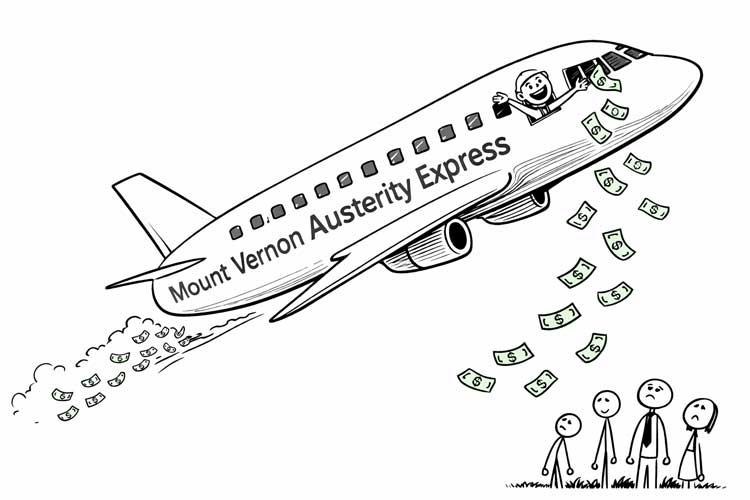
Mount Vernon taxpayers were told the City had no choice.
We were told the finances were dire. We were told restraint was necessary. We were told taxes had to go up because the City was broke and that an “austerity framework” would impose discipline on spending.
And then, almost immediately, the exceptions started.
So let’s call this what it is: the austerity budget was not austerity. It was branding.
A slogan. A talking point. A shield used to sell pain to taxpayers while preserving discretion for City Hall.
One recent email exchange with Comptroller Darren Morton — who, word on the street has it, thinks he’s going to be the next mayor — says the quiet part out loud.
In January, residents objected to discretionary travel being approved just weeks into the fiscal year. The argument was simple: if the City is truly in financial distress, travel should be limited to what is essential, mandatory, or contractually required. That is what residents were led to believe the framework meant. Morton responded at the time by assuring the public that the framework did not permit unrestricted or discretionary travel, and that formal protocols were being developed to ensure requests were evaluated under a heightened standard.
That sounded reassuring.
But by late March, when residents again challenged a travel request for Planning Commissioner James Rausse to attend a national conference in Detroit, the standard had changed. Or rather, the reality had become harder to hide.
Now the explanation was that online training is generally more cost-efficient, yes, but in-person training can sometimes offer additional value. Now the issue was no longer whether travel was essential or mandatory, but whether officials could describe it as useful. Now a “national conference” complete with networking and travel was being defended as a “consolidated training opportunity.”
That is not austerity.
That is a loophole wide enough to drive a city vehicle through.
The problem here is not just one $2,500 trip. It is the bait-and-switch.
Taxpayers were sold a story of discipline. They were told the City had entered a new era of hard choices. But when it came time to apply those hard choices to itself, City Hall reverted to the same old game: define the rule broadly, define the exception even more broadly, and then pretend the public is too unsophisticated to notice the difference.
Residents noticed.
They asked the obvious questions. What specific deficiency is this expense addressing? What measurable outcome justifies it? What exactly cannot be learned through lower-cost alternatives? What accountability follows after attendance? Will there be a report? A deliverable? A measurable benefit to taxpayers?
Those are not unreasonable questions. They are the bare minimum questions any serious austerity regime would ask before approving discretionary spending.
And yet even Morton, in his March 26 response, effectively conceded the point. He acknowledged that residents were right to demand a clearly defined purpose, identification of the specific need being addressed, measurable outcomes, and accountability following attendance. He admitted those were “reasonable expectations” and said he would discuss them as part of a “more structured and transparent review process.”
Think about that.
The Comptroller was defending a travel expense under an austerity framework while simultaneously admitting that the standards residents were demanding still needed to be discussed as part of some future process.
So what exactly was the framework?
Because if the rules were not clear enough to require a defined purpose, measurable outcomes, and post-attendance accountability before the expense was approved, then the so-called framework was never a framework at all. It was window dressing.
That is why this matters.
The issue is not merely whether one conference might have some professional value. Of course conferences can have value. The issue is whether City Hall should be indulging discretionary travel while telling residents to accept higher taxes, deteriorating services, and endless warnings about financial distress.
Mount Vernon residents are not stupid. They understand that every single questionable expense may be survivable on its own. That is how governments get away with waste. It is always “just” a few thousand here, “just” a conference there, “just” one more exception. But the cumulative message is unmistakable: austerity for taxpayers, flexibility for officials.
That is the breach of trust.
And it gets worse. Because once officials establish that a travel request need only be described in sufficiently vague language about training, value, networking, or city priorities, then the entire restraint narrative collapses. Every expense becomes defensible. Every trip can be reframed as worthwhile. Every exception becomes precedent.
Which means this will happen again.
Unencumbered.
Unless residents keep exposing it.
The City cannot have it both ways. It cannot declare financial emergency, raise taxes, invoke austerity, and then act as though ordinary standards of proof do not apply when officials want to spend public money on discretionary travel. If austerity means anything, it means saying no to things that may be useful but are not necessary. If every “beneficial” expense survives review, then austerity is a sham.
And that is exactly what taxpayers are looking at.
Not a serious system of fiscal discipline. Not a meaningful check on discretionary spending. Just another familiar Mount Vernon performance: stern language for the public, elastic standards for government, and an expectation that no one will connect the dots.
They did.
And they should keep doing it.
Because if this kind of fakery goes unchallenged, the “austerity budget” will become what so many City Hall promises become in Mount Vernon: a joke on taxpayers.