

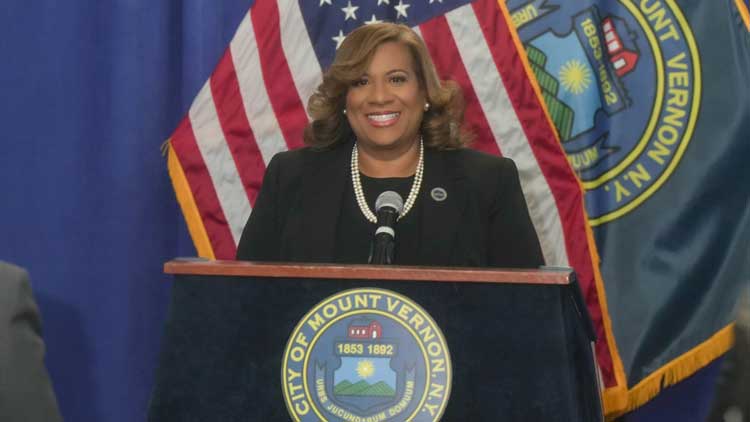
On March 31, Mayor Shawyn Patterson-Howard delivered her 2026 State of the City address. It ran over an hour. It included a prayer, a national anthem, a campaign-style video with administration allies praising her leadership, and the word “transformation” repeated until it lost whatever meaning it had left.
What it did not include was a single word about the financial emergency threatening to bankrupt this city within two years.
State of the City addresses are usually political theater. Nobody expects forensic accounting. But there is a difference between the normal polish of political performance and a speech that actively contradicts the documented reality residents live every day. Patterson-Howard’s address crossed that line.
Residents see cracked sidewalks, closed storefronts, and property tax bills that have risen over 40% in five years. They were told they were witnessing “transformation.” They were told the city is “not raising taxes to survive” but “generating revenue to thrive.” They were told the police department deserves applause. They were told the building department is now “modern” and “data-driven.”
None of that holds up. Let’s go through what the mayor said, and what she left out.
The Financial Emergency No One Mentioned
The single most important fact about Mount Vernon went completely unaddressed: the city is broke.
Comptroller Darren Morton has publicly warned that Mount Vernon could face insolvency within two years. At a recent Board of Estimates and Contracts meeting, he flagged that 2025 actuals were running $4 million short of projections. The city has no bond rating (withdrawn in January 2019 and never restored). It has no reserve funds. It has not completed an audit since 2020. It borrows through tax anticipation notes, essentially municipal payday loans, just to keep the lights on.
Three months before the State of the City, in December 2025, the NYS Comptroller issued a follow-up report revisiting 11 recommendations from a 2020 audit of the city’s financial reporting and oversight. The results: three implemented, four partially implemented, four not implemented. The findings read like a catalog of institutional failure.
The city still has no multiyear financial or capital plans. The Council President told auditors that without a credit rating, the city simply cannot do long-term planning. Budgets were adopted 13 to 85 days late over five years. Revenue was overestimated by $8.8 million in 2023 and $13.1 million in 2024. The overtime appropriation in 2024 was underestimated by $4.1 million, a 180% miss. The Comptroller’s own office has not filed Annual Financial Reports for 2021 through 2024; those filings are between 225 and 1,321 days late.
The mayor did not mention any of this.
Property taxes have risen 44% faster than inflation since 2001. The City Council has overridden the state tax cap in 11 of the last 15 years, adding a cumulative 34.73% above the allowable levy. The 2026 budget includes another 5.47% increase. Sales tax revenue has fallen 7% in two years while every neighboring city grew. The city is sitting on $60 million in unpaid property taxes it can’t or won’t collect.
We’ve documented this fiscal emergency in detail and presented it directly to state legislators. The NYS Comptroller has confirmed years of financial failures. The mayor’s response? “We’re not raising taxes to survive. We’re growing revenue to thrive.”
The state’s own auditors say the city can’t produce a reliable budget, can’t complete an audit, and can’t tell taxpayers whether the deficit is getting better or worse. That’s not thriving. That’s a city running on fumes and pretending the tank is full.
“Crime Is Down” — Until You Look at What Just Happened
The mayor celebrated 365 days without a gun-related homicide. She thanked the police department for its “dedication.”
Just days earlier, Mount Vernon Detective Kyren Braunskill, 34, had been arrested by the Suffolk County DA. He’d been promoted to detective on March 19. By March 26, he was in handcuffs, named in a 57-count indictment alleging he funneled guns to Long Island gang members tied to two murders, eight armed robberies, and five shootings. Braunskill had been on a state decertification list after being fired as a probationary corrections officer in 2020. The department hired him anyway. In September 2024, they named him Cop of the Month.
This isn’t an isolated incident. In October 2025, five officers were suspended after a prisoner smuggled a loaded revolver into a transport van and shot another detainee during transport. The gun should have been found during booking. The department’s own statement admitted the firearm “should have been detected during arrest or intake.”
In December 2024, the U.S. Department of Justice found a pattern of excessive force, unlawful arrests, and illegal strip and body cavity searches after a three-year investigation. Officers strip-searched nearly every person arrested until at least fall 2022. Two women, ages 65 and 75, arrested on fabricated drug charges, were strip-searched; an internal investigation found the officers had lied, and their punishment was losing a few vacation days. In one case, a resident was charged with selling drugs in Mount Vernon while he was actually in North Carolina, confirmed by Instagram posts, bus receipts, and browser history.
The mayor acknowledged the DOJ investigation in December. At the State of the City, she didn’t mention it.
And that “365 days without a gun-related homicide”? Lisa Grier, 33 was beaten to death with a hammer inside her East 4th Street apartment on March 21, days before the address. The mayor’s carefully worded metric (“gun related deaths”) allowed her to skip past the fact that a woman was murdered in her own home in Mount Vernon the same week.
The Building Department: “Modern and Data-Driven”?
The mayor described the building department as a transformed operation issuing permits in five to seven days. She introduced “Lucky,” an AI chatbot.
In April 2024, the New York State Department of State issued findings documenting systemic failures: backlogged permits, understaffing, city codes not updated in 30 years, and a failure to conduct required annual fire inspections of schools, houses of worship, and multi-family residences going back to 2009. Records were missing. Violations had no follow-up. The state threatened to hand code enforcement to Westchester County if improvements weren’t made by August.
That threat, not internal initiative, drove whatever changes followed. Residents have been documenting their struggles with this department for years. Calling it “modern” and “data-driven” isn’t transformation. It’s rebranding.
$44.4 Million in Tax Revenue, Gone
The mayor touted residential development. She mentioned MacQuesten Parkway and Vernon Commons. She talked about “diverse housing opportunities.”
What she didn’t say: the Mount Vernon Industrial Development Agency, the driver of housing development, has handed out $44.4 million in tax breaks over the past decade, collecting only $15.9 million in return. The school district lost $26.7 million. The city lost $13.3 million. And 67% of the IDA’s portfolio is low-income housing that generates zero sales tax and virtually no permanent jobs.
The flagship project at 115 South MacQuesten tells the story. The developer invests 6% of project costs, collects a fee worth 168% of that investment, and gets a 30-year tax abatement. The developer’s political operative was the mayor’s chief fundraiser. Campaign contributions from connected parties total $25,050. The abatement is worth $15.3 million. A 600-to-1 return. When a resident asked the mayor to recuse herself, her response was: “Sue me.”
Sales tax revenue, the clearest indicator of commercial health, has fallen 7% in two years. The gap with New Rochelle widened from $9.3 million in 2016 to $15.7 million in 2025. If IDA tax breaks were generating growth, that gap should be closing. It’s accelerating.
Five Years to Fix an Overpass
The mayor celebrated bridge reopenings. The Fulton Avenue and South Street MTA bridges, closed since 2022, have been rebuilt. Credit where it’s due; that was funded primarily through MTA and state partnerships.
But the Fulton Avenue overpass, the one that matters most for daily south side traffic, remains closed. It was shut down in January 2023. At the State of the City, the mayor said “yesterday we met with engineers to select a design” — convenient timing. Projected reopening: fall 2027. That’s nearly five years closed.
The Comprehensive Plan: Already in Court
The mayor touted the city’s first comprehensive plan in 55 years. She left out the part where residents immediately sued to void it. An Article 78 lawsuit filed by four residents, including a professional planner with 40 years of experience, alleges the City Council failed to provide meaningful public participation, withheld the full plan before hearings, and skipped required environmental review under SEQRA. We covered the underlying problems when the plan was released.
The Sewer “Success” Story
The mayor claimed sewer backups are down 95%. But she recently stated that only $25M of $150M of New York State sewer grants were spent so far. Did those $25M fix 95% of the problem?
Generally, any reduction is welcome. But the city still hasn’t openly addressed what happened in Hunts Woods, where residents fought for years to get the city to acknowledge a crisis the administration denied.
“Rewriting Narratives”
The mayor said Mount Vernon is “rewriting narratives.” She framed criticism as “misconceptions, myths, and sometimes outright disinformation.”
This is a pattern. When watchdog organizations publish documented, sourced criticism, the administration labels it misinformation. The mayor doesn’t engage with the data. She doesn’t contest the numbers. She reframes the act of criticism itself as the problem.
Residents don’t need better narratives. They need completed audits. A bond rating. A building department that doesn’t require state intervention. A police department that doesn’t hire from decertification lists. An IDA that doesn’t hand $44.4 million to developers while the school district, the most fiscally distressed in New York State, loses $26.7 million.
They got none of that on March 31. They got a prayer, a campaign video, and an hour of claims that collapse under the weight of public records.
Sidenote: The Production Itself
A small thing, but telling. The video of the State of the City address itself is a dumpster fire. The first 20 minutes of the broadcast are a static title card. The audio sometimes plays through one channel only. The mayor’s microphone cuts out repeatedly. Speakers are never identified. Sound clips and distorts. The video randomly jumps to title cards mid-sentence.
As of this writing, the video has been viewed about 500 times. Mount Vernon has a population the mayor claims is nearly 100,000.
The Reality Check
The mayor closed by telling Mount Vernon to “step into the future.” The future she didn’t mention is the one where the comptroller says the city could be bankrupt within two years.
Spin and flowery narratives don’t change that. Audits do. Oversight does. Accountability does.
None of those made it into the speech.
Watch the full 2026 State of the City address:
https://www.youtube.com/live/IJIp2aQQ7Wk