

Part 2 of a 4-Part Series
Part 1: What Is the IDA, What Are PILOTs — and Why Should You Care?
Why Mount Vernon’s IDA Matters
In Part 1, we explained what Industrial Development Agencies and Payments in Lieu of Taxes (PILOTs) are. We showed how they work in theory: temporary tax breaks to jumpstart economic development, subject to oversight and accountability. And we showed what they look like in practice: $44.4 million in lost tax revenue over ten years, with the school district absorbing the heaviest blow. Now we turn to the question that makes this series necessary: Why is Mount Vernon different?
The honest answer is that Mount Vernon isn’t just using PILOTs. It’s using them in ways that are atypical, poorly governed, and structurally designed — whether by intention or neglect — to transfer public wealth to private developers with minimal accountability. The evidence is in three places: the composition and behavior of the IDA board itself, the portfolio of projects it approves, and the audit trail — or lack of one — it leaves behind. Together, they tell a story not of economic development, but of institutionalized failure.
What makes Mount Vernon’s situation distinctly troubling is not any single problem in isolation, but the way these problems compound and reinforce each other. A weak board doesn’t just make poor decisions — it attracts the kind of developers who benefit from weak oversight. A portfolio dominated by subsidized housing doesn’t just shift costs; it changes the constituency that depends on the IDA and weakens incentives for reform. And missing audit records don’t just hide past mistakes; they remove the institutional memory that might prevent future ones. This is a system working as designed — just not designed for the benefit of the public.
The Makeup of the Mount Vernon IDA — Weakest Governance in the State
Start with the basics: Who runs the Mount Vernon IDA? Under the IDA’s enabling statute (Section 902-C of New York General Municipal Law), all voting members of the board are appointed by the mayor and “shall serve at the pleasure of the mayor.” The IDA’s own bylaws, restated as recently as November 2024, confirm this: each board member is appointed by the mayor as “Appointing Authority.” There is no City Council confirmation. There are no staggered terms. There is no independent nominating process. The board has four voting members — the minimum permitted under the IDA’s own bylaws, which allow up to eight, and the smallest of any comparable IDA in New York State. Every one of them serves at the mayor’s pleasure.
The bylaws provide that the board elects its own officers — Chair, Treasurer, Secretary — at each annual meeting. But that election is a formality when every voter owes their seat to the same person. Mayor Shawyn Patterson-Howard serves as Chair. The person who appoints every board member also runs the meetings, sets the agenda, and presides over votes. This is not oversight. This is control.
Look at who fills those four voting seats, and the picture becomes even more troubling. Two of the voting members — City Corporation Counsel Brian Johnson and City Assessor Stephanie Vanderpool — are mayoral appointees in their primary city positions as well. They don’t just serve at the mayor’s pleasure on the IDA board; they serve at her pleasure in their day jobs. Their livelihoods depend on remaining in the mayor’s good graces. When a developer’s PILOT application comes before the IDA, Johnson is simultaneously the city’s chief legal officer and a voting member of the agency granting the tax break. Vanderpool is the official responsible for property assessments voting on agreements that reduce the taxes her own office would otherwise calculate. The conflicts are structural and obvious.
Comptroller Darren Morton serves as treasurer of the IDA. Morton is an elected official — the city’s independently elected Comptroller and the Pastor of Macedonia Baptist Church. And — this is the part that should stop you cold — he himself has received a PILOT for his own development project. The person responsible for the IDA’s finances has a direct financial interest in the same kind of deals the IDA approves.
And then there is the fifth seat — the one without a vote. The IDA’s bylaws provide for one “standing, non-voting Member, appointed by the Mount Vernon City School District.” That seat is currently held by school board trustee Dr. Chris McDonough. He can attend meetings. He can participate in discussions. But he cannot vote. Let the irony sink in: the institution most financially devastated by PILOT tax exemptions — the school district — is the only stakeholder with a seat at the table, and it has been stripped of the one power that matters.
Even that voiceless seat did not come willingly. In January 2018, the Mount Vernon Board of Education sued the IDA and the mayor over a tax abatement deal with a developer, arguing that the agreement operated as “a gift of public funds” and improperly shifted the tax burden from wealthy developers to ordinary taxpayers. It was only through the settlement of that litigation that the school district won a non-voting seat on the IDA board. The district had to go to court just to be allowed to have a voice (but no vote…).
The IDA has no dedicated Executive Director. Robin Mack (since departed) carried the title “Director of Business Development” — a vague, part-time designation that diluted accountability. Her position is temporarily filled by Pamela Tarlow, who also serves as the Executive Director of the Mount Vernon Urban Renewal Agency (URA). The bylaws call for a full-time Executive Director serving as Chief Executive Officer with general supervision and management of the agency. That position is unfilled. There is no full-time professional manager responsible for tracking compliance, monitoring projects, or ensuring that PILOT recipients meet their obligations. The result is an agency that approves deals but doesn’t follow up on them.
Now compare this to how other New York IDAs are structured:
New Rochelle’s IDA has 7 members appointed by the City Council — not the mayor — with 3-year staggered terms. The board includes a labor representative from IBEW Local 3 and the school board president. It operates with formal Governance, Audit, and Finance committees. The mayor does not serve on the board.
Westchester County’s IDA operates with 23 members representing diverse constituencies: business, labor, education, and community development. Members are appointed by the county legislature with confirmation required.
Erie County’s IDA has 19 members and includes voices from organized labor, education, and community organizations — ensuring that multiple stakeholders, not just the executive, have a seat at the table when tax breaks are handed out.
Mount Vernon’s four-member voting board, appointed by the mayor, chaired by the mayor, with two members whose city jobs depend on the mayor and a treasurer with his own PILOT, is not an independent public benefit corporation. It is an extension of mayoral power, operating without the checks and balances that every other comparable IDA in the state has adopted.
A Shift Toward Residential PILOTs — The “Industry” Is Low-Income Housing
Even if the governance were sound, the IDA’s portfolio would raise serious questions. Because the Mount Vernon IDA is not doing what IDAs were created to do. IDAs were established to promote industrial and commercial development — factories, warehouses, office buildings, retail centers, research facilities. Projects that create permanent jobs, generate sales tax revenue, and strengthen the local economy. That’s the statutory purpose written into Article 18-A of New York General Municipal Law.
Mount Vernon’s IDA has drifted far from that purpose. Its portfolio is now dominated by low-income residential housing — not industrial projects, not job-creating ventures, not the economic development the IDA was created to encourage. In 2024, 70% of the IDA projects receiving PILOTs were housing — 14 out of 20 projects. From 2016 to 2023, 14 of 21 entities receiving a combined $45 million in tax exemptions were housing projects. If you expand the timeframe to include all projects approved after 2010, the figure is even starker: of 37 approved projects, 29 were residential. That’s 78 percent.
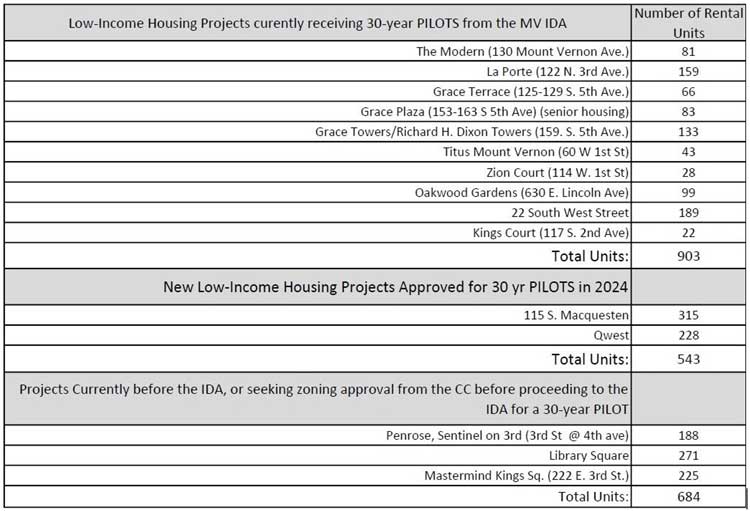
Let’s be precise about what “low-income housing” means in this context. These are not “workforce housing” developments serving middle-income families. They are projects targeting residents at 60% or below of Area Median Income (AMI) — the federal threshold for low-income designation. True workforce housing serves residents at 80–120% AMI. Mount Vernon’s IDA-subsidized developments serve a lower-income population by definition, regardless of what the marketing materials say.
Developers use euphemisms — “workforce housing,” “mixed income,” “NOAH” (Naturally Occurring Affordable Housing) — because these labels sound better in a press release. But the underlying economics don’t change: these projects are financed almost entirely with public debt, including federal Low-Income Housing Tax Credits (LIHTC), state financing programs, and local subsidy agreements. Demand is guaranteed because of the housing shortage. Occupancy rates approach 100%. Construction jobs are temporary and typically go to workers with specialized union credentials, not necessarily to Mount Vernon residents. The revenues are stable, the costs are fixed, and public subsidies absorb the market risk. A developer building subsidized housing with tax credits takes on less financial risk than someone opening a sandwich shop. The PILOT is not what makes the project viable. The PILOT is what makes it extraordinarily profitable.
Here’s what no one says out loud: low-income housing brings more students, more service demands, and more long-term municipal costs — but minimal property tax revenue and essentially no permanent jobs. A 200-unit apartment complex doesn’t employ 200 people. It employs a handful of maintenance workers and a property manager — typically 1 permanent job per 50–100 units. It is not economic development by any reasonable definition. It is cost shifting — new costs imposed on taxpayers, with the revenue to offset those costs negotiated away for decades.
Even Mount Vernon’s own mayor acknowledged this reality in April 2024, stating at an IDA meeting: “We have built more than our fair share of affordable housing.” And yet, four new low-income housing projects totaling over 1,000 units are in the pipeline, all seeking PILOTs. The question becomes: Who is pressuring the IDA to continue approving these deals despite the mayor’s own acknowledgment that they are no longer needed? The answer — the subject of Part 3 — is more revealing than the approval itself.
Consider two specific PILOT projects: Qwest is seeking $11.5 million in tax breaks over 30 years. The developer’s fee on the project? $19.2 million. The city foregoes decades of tax revenue so a developer can pocket nearly twice the subsidy amount. This is not investment in Mount Vernon. This is extraction from Mount Vernon.
Heritage South/Target is requesting a PILOT worth $14.9 million in foregone municipal revenue over 10 years. The developer has admitted the property is “underwater” — meaning it cannot sustain itself financially without continued subsidy. And yet, they’re asking for 14 additional years of tax exemption on top of the original deal, further extending the city’s subsidy of a failing project. This is not temporary tax relief to jumpstart a viable venture. This is permanent life support for projects that cannot compete in the market.
Concentration and Cumulative Impact
These projects are not scattered randomly across Mount Vernon. They cluster along specific corridors — South Side, MacQuesten Parkway, Gramatan Avenue — concentrating infrastructure strain, school enrollment pressure, and social services demand in neighborhoods that are already underserved. Predominantly minority neighborhoods bear the disproportionate burden of tax-subsidized development.

The cumulative fiscal impact — documented in detail in Part 1 — bears repeating in one sentence: over the past five years alone, the school district lost $13.85 million in expected revenue and the city lost an additional $6.762 million, all surrendered in negotiated tax abatement agreements.
Meanwhile, any claim that IDA abatements are driving economic growth is flatly contradicted by the data. Mount Vernon’s sales tax revenue — the best proxy for local economic activity — has actually declined 7% since 2023. New Rochelle’s continues to climb. The sales tax gap between the two cities widened from $9.3 million in 2016 to $15.7 million in 2025. If IDA tax breaks were stimulating Mount Vernon’s economy, that gap should be shrinking. It’s not. It’s growing.

Graphic from Mount Vernon Citizen, https://mountvernoncitizen.org/
What the NYS Comptroller Found (and What Hasn’t Changed)
As we detailed in Part 1, the New York State Comptroller’s 2014 audit of the Mount Vernon IDA was damning: board members who didn’t know the agency’s own policies existed, no cost-benefit analyses, missing records, over $217,000 in uncollected PILOT payments, and job projections based on “informal phone calls” to developers. The IDA had promised 1,471 jobs and delivered 800 — a 45% failure rate. No one was held accountable.
That was over a decade ago. What has changed? Remarkably little.
The MVIDA failed to submit certified PARIS data (Project Assessment Reporting Information System — the state’s mandated IDA reporting tool) for 2020 and 2021 — the years most critical to understanding COVID’s impact on PILOT performance. The state requires this data. The IDA didn’t provide it. As of this writing, the data remains missing. This is not a paperwork error. This is the erasure of the institutional record that would allow external accountability.
What Comes Next
If the IDA’s own economic impact analyses are unreliable, if the board cannot even track who has paid their PILOTs, and if Governor Hochul vetoed a bill that would have required labor and school representatives on IDA boards statewide — who is the IDA actually serving?
The Mount Vernon IDA’s governance is the weakest in the state. The portfolio has been captured by one type of project. The oversight is functionally nonexistent. And the people most affected — students, homeowners, taxpayers — have never been given a meaningful voice.
The answer to who benefits involves campaign money, developer profits, political patronage, and a machine that rewards alignment with power while punishing scrutiny. That story begins in Part 3.
*Numbers and data analysis are from mountvernoncitizen.org. Chris McDonough and mountvernoncitizen.org are not affiliated with the Civic Integrity Project.