

The final year of ARPA spending in Mount Vernon should have marked a transition from implementation to accountability. Federal guidance was settled. Reporting frameworks were established. The remaining task was straightforward: demonstrate that funds had been used lawfully and in furtherance of genuine recovery. The 2025 record fails that test.
Rather than closing out a deliberate and transparent recovery effort, the City’s final ARPA expenditures reinforce a pattern evident since 2021—fragmented decision-making, weak internal controls, and little evidence that spending was aligned with direct, accountable community outcomes. Compounding the problem, the City never developed a coherent recovery plan. As the December 31, 2024, obligation deadline approached, 2024 devolved into a rushed effort to obligate funds and execute contracts. Predictably, haste produced errors.
Several 2025 expenditures appear not to have been timely, legally, obligated at all. That, however, did not stop the City from cutting checks.
For example:
- On February 25, 2025, the City issued a check for $75,885 to Don Brown Bus Sales, Inc., but there is no indication in the file showing that this money was obligated prior to December 31, 2024.
- On February 25, 2025, the City issued a check for $112.,943.36 to MES Service Company LLC to purchase equipment for the fire department. However, while the legislation authorizing the purchase occurred in 2024, the City did not obligate itself to make the purchase until 2025.
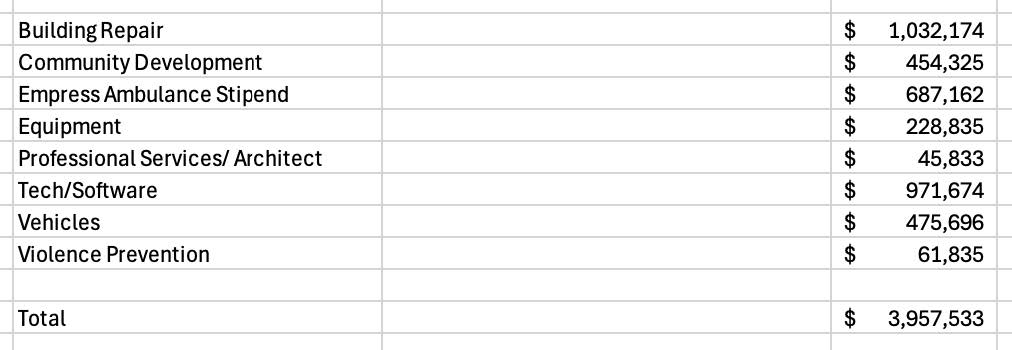
The year also saw nearly $1 million spent on building repairs for facilities that remain leaky and dilapidated; additional vehicle purchases; more software—some involving recurring costs the City neither planned for nor can afford; and yet another gift card program. A snapshot of the City’s 2025 ARPA spending appears below.
I. The City’s Own Blueprint—and Its Failure to Follow It
In 2024, the City unveiled the “Mount Vernon First: Small Business Grant” program as its flagship ARPA-based recovery initiative. On paper, it was robust:
- Clear eligibility criteria
- Defined geographic focus (Downtown Business District)
- A competitive application window
- A 120-point scoring rubric and individual evaluator scorecards
- Interviews and rankings
- Restricted uses of funds
- Monitoring, site visits, and documentation requirements
The City represented to the public—and to the federal government—that ARPA funds would be deployed through a structured, merit-based, documented process designed to spur recovery and revitalization.
The records tell a different story.
II. What the Files Actually Contain—and What They Do Not
Across the ARPA grants disbursed in late 2024 and throughout 2025, the City’s files fairly consistently include executed contracts, claim vouchers, and issued checks. But they just as consistently do not include:
- Proof that funded projects occurred
- Receipts or invoices tied to eligible uses
- Photographs of completed work, site visit reports, or completion certifications
- Monitoring or compliance memoranda
- Outcome or impact summaries
In short, the files show authorization and payment, but not performance or results.
That is not a clerical oversight. Under ARPA, the obligation to ensure compliance does not end when a check is cut. It begins there.
III. The Small Business Grants: Recovery in Name Only
ARPA’s small business grants were typically capped at $25,000 and often paid in two installments—sometimes months after the contract period had ended. While the City justified these grants as relief for “negative economic impacts of COVID-19,” the underlying uses frequently included: rent arrears, utilities, payroll, marketing, inventory, equipment, vehicle purchases, and general operating expenses.
Many of these uses stretch, if not exceed, the program’s own stated purposes, which emphasized façade improvements, build-outs, exterior work, and code compliance tied to downtown revitalization. More importantly, the files do not demonstrate that the funded activities actually occurred, let alone that they addressed pandemic-related harm.
IV. What If You Knew: A Case Study in Process Breakdown
One grant illustrates the systemic failures especially clearly.
The business What If You Knew received a $25,000 ARPA small business grant, justified as pandemic recovery assistance. The contract—executed only by the recipient—contained a clearly computer-generated signature, without an accompanying audit trail or signature certificate. While electronic signatures are legally permissible, the absence of authentication metadata in a federally funded contract weakens the integrity of the record.
More troubling is what is missing:
- No lease documentation
- No renovation or build-out receipts
- No permits
- No proof of expansion
- No expenditure report—despite the contract explicitly requiring one
- No monitoring or follow-up
The proposed use of funds—marketing, staffing, and contingency planning—also diverged from the core design of the Mount Vernon First program, which prioritized physical improvements and downtown storefront activation. In any event, there is no trace of a business operating under the name What If You Knew in downtown Mount Vernon. While the New York State Department of State lists the entity as “active,” its address remains the single-family home listed in the contract.
Whether this grant was well-intentioned is beside the point. The City cannot demonstrate that it complied with its own rules or with ARPA’s accountability requirements.
V. The Illusion of Oversight
The City produced scorecards, rubrics, FAQs, and selection packets that suggest rigor and discipline. But these materials largely exist in isolation, detached from the grant files themselves.
For many recipients:
- Scorecards are missing
- Rankings are undocumented
- Interview notes are absent
- Final selection rationales are unclear
Compounding these deficiencies, the review team consisted of the Mayor’s Deputy Chief of Staff and the Comptroller’s Assistant Comptroller—the same Assistant Comptroller whose father benefitted from ARPA funds when the City spent $72,000 to demolish his long-neglected property.
Once again, the City appeared unconcerned with substantive review or even the appearance of impropriety. What resulted was the appearance of oversight, not its substance.
VI. The Gift Cards That Couldn’t Be Used
The lack of follow-through and verification in Mount Vernon’s ARPA spending is not limited to small business grants. It also appears in resident-facing public safety initiatives, including programs involving cash-equivalent gift cards—one of the highest-risk forms of public expenditure.
In late 2024, the City used $61,835 in ARPA funds to purchase 400 prepaid Visa gift cards, each valued at $150, plus associated fees, for a program labeled the “Neighborhood Camera Program.” The purchase was processed through Commerce Bank and paid directly by the City. The authorizing ordinance describes a structured program: residents would receive gift cards to purchase security cameras, eligibility would be based on neighborhood need and crime data, and participants would agree to provide camera footage to the Mount Vernon Police Department if requested.
However, as with other ARPA programs, what the City’s files do not contain is equally important. There is no documentation showing:
- how recipients were selected,
- who received the cards,
- when or how the cards were activated,
- whether the cards were successfully redeemed, or
- whether cameras were ever purchased or installed.
Nor do the files include serial-number logs, distribution acknowledgements, redemption confirmations, or post-program reports—controls that are standard when public funds are converted into gift cards.
This absence of documentation is especially troubling in light of community reports that residents who attempted to redeem gift cards from a separate, earlier City-run gun buyback program found that the cards had no funds available when presented for use. According to residents, the cards were distributed, but the money “never went on the cards.”
Each gift card program involved different vendors, amounts, and inventories. What remained constant was City coordination—and a near-total failure of internal controls. Time and again, ARPA funds were used to purchase gift cards with no records demonstrating activation, distribution, or successful use.
Gift cards are not inherently improper. But they are inherently high-risk, precisely because once funds leave the City in that form, they are difficult to trace without strict controls. The City’s ARPA files show the money being spent—but not the programs being executed.
VII. The Final Accounting: Less Than Recovery, More Than Risk
By the end of 2025, Mount Vernon had expended or obligated virtually all of its $41,108,657 ARPA allocation. And yet:
- Less than 5% went to direct assistance for residents
- Community-facing programs lack proof of delivery
- Small business grants lack proof of performance
- The City absorbed long-term costs it cannot sustain
- The public was left without a transparent accounting
| Category | All Years total | % of $41,108,657 |
|---|---|---|
| Vehicles | $7,817,229 | 19.02% |
| Sewer | $6,195,929 | 15.07% |
| Tech/Software (incl. “Software”) | $2,927,441 | 7.12% |
| Equipment (incl. “Computer Equipment”) | $2,292,534 | 5.58% |
| Community Development (incl. “Total Community Development”) | $1,300,310 | 3.16% |
| Building Repair | $1,156,070 | 2.81% |
| Building Demo | $1,051,475 | 2.56% |
| Mayor’s Guaranteed Income | $1,000,000 | 2.43% |
| Roof Replacement | $697,157 | 1.70% |
| Empress Ambulance Stipend | $687,162 | 1.67% |
| HVAC | $312,247 | 0.76% |
| Professional Services/Architects | $135,051 | 0.33% |
| Violence Prevention/Reduction | $81,443 | 0.20% |
| Building Renovations | $31,400 | 0.08% |
| Building Review | $19,680 | 0.05% |
| Plumbing | $8,500 | 0.02% |
| Marketing | $4,910 | 0.01% |
| Translation Service | $1,149 | 0.00% |
| Catering | $743 | 0.00% |
ARPA was meant to stabilize households, strengthen systems, and reduce future fiscal stress. In Mount Vernon, it did none of those things. Instead, it enriched City Hall.
VIII. Conclusion: Haphazard Spending Is Not Recovery
The ARPA era in Mount Vernon ends not with recovery, but with a reckoning.
The federal government entrusted Mount Vernon with more than $41 million in emergency relief—one-time funding meant to stabilize finances, protect residents, and prevent exactly the kind of fiscal collapse the City now faces. What residents received instead was a 5.47% property-tax increase, nearly non-existent services, unchecked crime, rampant homelessness, filthy streets, and so many fires that one resident publicly asked, “Is Mount Vernon Hell?”
Residents were never meaningfully prioritized. Developers dominated decision-making. And the City’s finances are weaker than before the money arrived.
This outcome was not inevitable. It was chosen.
City leadership failed to produce a comprehensive recovery strategy. They failed to adopt a disciplined plan to stabilize City finances or reduce long-term risk. They failed to create any framework that prioritized residents over vendors, insiders, or politically favored projects. They failed to impose guardrails to prevent one-time federal dollars from being used to create recurring costs the City could not sustain. Oversight was treated as optional. Documentation was treated as an inconvenience. Proof of results was treated as unnecessary.
And when the money ran out, the bill was handed to taxpayers.
Mount Vernon’s ARPA story is one of failed oversight at every level—local, state, and federal. It is a story of greed, corruption, and incompetence, of extraordinary public resources poured into a system that lacked the discipline, transparency, and integrity required to manage them. It is a story of misaligned incentives, where insiders benefited while residents paid more for less. It is the story of what happens when “free” money is given to people who think it is okay to give themselves 40% raises with back pay, buried in a contingency line and justified under an obscure provision of state law the public was never informed about. It is a story about the abject failure of the checks and balances on which our system of government relies.
In the end, a struggling city received a once-in-a-lifetime infusion of cash—roughly a quarter of its annual budget—and the people in charge still managed to drive it into bankruptcy. That is not bad luck. It is not misfortune. It is what happens when those entrusted with public money choose themselves over the people they were supposed to serve.
* * * *
This concludes The Sunday Series: ARPA in Mount Vernon.
Our next series, PILOTs, Politics, and the Public Cost, will examine the Mount Vernon Industrial Development Agency (IDA) and the unchecked expansion of developer-driven low-income housing, focusing on how these deals are structured, who benefits, and what they cost the public. That series, along with prior installments of ARPA in Mount Vernon, and other City-related material, is available at The Integrity Project’s website: https://mvcip.org/.