

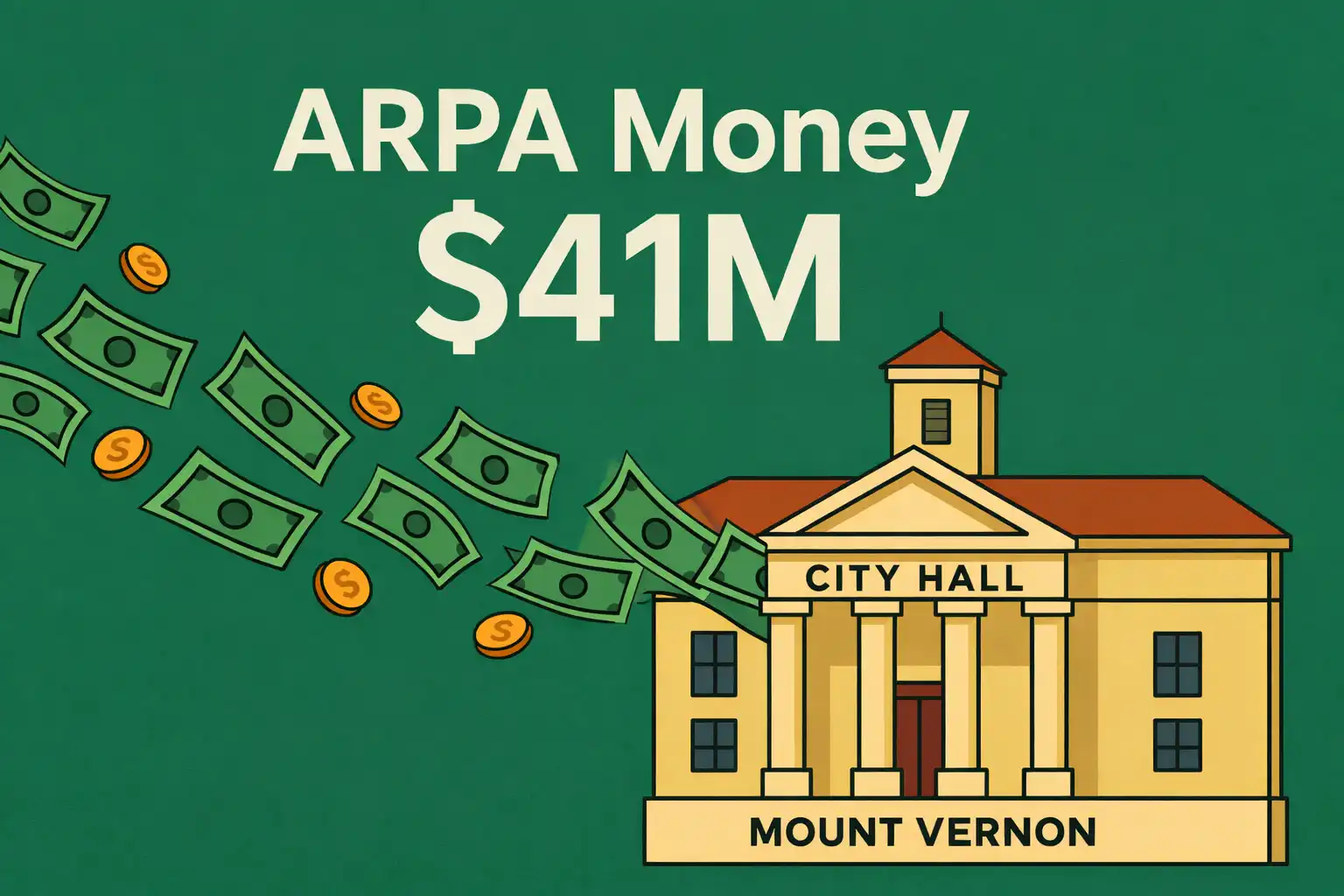
When COVID-19 shut down the country, local governments lost revenue almost overnight.
Congress responded with the American Rescue Plan Act of 2021 — better known as ARPA — a
one-time federal rescue package meant to keep communities stable when tax bases collapsed,
businesses closed, and families faced economic crisis.
This was not normal funding. It was emergency money designed to help cities survive and
emerge stronger.
What ARPA Was Designed to Do
ARPA had three core purposes — and clear rules about how the money could and could not be used.
1. Stabilize Local Budgets and Keep Essential Services Running
Permitted uses included:
- Filling temporary budget gaps caused by pandemic-related revenue loss
- Keeping police, fire, sanitation, and EMS services staffed and operational
- Preventing layoffs of municipal workers
- Covering pandemic-related overtime or hazard pay
- Maintaining transit, public health clinics, or schools facing shutdowns
Prohibited uses included:
- Creating new permanent positions without long-term funding
- Increasing salaries unrelated to pandemic need
- Using ARPA to mask recurring structural deficits
- Pension deposits, debt payments, or court judgments
- Undocumented gifts, bonuses, or payments
- Economic development spending unrelated to COVID impact
In short, the point was to keep cities afloat — not to reinvent government.
2. Provide Direct Relief to Residents and Small Businesses
ARPA was not only about stabilizing government operations. It was also intended to directly help
people harmed by the pandemic.
Permitted uses included:
- Emergency rental and utility assistance
- Grants to small businesses forced to close
- Food distribution and child nutrition programs
- Aid to essential workers
- Financial counseling, legal aid, and eviction prevention
Not permitted:
- Grants with no eligibility tied to pandemic impact
- Cash giveaways used as political branding
- Funding nonprofits without accountability or measurable outcomes
The money was meant to help those hit hardest — not reward allies.
3. Fund Eligible Infrastructure and Public Health Improvements
Some ARPA funds could be used for infrastructure or public health investments — but only when
they addressed pandemic-related needs or fell into explicitly authorized federal categories.
Eligible uses included:
- Broadband expansion
- Lead pipe replacement
- Water and sewer upgrades
- Public health infrastructure
- Technology modernization for government operations
Not allowed:
- Recurring software subscriptions without future funding plans
- Large capital projects launched without completion strategies
- Development deals unrelated to COVID impact or ARPA eligibility
ARPA was meant to help cities recover and rebuild — not serve as a slush fund for wish-list projects.
How Much ARPA Money Did Mount Vernon Receive?
According to the National League of Cities’ ARPA allocation data, Mount Vernon received
$41,108,657 in State and Local Fiscal Recovery Funds.
- The city’s 2021 gross budget was $123,298,088
- ARPA equaled roughly one-third of an entire year’s budget
This was an unprecedented infusion of cash for a city already struggling with long-standing
financial and operational instability.
But ARPA came with conditions. Cities were required to:
- Document every expenditure
- Track procurement
- Report subrecipients
- File mandatory Treasury reports
- Retain records for at least five years
Cities that failed to comply risked having to return misused funds.
Why ARPA Mattered So Much for Mount Vernon
Mount Vernon was already in fiscal distress long before COVID.
In 2020, the New York State Comptroller issued a fiscal assessment finding that the city:
- Lacked reliable financial records
- Maintained outdated ledgers
- Failed to reconcile millions in cash accounts
- Relied on one-shot revenues to cover ongoing expenses
- Missed filing deadlines for years
- Repeatedly failed to correct prior audit findings
- Could not produce accurate fund balance or capital account data
The State warned conditions would likely worsen due to weak internal controls, recurring deficits,
and persistent lack of transparency.
In other words, ARPA did not arrive in a city with functioning fiscal systems — it arrived in a city
already under warning.
What Happened Next: The 2025 State Report
In February 2025, the New York State Comptroller released Boom or Bust? Federal Relief Aid and Local Government Finances in New York State.
The report warned that municipalities receiving large proportions of ARPA funding face a serious
risk of a “fiscal cliff” if temporary federal money is used to support recurring expenses.
When that temporary funding disappears, budgets don’t decline gradually — they drop sharply.
Critically, the report stated that Mount Vernon could not be evaluated at all because it failed to
submit required financial reports, despite receiving more than $20.5 million in ARPA funds in
2021 and 2022.
Without those filings, the State could not assess spending outcomes, assign fiscal stress scores,
or conduct basic oversight.
ARPA required responsible stewardship. It was a stress test of whether Mount Vernon could manage
major public funds with competence and transparency.
Mount Vernon failed that test.
Where This Series Goes From Here
ARPA gave Mount Vernon a once-in-a-generation opportunity to stabilize core systems, repair
infrastructure, and strengthen government capacity.
Whether that opportunity was used responsibly is the question this series will explore.
Join us Sundays on Nextdoor as a Mount Vernonite, or by signing up for the Voice of Mount Vernon.
Next: Part 2 — ARPA in Mount Vernon in 2021
How the first year of spending set the tone: early contracts, early beneficiaries, and early warning signs.