

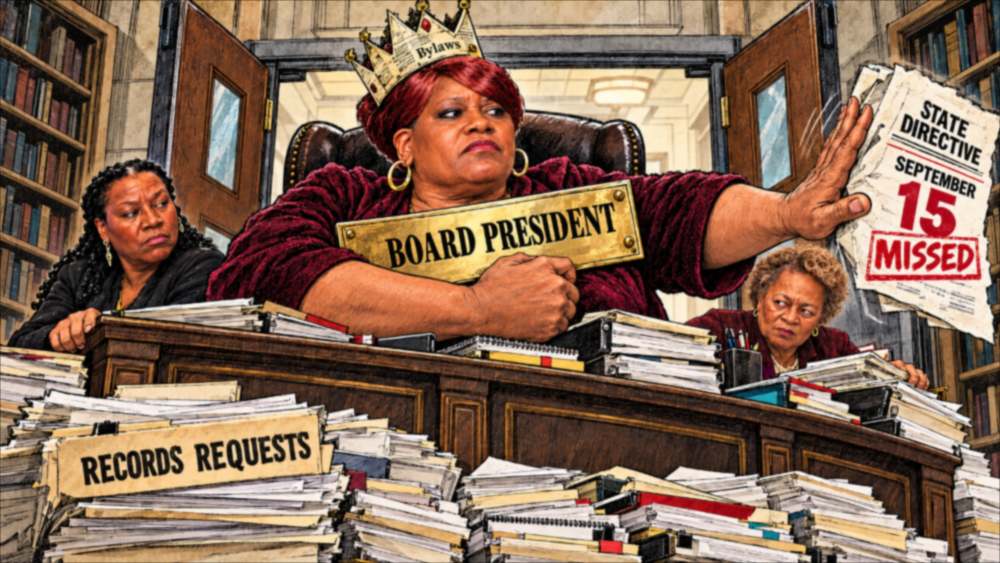
For three months, Mount Vernon Public Library Board President Kim Harper did nothing with a State directive that carried a September 15 deadline. Trustees implored her to act — she refused. We wrote about it here.
Then, on October 1, word spread that the State Board of Regents might take up the Library—and that the removal of trustees had been discussed. The next evening, at 6 p.m., Harper fired off a submission to the Westchester Library System (WLS) “on behalf of the Board of Trustees.” But the submission was never brought before the Board, thus, the Board never voted on it.
When Trustee Jonathan Michael Davis asked five direct questions about that submission, Harper answered none of them. Instead, she told him he could be formally reprimanded, reminded him that he had been “adequately” trained, and told him to look things up himself.
That has been the pattern at every turn: silence when asked to act, motion only under threat, and contempt for anyone who points it out.
The Regents may consider the Library as soon as October 5 or 6. They should. They must. Harper’s behavior demands it, and it is what residents voted for when they overwhelmingly “dethroned” Hope Marable, Trustee Davis’ predecessor.
What the State Asked For
On June 22, 2026, State Librarian Lauren Moore wrote to the MVPL Board of Trustees about the Library’s financial reporting failures.
Among other things, the State directed the Board to request WLS approval of an independent auditor, hired by the Board, to review and certify all annual financial reports beginning in 2026. The deadline to submit that auditor to WLS was September 15.
The same letter required:
- An independent treasurer
- Monthly Board meetings
- Monthly financial statements
- Compliance with the Open Meetings Law
- Compliance with the Freedom of Information Law
It warned that the Library’s registration could be suspended or revoked.
The current Board took office on July 1. That gave it more than ten weeks to act.
It held a regular meeting on September 9—six days before the deadline. The auditor directive was not on the agenda. A special meeting agreed to that night was never held.
According to Trustee Davis, he and Trustee Loretta Thomas repeatedly emailed Harper and the other trustees before September 15, asking that the directive be brought before the Board.
It never was.
Three Months of Nothing, Then a 6 P.M. Email
Laid end to end, the sequence speaks for itself. Harper had time for training sessions and a September meeting. Yet, she found time to act on the State’s directive only after removal entered the conversation.
| Date | What Happened |
|---|---|
| June 22 | State Librarian directs the Board to submit an independent auditor to WLS by September 15. |
| July 1 | Current Board, with Harper as president, takes office. |
| July–September | Trustees Davis and Thomas repeatedly email asking that the directive be brought before the Board; according to Davis, their requests go unaddressed. |
| September 9 | Regular Board meeting; the directive is not on the agenda. A special meeting is agreed to but never held. |
| September 14 | Trustee Davis receives BoardDocs training—the Board makes time for that. |
| September 15 | Deadline passes. No submission. No vote. |
| Late September | At a WLS meeting, MVPL’s missed State deadlines and the possible removal of trustees are discussed. |
| October 1 | WLS Trustee Hudson Trader confirms that the Regents may take up MVPL on October 5 or 6. |
| October 2, 6 p.m. | Harper submits two firms to WLS “on behalf of the Board.” |
Harper now calls the October 2 email a routine follow-up.
The calendar says otherwise: the Board president acted only when her reign was in question.
A “Follow-Up” That Reads Like a First Request
Harper’s defense is that nothing was late.
In her reply to Davis, she wrote that the auditors “were timely identified by the past Board President,” that the Board “presumed” WLS would respond, and that the October 2 email was simply a “follow up” because WLS had not.
Her own October 2 email says otherwise.
It does not mention any earlier submission. It does not reference a prior date, a prior letter, or a pending decision. It walks WLS through the June 22 directive from the beginning, introduces each firm, and closes with:
“We request that WLS approves.”
That is the language of a first request, not a reminder.
The timeline raises its own question. The directive arrived June 22. The “past Board President” served only until the new Board took office July 1—a window of approximately nine days.
If a timely submission was made during that window, it should be easy to produce.
MVCIP will seek it, although we imagine it will go the way of our other FOIL request which, currently, is nowhere.
And if the Board was waiting for WLS all summer, why did no one tell the trustees who kept asking? A short email—“Already submitted; awaiting WLS”—would have ended the matter in July.
A 2022 Resolution Cannot Answer a 2026 Directive
Harper rests her authority on two resolutions:
- Resolution 083-22, adopted July 20, 2022, retaining Hudson Forensic Solutions
- Resolution 078-25, adopted November 5, 2025, engaging PKF O’Connor Davies
Because neither resolution has been repealed, she argues, they “remain actionable,” and implementing them is the president’s job.
The problem is simple: neither resolution could have authorized a response to a directive that did not yet exist.
Retaining a firm is one decision. Telling the State that the firm satisfies a new oversight requirement is another—and that decision belongs to the Board. The full Board; not the shadow board created by Marable, Harper, Crenshaw, and Dickerson in a pathetic attempt to retain power, despite the wishes of Mount Vernon’s electorate.
Under New York law, a board acts as a body, by majority vote at a properly held meeting. A president carries out what the Board decides. She does not decide for it.
Calling herself “the official spokesperson” does not change that. A spokesperson speaks for a decision.
Here, there was no decision to speak for.
Five Direct Questions, Zero Answers
Davis put five plain questions in writing. Each could have been answered with a document or a sentence.
Harper’s reply addressed none of them.
| Trustee Davis Asked For | President Harper’s Response |
|---|---|
| The specific Board authority for the post-deadline submission | Repeated that it was “pursuant to resolutions duly adopted”; cited no vote addressing the June 22 directive. |
| The language in Resolutions 083-22 and 078-25 authorizing a response to the June 22, 2026 directive | Named the resolutions; quoted no such language, because none could exist. |
| Current retainer or engagement documents for each firm | Not addressed. |
| Current invoices showing that the firms are performing this work | Asserted that invoices were “approved”; produced none; told Davis to find them in BoardDocs. |
| Why the directive was omitted from the September 9 meeting despite repeated requests | Not addressed; said only that the Board “presumed” WLS would respond. |
Non-answers are a choice.
If the documents exist, producing them would end the argument. Instead, the Board president chose to answer a records request with a disciplinary warning.
One Auditor Requested, Two Submitted
The State asked for an independent auditor. Harper submitted two firms and asked WLS to approve both.
By her own account, Hudson Forensic Solutions has been “reviewing and certifying” the Library’s annual financial reports since 2019–2020. PKF O’Connor Davies has led an engagement since 2024 and has had a relationship with the Library since approximately 2015–2016.
That history is the point — and the problem.
These arrangements were already in place while the reporting problems identified by the State were occurring. If they had been working, the State would have had no reason to order an independent auditor “beginning in 2026.”
Submitting the same firms back to the State as the solution invites an obvious question:
What, exactly, is new?
Perhaps these firms are competent. Perhaps they’re not. But the question is one the Board should have considered—in public, before the deadline—and never got the chance to.
Contempt at Every Turn
The email exchanges reveal more than a refusal to answer. They show a Board president who responds to scrutiny with ridicule, reprimands, and reminders of her title. Rather than engage trustees on the substance, Harper repeatedly uses contempt to belittle them and her perceived authority to silence them.
When a WLS Trustee Tried to Calm Things Down
On October 1, WLS Trustee Hudson Trader emailed the Board after receiving questions about Davis’s social media post concerning the WLS meeting. Trader emphasized that the possible removal of trustees had been discussed but that no final decision had been made.
Davis responded:
“I posted a synopsis that someone made of Terry’s report. No one has said a decision has been made. I think any statements concerning this matter should come from Terry. Your interpretation is suspect.”
Harper’s entire response was:
“So was your social media post.”
Trader then sent a detailed clarification, stressed that the Board should focus on satisfying the State’s requirements, and called for additional education and training for all MVPL trustees.
Harper addressed none of that. She did not discuss the missed deadlines, the State’s concerns, or what the Board intended to do next. Her only contribution to the exchange was a shot at Davis.
When a Trustee Asked for Documents
Davis asked for resolutions, contracts, and invoices.
Harper told him that he had “received adequate BoardDocs training” and was “expected” to find things himself “before directing questions to others.”
But it is not possible to find what isn’t there. More importantly, Trustee Davis is asking for the public as is his duty as an elected Trustee, and Harper, as Board President, owes the public answers.
When a Trustee Questioned Her Authority
She threatened him.
“Individual Trustees may not speak for the Library or Board without express authorization. Continued violations may result in Board action, including a formal reprimand.”
Harper never identified what Davis supposedly said—or to whom—that purported to speak for the Board.
The irony is hard to miss.
Davis wrote to his own Board president. The person who spoke for the Board without authorization was Harper herself—in writing, to WLS, with the State Librarian copied.
When She Had Nothing Else to Say
“Once again, the Board President is the official spokesperson.”
“You are reminded.”
“It is also reiterated.”
Even Davis’s trustee orientation, scheduled for October 7, was delivered as a rebuke.
Trustee Trader, by contrast, urged more training for the entire Board.
That would include its president.
This is not new. In September, when Davis pressed for records concerning the State’s directives and a former treasurer’s separation terms, Harper brushed him off then, too.
What the Public Should Demand
Harper closed by saying that the Library “will respect and comply with the outcome” of WLS’s decision.
That ship sailed — compliance was due September 15.
Moreover, respect for the process would have meant bringing the matter before the Board.
Before the Regents meet, the public record should include:
- Any submission made to WLS by the prior Board president between June 22 and July 1, 2026, including its date.
- The identification of what language in Resolutions 083-22 and 078-25 respond to WLS’ June 2026 request.
- Current engagement letters for Hudson Forensic Solutions and PKF O’Connor Davies.
- The invoices Harper says the Board approved, and identification of the meetings at which they were approved.
- An explanation of why the June 22 directive was not placed on the September 9 agenda.
What the Public Record Already Shows
Harper did not lead the Board into compliance. She kept the State’s directive off the agenda, allowed the deadline to pass, acted in the Board’s name without a vote, refused to produce the authority or records supporting her action, and threatened the trustee who demanded answers.
A president who treats State directives as optional, Board authority as her personal entitlement, and oversight as insubordination is not merely ineffective — she is unfit to govern.
The Regents should not give Harper another warning. They should remove her, along with her enablers, Trustees Crenshaw and Dickerson.
MVCIP will continue to follow the Board’s response—and the State’s.