
The Mount Vernon City School District put its budget to a vote on May 19, 2026. Voters rejected it. Under Education Law § 2601-a(4), the board had two options: go back to voters with a revised budget, or go straight to a contingency budget. The board chose to try again — that revote is June 16, 2026. If voters reject the budget a second time, a contingency budget is mandatory. There are no more votes.
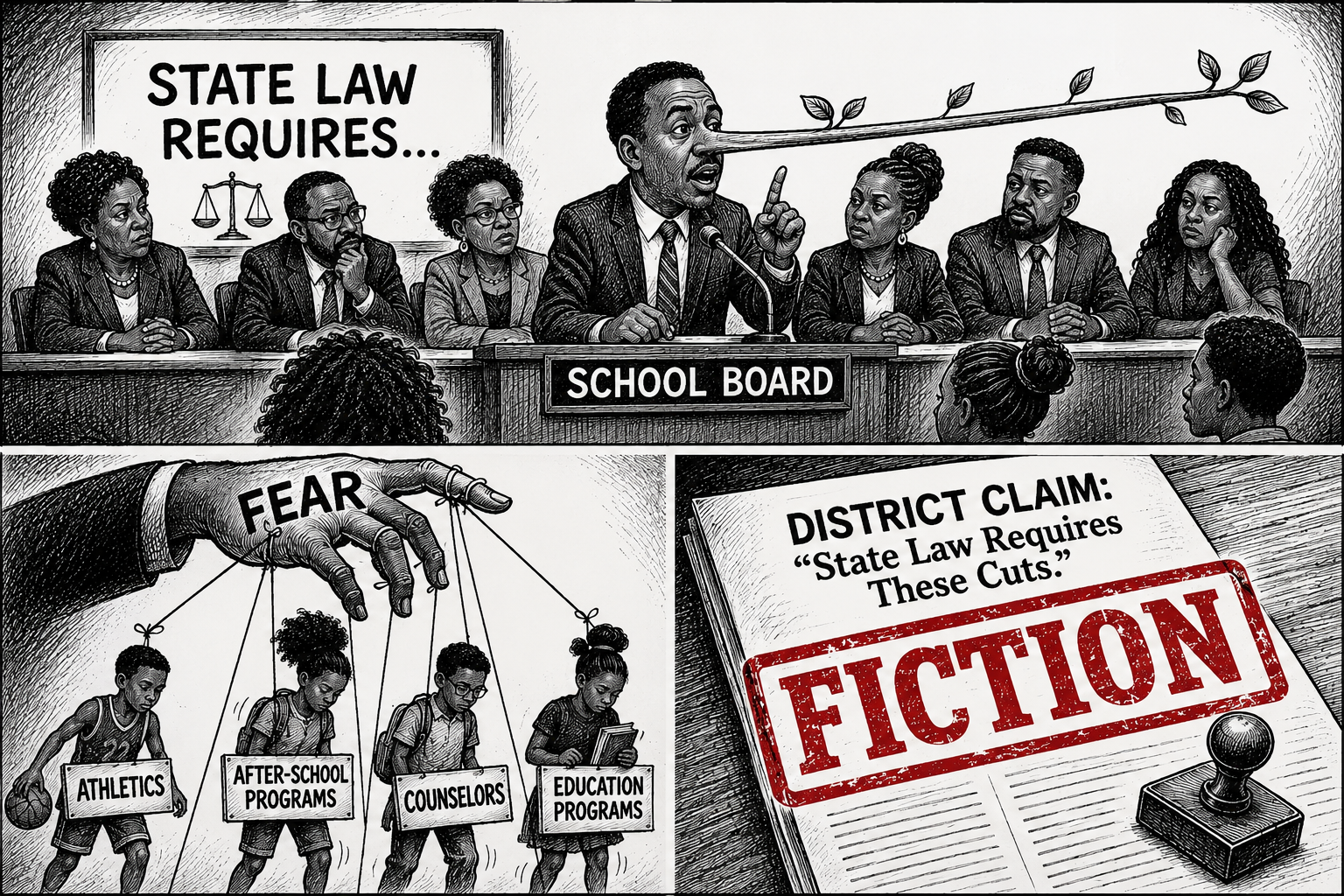
In the run-up to June 16, Superintendent Demario Strickland and the school board have launched an aggressive social media campaign telling voters what will happen if the budget fails again. On social media and in interviews, Dr. Strickland has leaned hard into the specter of “no athletics” — no basketball — knowing exactly what that means to a community where youth sports are often a lifeline.
At board meetings, Dr. Strickland and board members have openly discussed the importance of shaping the right narrative to reach voters.
Nowhere in those conversations is there a discussion of whether that narrative is accurate.
The District’s revised budget newsletter, still posted on the District’s website as of June 8, 2026, tells voters:
“Due to state regulations, a contingency budget would require the District to make specific reductions.”
The newsletter then lists:
- ALL ATHLETIC PROGRAMS ENDED
- NO FREE PUBLIC FACILITIES USE
- PROGRAMMING CUTS
- CTE EXPANSION HALTED
- STAFFING REDUCTION
- CONTRACTS REMAIN UNNEGOTIATED
This post examines each claim against what New York law actually says. The conclusion is not subtle: the District is using fear to obscure the difference between what the law requires and what the Board has chosen to do.
First — What Laws Apply to Mount Vernon?
Mount Vernon is a “small city school district” — a city with fewer than 125,000 people — and three laws govern its budget:
Education Law § 2023-a sets the annual tax levy cap. Budgets within the cap pass with a simple majority; budgets above it need 60% approval.
Education Law § 2023 is the general statewide fallback rule — what any district can spend after a budget defeat.
Education Law § 2601-a is the law written specifically for small city districts like Mount Vernon. Where it and § 2023 overlap, § 2601-a controls. It is the most important law here.
What § 2601-a Actually Says About Contingency Budgets
Section 2601-a(5) is explicit. A contingency budget must include funding for:
- all teacher and supervisory staff salaries;
- legally required services, including busing, textbooks, special education, health services, kindergarten and nursery programs, services for nonpublic school students, and BOCES costs;
- legal obligations, including existing contracts, debt payments, court orders, and mandates from the Board of Regents or Commissioner with the force of law;
- library books and instructional materials;
- whatever is needed to keep programs running, buildings safe, and students and staff protected;
- athletics, field trips, and extracurricular activities; and
- anything else the Commissioner classifies as an ordinary contingent expense.
Read that list carefully. Now read the District’s claims again.
The Claims — Fact vs. Fiction
Claim #1: “ALL ATHLETIC PROGRAMS ENDED”
The District says: Eliminate the entire sports program — all modified, JV, and varsity teams.
What the law says: “Such contingency budget shall include the sum determined by the board to be necessary for . . . expenses incurred for interschool athletics, field trips and other extracurricular activities.” Ed. Law § 2601-a(5)(f).
Claim #2: “NO FREE PUBLIC FACILITIES USE”
The District says: School facilities — including the pool and playgrounds — closed to the public unless users pay the full cost.
What the law says: Guidance from the New York State School Boards Association is consistent with this: community use of school buildings is not an ordinary contingent expense unless fees cover the cost. Taxpayers cannot be required to subsidize free public use during a contingency budget year.
Claim #3: “PROGRAMMING CUTS”
The District says: After-school programs, summer programs, and the Gifted & Talented Program will not be implemented.
What the law says: Section 2601-a(5)(f) expressly authorizes funding for extracurricular activities. Section 2601-a(5)(e) authorizes expenses necessary to maintain educational programs.
Claim #4: “CTE EXPANSION HALTED”
The District says: No expansion of the Career & Technical Education program at Mount Vernon High School.
What the law says: Contingency budgets are built around maintaining existing programs, not launching or expanding new ones. Expanding CTE is a harder case to make as an ordinary contingent expense.
Claim #5: “STAFFING REDUCTION”
The District says: 5% cuts to staffing across all levels, including reduction of full-time counselors in elementary buildings.
What the law says: The statute requires funding for teachers’ salaries and authorizes “the necessary salaries for the necessary number of non-teaching employees.” Nothing in the law mandates a 5% staffing cut.
Claim #6: “CONTRACTS REMAIN UNNEGOTIATED”
The District says: The District will be unable to negotiate two bargaining unit contracts that have already lapsed 2–3 years.
What the law says: Nothing in §§ 2601-a, 2023, or 2023-a prohibits collective bargaining during a contingency budget year. The statute explicitly recognizes contractual obligations as ordinary contingent expenses.
What the District Left Out
The District’s newsletter creates the impression that a contingency budget is barely functional — little more than teacher paychecks and the lights on. That is not what the law says.
A contingency budget in Mount Vernon must fund athletics and extracurricular activities, after-school and educational programs, special education, transportation, instructional materials, kindergarten and nursery programs, support staff, health services, and anything else necessary to maintain the educational program and protect students and staff.
The District knows this. That is what makes this campaign something worse than spin.
The Question Voters Deserve an Answer To
The District has every right to advocate for its budget. Advocacy is legitimate. Misrepresentation is not.
There is a fundamental difference between these two statements:
“The Board has decided these cuts are necessary.”
“State law requires these cuts.”
They are not the same. One is a policy choice that voters can hold the Board accountable for. The other is a false claim designed to make voters feel they have no real choice at all.
Voters casting ballots on June 16 deserve to know: most of what the District is threatening is not required by law. It is a choice. And choices have authors.
This post is an analysis of publicly available New York State statutes and is not legal advice. Voters with specific legal questions should consult a qualified attorney or contact the New York State Education Department.