


Two men pleaded guilty in cases involving children. A third faces unresolved sexual-assault claims from multiple former subordinates, several of whom were teenagers at the time of the alleged assaults. Around each of them, Mount Vernon’s institutions have responded with silence, secrecy, or support.
Does Mount Vernon have a predator problem?
It is a brutal question. But after repeated cases involving people connected to the city’s schools, library, youth programs, churches, and political establishment, it is no longer an unreasonable one.
Consider what the public record establishes: two men pleaded guilty in cases involving children, while a third is defending a six-year-old civil lawsuit in which multiple former subordinates — several of them teenagers at the time — accuse him of sexual assault and harassment.
The names are Dwayne Murray, Justin Brewington, and Oscar Davis Jr.
Their cases are different. Murray pleaded guilty to repeatedly sexually abusing a girl younger than 13. Brewington pleaded guilty to a reduced charge described by his mother as “acting in a manner injurious to a child,” following more serious sexual accusations. Davis has not been convicted of a crime, but three former teenaged library subordinates accuse him in an active civil case of unwanted sexual assault and battery.
None of these people are politically peripheral figures. Davis is the nephew of former Mount Vernon Mayor Ernie Davis. Brewington’s mother, Kathie Brewington, is president of the Mount Vernon NAACP, while his father, Curtis Brewington Sr., chairs the city council-appointed Mount Vernon Board of Ethics, and his pastor is current Mount Vernon Comptroller Darren Morton. Murray was formerly engaged to and lived with current school board trustee Erica Peterson, whose campaign Mayor Shawyn Patterson-Howard heavily supported. Peterson defended Murray publicly, including speaking against two of his critics at a school board meeting (while she was running to be a trustee). Murray was also a vocal political ally of Patterson-Howard and supported her endorsed candidates in the 2025 school board election. By Murray’s account, the mayor personally told him about the accusations before his arrest.
And in each case, Mount Vernon’s institutions answered disturbing facts with political protection, institutional silence, carefully worded evasions, or public support for the accused.
Dwayne Murray: No Longer an Allegation
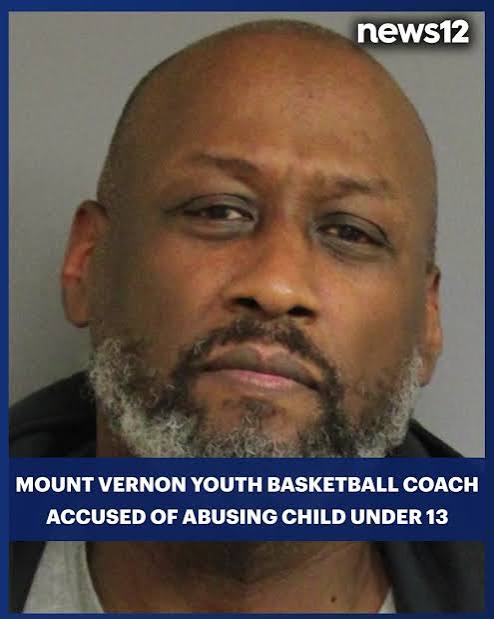
Dwayne Murray was a prominent Mount Vernon youth basketball coach entrusted with young girls.
On September 18, 2026, he pleaded guilty to Course of Sexual Conduct Against a Child in the First Degree. Prosecutors said Murray repeatedly subjected a girl younger than 13 to sexual conduct over five months, including at least one act of oral sexual conduct.
Investigators recovered sexually inappropriate messages between Murray and the child. Murray confessed during an interview with investigators.
He is expected to receive 18 years in state prison, followed by 20 years of post-release supervision, and will be required to register as a sex offender.
This was not a stranger lurking outside a school. Murray occupied a position of community trust. He coached girls, participated in Mount Vernon politics, and publicly supported candidates favored by Mayor Shawyn Patterson-Howard.
One of those candidates was Erica Peterson, who now serves on the Mount Vernon Board of Education.
According to two court complaints, corroborated in part by several publicly available Facebook posts, Murray and Peterson had previously been engaged and were still living together when the allegations against Murray first surfaced.
Patterson-Howard did not merely prefer Peterson in the school-board race. The mayor campaigned heavily for her. The taxpayer complaint says Patterson-Howard gathered petition signatures, attended campaign events, held public forums, and distributed city-branded material expressly endorsing Peterson and two other candidates.
Peterson, meanwhile, publicly came to Murray’s defense.
On May 6, 2025—the day after Murray posted his denial and before his arrest—Peterson addressed the Board of Education. Rather than question Murray, her former fiancé and housemate, she accused then-Board President Adriane Saunders and Saunders’s husband, Gregory Bonaparte, of failing to report child sexual abuse and exploiting the accusations for political purposes.
Peterson declared that if this was the campaign strategy Saunders and another candidate were pursuing, “they have absolutely no business being near or around any of our children in this school district.”
But the verified defamation complaint filed against Peterson alleges that Bonaparte had already reported the suspected abuse directly to the Westchester County District Attorney’s Office before contacting the mayor. The complaint alleges that Peterson turned the accusation against the person who reported Murray while publicly defending the political circle around him.
That case remains unresolved, and its claims have not been tested in court. But Peterson’s public statement—and the timing of it—are documented in the complaint and by contemporaneous statement she made on Facebook.
And before Murray’s arrest, he received a warning.
According to Murray’s own Facebook Live statement, Patterson-Howard told him on April 28, 2025, that she had received a text describing sexual allegations against an unnamed “middle-aged close associate” connected to an eighth-grade girl.
The text never identified Murray. Yet Murray said the mayor discussed it with him directly.
One week later, Murray posted a six-minute video denying wrongdoing. He called the accusations a “smear campaign to silence me, plain and simple,” which he tied to his political support for the mayor’s preferred candidates in the school-board election.
Nine days after that video, investigators arrested him.
A taxpayer lawsuit later accused Patterson-Howard of using her office to warn and protect a political ally. City attorneys did not merely deny the accusation. They mocked it.
Their motion to dismiss called the claim “at best plaintiff’s baseless imaginings,” accused the plaintiff of taking “a page from QAnon’s playbook,” and labeled the accusation “ludicrous slander.”
The court dismissed the case on questionable grounds without reaching the merits. The judge originally assigned to it recused himself because of his “personal and political connection” to the mayor. Less than 36 hours after receiving the case, a second judge dismissed it without making any factual findings—including whether the mayor abused her office by warning Murray before his arrest.
What remains unanswered is why a man entrusted with young girls learned that accusations had surfaced before law enforcement arrested him—and why the mayor, her preferred school-board candidate, and Mount Vernon’s political establishment treated concerns about him as a political attack rather than a serious allegation worthy of investigation.
Justin Brewington: How a Guilty Plea Became a Story of Persecution

The controversy involving Justin Brewington is not merely an online rumor.
Brewington pleaded guilty in 2022 to a reduced charge described by his mother, Kathie Brewington, as “acting in a manner injurious to a child.” His arrest followed more serious sexual accusations made against him in New York City.
An email from Bronx Assistant District Attorney Astrid Borgstedt, dated May 31, 2022, confirms that the defendant had pleaded guilty and was awaiting sentencing on July 26.
The email advised the victim that they could address the court at sentencing. It also stated that the Probation Department would prepare a pre-sentence report and obtain a victim-impact statement.
Brewington’s mother publicly acknowledged the plea in an August 2026 Black Westchester editorial. She wrote that her son had originally faced more serious accusations but accepted a plea to the lesser charge rather than proceed to trial.
“A plea to a lesser charge should not be presented as an admission to every allegation originally made against him,” she wrote.
Plea agreements are negotiated by prosecutors and defendants for many reasons, including certainty, available evidence, witness considerations, and the risks of trial. Victims may be consulted or heard, but they do not decide what plea a prosecutor offers or accepts.
The lesser charge establishes what Brewington admitted in court. It does not establish that the more serious sexual accusations were false.
Brewington’s mother also cited a March 2023 administrative decision concerning a separate child-abuse and maltreatment report maintained through the New York State system. According to her account, the Westchester County Department of Social Services declined to present evidence supporting the report, which was then amended to “unfounded” and sealed.
She expressly acknowledged that the administrative proceeding was separate from the criminal case and did not constitute a criminal acquittal.
Kathie Brewington is not simply a mother defending her son. She is the longtime president of the Mount Vernon NAACP, an organization whose public mission includes protecting civil rights, defending vulnerable people, and demanding institutional accountability.
Justin Brewington’s father, Curtis Brewington Sr., chairs the Mount Vernon Board of Ethics—the city body that receives complaints involving misconduct and conflicts of interest by municipal officers and employees. The City’s website identifies him as the current chair and states that Ethics Board members are appointed by the City Council. MVCIP has written about the Brewingtons before: they pay about 40 percent of what their neighbors pay in property taxes.
Those positions do not make either parent responsible for their adult son’s conduct. But they do make the family’s treatment of the case a legitimate matter of public interest, particularly when the defense of Brewington relies upon minimizing what the criminal proceeding actually established.
Yet when Brewington’s history recently returned to public attention, members of Macedonia Missionary Baptist Church rallied around him in prayer. Including Macedonia’s pastor and owner, Mount Vernon Comptroller Darren Morton.
Messages circulated among church members described the circumstances as a spiritual battle, urged the congregation to pray for Brewington and his family, and assured him that God and his church stood with him.
Prayer is not the issue here. A church may believe in forgiveness, redemption, and supporting a member through a crisis. Nor does Morton’s public office prevent him from ministering to a member of his congregation.
But the messages said nothing about the guilty plea. Nothing about the child at the center of the case. Nothing about the victim who was invited to deliver a victim-impact statement at sentencing.
They presented Brewington only as someone under attack and in need of support.
Three politically influential figures connected to three significant civic institutions publicly or institutionally rallied around him while showing zero regard for his child victim.
It is institutional support stripped of institutional accountability.
Oscar Davis Jr.: One Lawsuit, Four Plaintiffs, and Six Years of Litigation
The public discussion surrounding Oscar Davis Jr. has produced conflicting claims, including repeated statements that he has been named in four separate lawsuits.
The available court record establishes something slightly different but no less serious: one civil action filed in 2020 by four plaintiffs—John Doe 1, John Doe 2, John Doe 3, and Catherine Webb. The John Doe plaintiffs are former library employees whom Davis allegedly helped obtain jobs at the library as teenagers. According to contemporaneous Lohud reporting, they were between 16 and 18 when the alleged conduct occurred.
The defendants include Davis, the Mount Vernon Public Library, its Board of Trustees, former library director Evania Thompson, and the Mount Vernon City School District.
The case asserts claims including assault, battery, negligence, intentional infliction of emotional distress, negligent hiring and supervision, gender discrimination, sexual harassment, and hostile work environment.
A 2024 court decision summarized the complaint as accusing Davis of abusing his power and sexually harassing the plaintiffs while alleging that the institutional defendants were negligent in hiring and retaining him.
A May 2026 ruling supplies even more consequential detail.
In allowing John Does 1, 2, and 3 to continue using pseudonyms, Justice Walter Rivera described the case as involving “various forms of unwanted sexual assault and battery” allegedly committed by Davis while he was their supervisor at the Mount Vernon Public Library.
The court concluded that revealing the plaintiffs’ identities could compound their trauma and expose them to retaliation, stigma, and further emotional harm.
The ruling also notes that the case has been pending for six years, that the plaintiffs and Davis have already been deposed, and that the parties have “zealously litigated” the matter.
The court has not found Davis liable for the conduct described. The case is civil, not criminal, and remains unresolved.
But neither is it merely a Facebook rumor or unnamed community gossip.
It is an active Supreme Court case involving four plaintiffs, three of whom accuse their former supervisor of unwanted sexual assault and battery and have been permitted to remain anonymous because of the trauma, stigma, and potential retaliation associated with publicly revealing their identities.
And that’s probably for the best, because Davis’s connections abound.
Davis is the nephew of former Mount Vernon Mayor Ernie Davis and he is being defended by the Law Office of William O. Wagstaff III—the same firm and attorney that represented Mayor Shawyn Patterson-Howard in the taxpayer lawsuit that mentions Dwayne Murray. Wagstaff was the attorney who branded the claim that Patterson-Howard warned Murray about the accusations as “baseless imaginings,” compared it to “QAnon’s playbook,” and called it “ludicrous slander,” only for Murray to later plead guilty to sexually abusing a child and for his public statements to confirm that Patterson-Howard told him about the message before his arrest. The firm has also been paid hundreds of thousands of dollars — at least — by the City for various outside-counsel assignments.
Davis’s access to City Hall predates the Patterson-Howard administration. In 2015, the Daily Voice reported that Davis received an $82,000 no-bid City Hall contract for database work while employed in the Mount Vernon City School District’s technology department.
There are also questions about Davis’s later conduct inside the school district.
A video circulated publicly shows Davis touching the face and facial hair of a Southern Westchester BOCES employee inside a school district building. The employee appeared visibly shaken and wiped his face several times in disgust afterward. See the video here.
A parent wrote to Superintendent Demario Strickland and the Board of Education demanding to know why Davis remained employed around children.
Strickland responded that the incident predated his tenure, that the district had taken “immediate and appropriate action,” and that he could not discuss the details because it was a personnel matter.
The unanswered questions are plentiful.
Was Davis disciplined?
Was the incident reported outside the district?
Were restrictions imposed on his contact with students or vulnerable employees?
Does he remain employed by the district?
That last question is no longer speculative. The Mount Vernon City School District’s current Technology Department directory identifies Oscar Davis as a computer technician and publishes his district email address. And SeeThroughNY, confirms that Davis remains an active school district employee making over $100,000 / year of taxpayer money.
The Voice of Mount Vernon has raised questions about Davis’s history at the library and the silence surrounding the litigation. Its reporting correctly distinguishes the documented court case from unverified community claims and says it cannot independently substantiate the label “pedophile.”
The civil case remains unresolved six years after it began. Davis remains employed by the school district, and the district refuses to explain what it found, what action it took, or what safeguards it imposed.
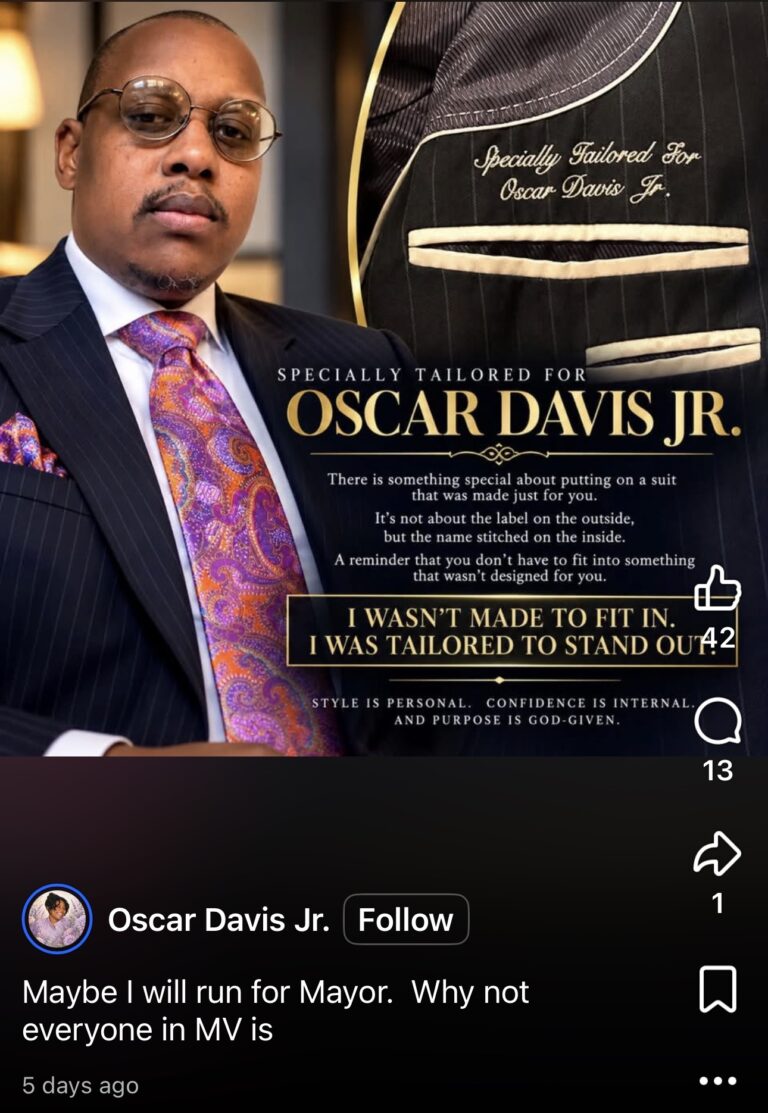
Yet Davis is not retreating from public life while those questions remain unanswered. On October 18, he posted a campaign-style portrait on Facebook and floated a run for Mount Vernon mayor: “Maybe I will run for Mayor.” The image declared, “I wasn’t made to fit in. I was tailored to stand out.” The post received 42 likes.
In a functioning city, allegations that a public official sexually assaulted and battered teenagers he supervised would produce answers before political ambition. In Mount Vernon, six years of litigation, an unresolved school-district incident, and a wall of institutional silence have apparently left Davis comfortable enough to imagine himself running the city—and dozens of people comfortable enough to applaud.
That is what is sick: not merely the allegations against one man, but a political culture so accustomed to unanswered questions, protected connections, and institutional silence that even this record is treated as no barrier to power.
The Sex Offender Registry: What It Shows, and What It Does Not
There is no public registry of “pedophiles.” There is a registry of people convicted of offenses requiring sex-offender registration, and those are not necessarily the same thing.
A person may be required to register for an offense involving an adult, while someone who has sexually harmed a child may not appear in the public directory because of the particular charge, case disposition, or assigned risk level.
New York classifies registered sex offenders as Level 1, Level 2, or Level 3, based on a judge’s assessment of the risk of reoffending. Level 1 is considered the lowest risk, Level 2 a medium risk, and Level 3 the highest risk. Only Level 2 and Level 3 offenders appear in New York’s searchable public directory.
A nongovernmental compilation of state registry information reported 94 registered sex offenders living in Mount Vernon as of October 20, 2026—approximately one registered offender for every 730 residents. The same compilation reported 63 in ZIP code 10550 alone.
The concentration becomes more striking when Mount Vernon is compared with nearby communities using the same source:
| Community | 2020 population | Land area | Reported offenders | Residents per offender | Offenders per sq. mile |
|---|---|---|---|---|---|
| Mount Vernon | 73,893 | 4.39 | 94 | 730 | 21.4 |
| New Rochelle | 79,726 | 10.29 | 41 | 1,940 | 4.0 |
| Yonkers | 211,569 | 18.01 | 120 | 1,673 | 6.7 |
| Pelham | 7,326 | 0.82 | 1 | 7,034 | 1.2 |
New Rochelle is larger than Mount Vernon in both population and area, yet Mount Vernon reports more than twice as many registered offenders. Yonkers has nearly three times the population and more than four times the land area, yet reports only 26 more. Pelham is considerably smaller, but its per-capita rate is nearly one-tenth Mount Vernon’s.
These figures should be treated as estimates, not official municipal counts. The state does not publish a simple Mount Vernon total, the public directory excludes Level 1 offenders, and the nongovernmental compilation warns that some addresses or registration statuses may have changed. The numbers also do not establish how many convictions involved children.
But even with those limitations, the available data makes one point unmistakable: the three names examined in this story are not the full measure of Mount Vernon’s child-safety concerns.
The city has a substantial population of registered sex offenders, yet residents receive little accessible information about how local institutions assess risk, supervise contact with children, share warnings, or respond when concerns arise inside schools, libraries, athletic programs, churches, and other trusted spaces.
The registry cannot tell residents who may offend next. But Mount Vernon’s institutions should be able to explain what they are doing to protect children now.
The Problem Is Bigger Than Three Names
These three cases cannot honestly be collapsed into a single accusation.
Murray admitted repeatedly sexually abusing a child.
Brewington accepted a reduced guilty plea to conduct injurious to a child, while disputing the more serious accusations that preceded it.
Davis has not been convicted of a crime, but multiple former subordinates accuse him in an active civil lawsuit of unwanted sexual assault, battery, and harassment.
Those are different legal circumstances.
But the institutional responses share a recognizable pattern:
- A trusted youth coach publicly denied everything before pleading guilty.
- The mayor allegedly warned that coach about a message that never named him.
- A mayor-backed school-board candidate who had been engaged to, and was living with, that coach publicly attacked other people over the allegations before his arrest.
- City lawyers mocked concerns about the mayor’s warning rather than addressing them directly.
- A church rallied around a man who pleaded guilty to conduct injurious to a child without acknowledging the child, the victim, or the victim-impact statement.
- That man’s mother leads the Mount Vernon NAACP, while his father chairs the City’s Board of Ethics.
- A civil sexual-assault case involving a former library president has remained unresolved for six years.
- That former library president is the nephew of a former mayor and continues to work for the school district.
- The school district says it took action concerning a later incident involving Davis but refuses to tell parents what it determined or what safeguards it imposed, and that person still works for the district.
Mount Vernon’s problem is not simply that disturbing conduct occurs here. Sexual abuse and accusations of sexual misconduct arise in communities everywhere.
The defining question is what institutions do when they arise.
Do they report allegations immediately? Preserve evidence? Separate accused individuals from access to children while the facts are examined? Notify parents when necessary? Support potential victims? Commission independent reviews? Explain what safeguards were imposed?
Or do they warn allies, invoke personnel confidentiality, close ranks, pray for the accused, attack the people raising alarms, and wait for the public to lose interest?
Mount Vernon Needs a Public Accounting
Residents should not have to reconstruct child-safety failures from Facebook videos, leaked emails, civil-court decisions, and fragments of institutional correspondence.
The school district, library, city government, youth organizations, civil-rights organizations, and religious institutions should establish and publish clear procedures governing sexual-misconduct complaints, mandatory reporting, access to minors, preservation of evidence, and outside review.
The Mount Vernon City School District should explain why Davis remains employed and whether restrictions have been placed on his contact with students or vulnerable employees.
The library should explain what it knew about the accusations involving Davis, when it learned of them, and what action it took.
Macedonia Missionary Baptist Church may choose to support Brewington spiritually, but it should not erase the guilty plea or pretend that the only person entitled to concern is the man who entered it.
The Mount Vernon NAACP should explain how its public commitment to protecting civil rights and vulnerable people is reconciled with its president’s effort to recast her son’s guilty plea primarily as a story about what happened to him.
The chair of the Mount Vernon Board of Ethics should explain whether he believes institutional accountability begins at home.
The Board of Education should explain whether Peterson ever disclosed the full extent of her relationship with Murray while publicly attacking others over accusations against him.
City officials should explain what policies prevent political relationships from interfering with criminal referrals or allowing a potential subject to learn of accusations before investigators act.
Local officials should also explain what, if anything, Mount Vernon does beyond maintaining the state-required registry information to protect children in publicly funded programs and facilities.
So, Does Mount Vernon Have a Predator Problem?
Mount Vernon unquestionably has a child-safety and accountability problem.
One trusted youth basketball coach admitted repeatedly sexually abusing a girl younger than 13.
Another Mount Vernon man pleaded guilty to conduct injurious to a child after facing more serious sexual accusations.
Three former library employees—who were between 16 and 18 when the alleged conduct occurred—have spent six years pursuing sexual-assault and harassment claims against a politically connected man who continues to work inside the school district and is now publicly floating a run for mayor.
Publicly compiled registry data identifies approximately 94 registered sex offenders living in just 4.39 square miles—more than twice the number reported in larger New Rochelle and, relative to population, a substantially higher concentration than New Rochelle, Yonkers, or Pelham. The figure does not reveal how many offenses involved children and may not capture every offender.
And around the three men examined here, Mount Vernon’s institutions have supplied some combination of silence, secrecy, ridicule of allegations, political protection, attacks on those raising alarms, and public sympathy for the accused.
That pattern—not any single label—is the problem Mount Vernon must confront.
It can decide whether its institutions expose the danger—or help bury it.
On November 16, 2026, Mount Vernon NewsCenter reported that Lerone Gentile, 47, was arrested and charged with Rape in the Third Degree, Sexual Abuse in the Third Degree, and Endangering the Welfare of a Child. The allegations reportedly involve his girlfriend’s daughter.
The report identified Gentile as a Mount Vernon Water Department employee. A Facebook profile under the name Lerone Gentle lists the Water Department as his workplace, while the Empire Center’s SeeThroughNY database identifies a Lerone T. Gentle on the City’s payroll in 2018 and 2019. It is unclear whether the spelling discrepancy has significance.
The arrest adds another disturbing case involving alleged sexual misconduct with a child and someone reportedly connected to a Mount Vernon public institution.
Another name. Another child allegedly victimized. Another connection to a Mount Vernon public institution.
The charges are allegations, and the accused is presumed innocent unless proven guilty.