

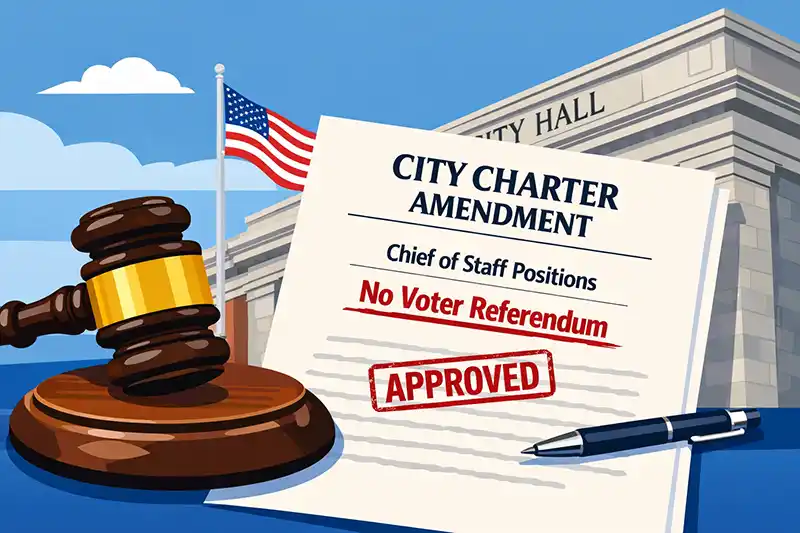
Last week, the City of Mount Vernon adopted a local law that quietly does something serious: it rewrites part of the City Charter to lock in the Mayor’s Chief of Staff and Deputy Chief of Staff positions.
Charter amendments can serve many purposes. Some are technical or corrective. Others are consequential. This change falls squarely in the latter category.
The City Charter is the people’s document—much like the U.S. Constitution. It is the rulebook for how Mount Vernon government works. It defines how power is organized, where authority sits, and what limits apply. Because of that, the Charter is not supposed to be changed casually, quietly, or without public consent.
By writing the Chief of Staff and Deputy Chief of Staff positions directly into the Charter, the City did not merely approve hires or job titles. It permanently created high-level executive offices and assigned them defined authority over City departments, boards, and commissions. That affects how power is exercised inside City Hall, not just who happens to hold a particular job at a particular moment.
When a change of that magnitude is proposed, state law does not allow City officials to decide it on their own. It requires a referendum—meaning the question must appear on the ballot and voters get the final say.
That did not happen here.
Instead, this charter amendment was handled as if it were routine legislation. It moved through the same process used for minor local laws, with no serious effort to alert residents that the City’s governing document was being altered and no opportunity for voters to decide whether they agreed with the change.
The Mayor’s public hearing was held at 9:30 in the morning on December 30, between major holidays, when most people were at work, traveling, or otherwise unavailable. A single weekday morning hearing at year’s end does not amount to meaningful public engagement for a charter amendment of this significance. And regardless of turnout, a hearing cannot substitute for a referendum when the law requires one. Public comment is not voter approval. A hearing lets people speak; a referendum lets people decide.
The stated justification for this amendment was that codifying these roles would “modernize and professionalize” the Mayor’s office. Labels do not change legal reality. Calling something modernization does not make it harmless, and it does not erase the obligation to obtain voter approval when that obligation exists.
There has been no explanation of why these positions needed to be written into the Charter at all, rather than addressed through ordinary staffing and budgeting. There has been no explanation of why voters were excluded from the decision. And there has been no acknowledgment that altering how executive authority is structured is exactly the kind of change the public is entitled to weigh in on.
This was not an isolated misstep. It reflects a familiar pattern in Mount Vernon: significant decisions are minimized in public presentation, rushed through narrow procedural windows, and structured to avoid meaningful public participation. Rebranding that approach as “modernization” does not make it lawful—or democratic.
This is not about whether a Mayor should have senior staff. Every Mayor does. It is about whether City officials can rewrite the City’s rulebook as if it were ordinary legislation, and whether the public’s right to approve major changes to how government works can be treated as optional.
When that happens, the Charter stops being a safeguard and starts being a suggestion.
The remedy is straightforward. The City should repeal this local law. If officials believe these positions truly belong in the Charter, they should put the question to the voters and let residents decide. That is how the law is supposed to work—and that is the point of having a Charter in the first place.