

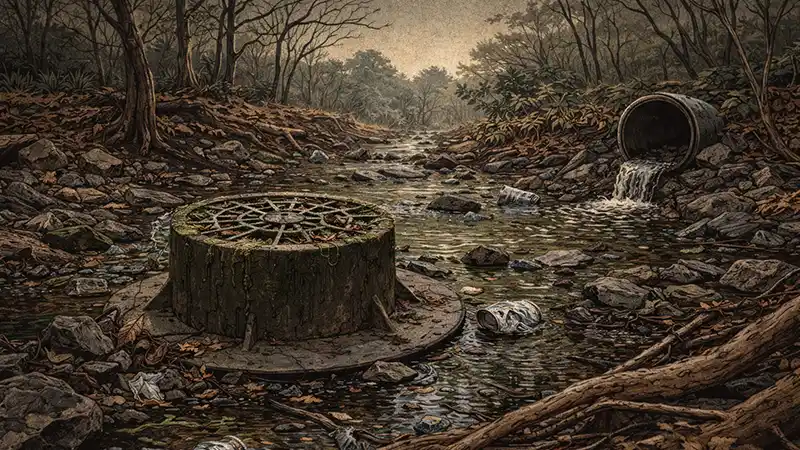
If you live near Hunt’s Woods, you don’t need a press release to know something is wrong. You smell it. You see it. You watch the brook change after rain. You watch your dog go for the water and pull them back because your instincts are screaming, don’t.
Hunt’s Woods isn’t a concept or a talking point. It’s a real place people actually use—to wander, to work out, to watch their kids play, and to walk their dogs. It’s one of the few scraps of green space Mount Vernon has left. And for years, residents have been saying the same thing:
Something stinks in Hunt’s Woods.
Residents Put the City on Notice
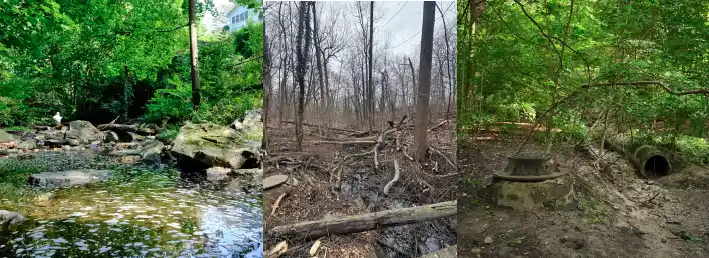
One resident, Gabriel Thompson, who lives a stone’s throw from the Woods, has been particularly vocal. He didn’t speak up for attention. He did it because something was clearly wrong—the smell, the conditions pointing to gross neglect, and the obvious signs that sewage was not staying where it belonged.
His interactions with the City consisted of shared factual observations and photographic evidence. When the City responded, he thanked them. He followed up. He trusted that, given the evidence provided, the City would act to protect its residents. He trusted that if you showed officials evidence of a public-health problem, they’d act like adults and deal with it.
That’s not what happened.
So he pressed harder. And the City began to do what it always does when the truth is inconvenient: it ignored it. And it tried to ignore him—but he wasn’t having it. Any of it.
He pressed, pushed, and organized his neighbors. Together, they sent dozens of emails and attended city council meetings to make their voices heard. That’s when the City got ugly. Officials didn’t just deny the problem—they went after the people raising it. Residents were called “provocateurs” and “troublemakers.” They were told they were imagining things. They were told there was no sewage leaking into Hunt’s Woods.
At one point, when Mr. Thompson photographed what very clearly looked like human feces in a storm drain, the City responded with an email that blamed raccoons. That is not a metaphor. That was the actual explanation.
In response to that email, another resident asked a simple question: “I walk with my dog in Hunt’s Woods Park almost every day. I have one simple question for you: Are there elevated levels of fecal coliform in Laurel Brook?”
There was no response.
The subtext was clear: don’t trust your eyes; trust our spin. City responses even hinted that maybe residents had planted the evidence themselves. Because yes, obviously, concerned neighbors are staging feces for fun.
Residents Take the Lead
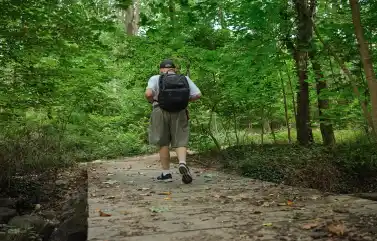
After months of denial, residents did what the City refused to do. In August 2025, Mr. Thompson and another neighbor went to the same Westchester County lab used by engineering firms and other cities, obtained the proper containers, and collected water samples from three locations:
- Outfall 61 (Vernon Pkwy & Hunt’s Woods) – Fecal coliforms
- Laurel Brook (Hunt’s Woods / Oakledge) – E. coli
- Laurel Brook (Hunt’s Woods / Oakledge) – Fecal coliforms
They then personally dropped the samples off at the lab.
Quick primer: E. coli and fecal coliform are bacteria associated with human or animal waste. In plain terms, when you see high levels in a brook or outfall near a public park, it’s a red flag for sewage contamination. Public-health guidance often uses 410 E. coli per 100 mL as a common “single-sample” threshold—above that, water contact is considered unsafe.
Here’s what the lab report found:
- Outfall 61 (Vernon Pkwy & Hunt’s Woods): 2,010 fecal coliform per 100 mL
- Laurel Brook (Hunt’s Woods / Oakledge): >24,200 E. coli per 100 mL
- Laurel Brook (Hunt’s Woods / Oakledge): 12,000 fecal coliform per 100 mL
That’s not “slightly elevated.” That’s off-the-charts contamination. When an outfall is testing in the thousands and the brook is testing at greater than 24,200, the only responsible response is to treat it like what it is: a serious public-health hazard moving through a system that was never supposed to carry sewage. It’s not neighbors planting poop. And it’s not the local wildlife.
Incontrovertible evidence, right? Or at least enough to trigger an investigation?
Not in Mount Vernon.
Mount Vernon’s response was to take to social media and proclaim the results invalid because, apparently, residents are too stupid to collect water and drop it off at a lab. And so that was that. No “Thank you for flagging a public-health hazard.” Not “Let’s investigate immediately.” Just: “You’re not qualified.”
So Mr. Thompson called in the big guns.
The Adults Enter the Room
Mr. Thompson called in an organization that doesn’t play make-believe. Save the Sound protects the Long Island Sound and the rivers that feed it. They test water. They publish results. They pressure agencies to enforce the law. They are, very often, the adults in the room when local governments refuse to act like grown-ups.
On September 17, 2025, Save the Sound tested Outfall 61 on Vernon Parkway, which discharges directly into Hunt’s Woods, for Enterococcus (an indicator of fecal contamination) and E. coli. The standard measures for enterococcus contamination are:
- Below ~100 → generally considered safe
- 100–400 → contamination present; caution warranted
- Over 400 → unsafe; strong indicator of sewage pollution
The Save the Sound results are below:

When Enterococcus comes back at 4,106 per 100 mL, that’s not borderline—that’s ten times the action threshold and dozens of times higher than what’s considered safe. That is an indicator of severe contamination and a public-health four-alarm fire.
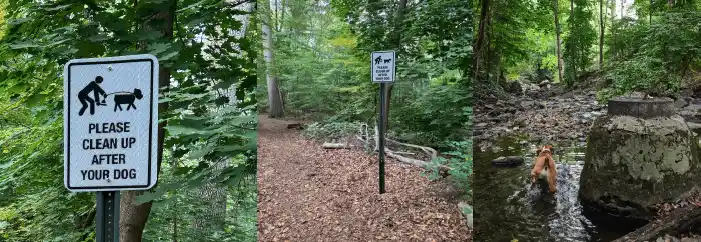
And still—even after these results—no clear public warning. No explanation. No plan. The most visible City response was a sign at the entrance to Hunt’s Woods chastising residents to “Please Clean Up After Your Dog.” Because apparently the problem wasn’t sewage. It was the dogs.
Oscar-Worthy Gaslighting
After months of denials, a resident finally obtained the City’s own City/Arcadis lab reports through a FOIL request. These are not activist samples. These are the tests the City relied on when it publicly insisted there was “no real problem” in Hunt’s Woods. The samples were collected on March 1, 2022, at multiple Mount Vernon stormwater outfalls discharging into and upstream of Hunt’s Woods. Those reports show fecal coliform contamination inside the stormwater system at levels that should never exist:
- Locust Lane outfall: 2,050 and 2600 fecal coliform / 100 mL
- Vernon Parkway outfall: 1700 and 995 fecal coliform / 100 mL
For context: public-health agencies commonly use 200 fecal coliform per 100 mL as the upper limit for safe body-contact recreation, with 400 per 100 mL treated as a clear failure threshold. Every one of these 2022 results exceeds those limits—some by an order of magnitude.
More importantly, these standards apply to open recreational waters, not stormwater infrastructure. Under normal conditions, a storm sewer should carry rainwater only. Fecal coliform levels in the hundreds—let alone the thousands—inside a stormwater system are a red flag for sewage intrusion, system failure, or an illicit connection.
In other words: the City’s own tests, taken more than three years before independent testing, already showed severe contamination consistent with sewage entering the storm system feeding Hunt’s Woods.
They knew.
And instead of fixing the problem, they let it fester. Instead of warning the public, they downplayed it. And when residents raised legitimate concerns, officials didn’t investigate—they attacked. They dismissed. They lied.
Only when the alarm was raised by organizations the City could not bully or discredit did it finally do something that even remotely resembled responsible governance.
The City Finally Acts
Only after denial became unsustainable did we start seeing real activity—and what crews are finding now explains why this problem never “went away.”
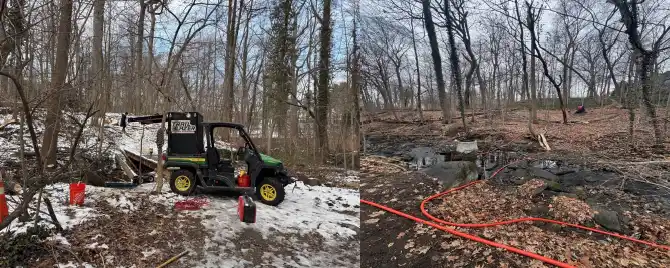
Recent inspection and camera work make it clear the sewer system running through those woods wasn’t just neglected—it was abandoned. Crews are now saying there are many more months of work ahead. Why? Because they have found sanitary sewer manholes buried for decades, with mature trees grown directly over them.
These findings raise questions nobody at City Hall wants to answer, like: how does this happen after Mount Vernon paid millions to Arcadis to map our sanitary and storm sewer systems under a State consent order? What exactly were we paying for?
As cameras are finally pushed through the sanitary sewer lines, crews are finding gravel, rocks—even boulders—throughout the system. The pipe is cracked all over. Sewage has been seeping into the woods for years. This is how you end up with a park that smells like a sewer: not “mystery odors,” but a system that has been functionally failing and bleeding into the environment.
And then there’s the logistical farce: no access road, so vacuum trucks can’t get in. Crews are forced to push debris to distant points with jet equipment from Burkewood Road and Pondfield Parkway—slow, expensive, and completely predictable if you never maintained the place.
The City’s Pattern of Neglect
What happened in Hunt’s Woods is an age-old story in Mount Vernon:
Residents noticed the problem.
Residents reported it.
The City ignored it. Then denied it. Then attacked the people raising it.
Residents tested. The City dismissed them.
Independent experts tested.
The numbers were undeniable.
The City acts – half-assed and grudgingly.
Too little. Too late. As per usual.
In the end:
That smell people complained about? Real.
Those warnings residents raised? Accurate.
The City’s denials? False.
And although work is finally happening in Hunt’s Woods, the public is still largely in the dark:
- What’s the real timeline for fixing the remaining sewer failures?
- What remediation has actually happened at Outfall 61?
- What upstream contamination is being addressed—including Bronxville’s role?
- And what is the City’s long-term maintenance plan so this never happens again?
This isn’t just about old pipes. Every city has those.
The degradation of Hunt’s Woods is what happens when incompetence dates dysfunction, starts cheating with corruption, and protecting that perverse relationship becomes more important than protecting the public.