

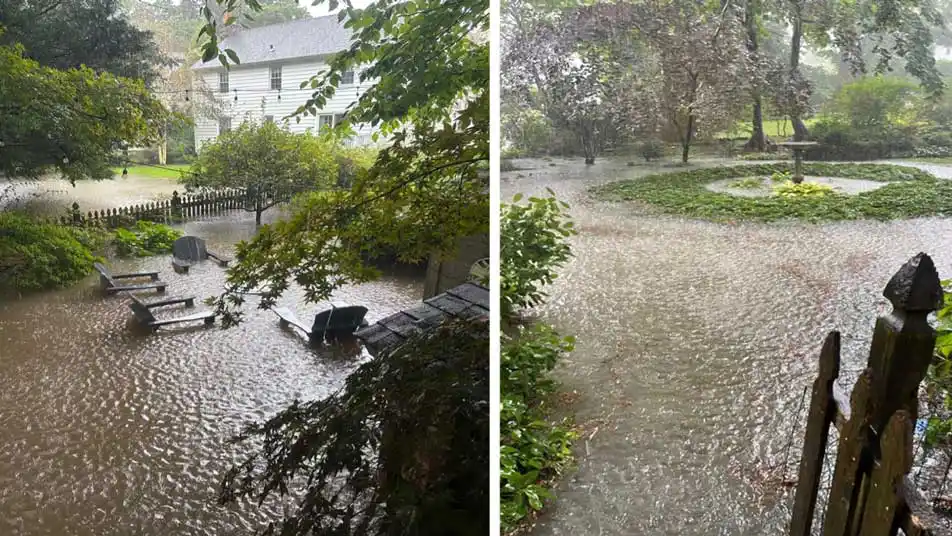
This is what Hunt’s Woods looks like after it rains.
Flooded yards. Damaged homes. Unsafe conditions. Money out of residents’ pockets—again and again – wash, rinse, repeat.
This is not a mystery. It’s not climate change in the abstract. And it’s not just bad luck.
Everyone in Hunt’s Woods knows exactly why this keeps happening.
Because the ultra-wealthy “Bronxville” Field Club—located entirely within Mount Vernon, in the middle of a residential neighborhood—decided long ago that Mount Vernon doesn’t count. And for decades, they’ve acted accordingly.
They built what they wanted.
They expanded when they felt like it.
They treated stormwater as someone else’s problem.
Because it is. When the Club alters land, adds structures, or ignores drainage impacts, the consequences don’t land in Bronxville. They land here. In Hunt’s Woods. In basements. In yards. In streets that turn into rivers.
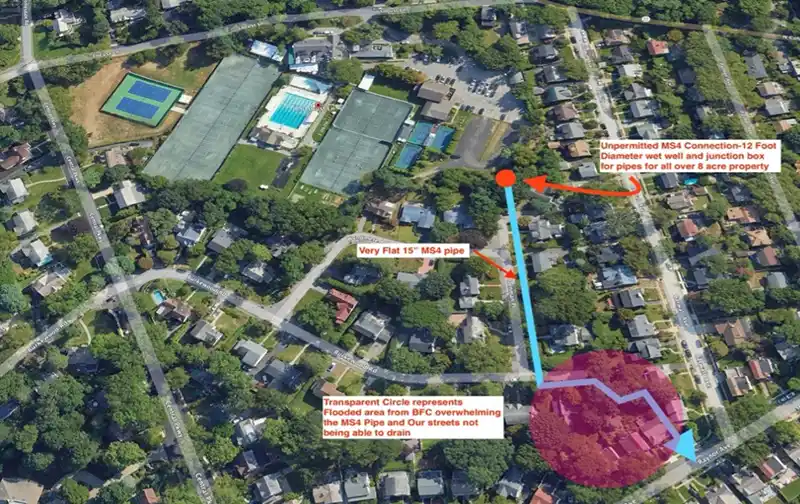
The Club throws late-night parties that spill noise and traffic into the neighborhood. Guests clog residential streets. Access is blocked. Quiet enjoyment disappears. Homes that now directly abut the Club—because of its relentless expansions—pay the price in ways that never show up on the Club’s balance sheet.
But worse than that is this: when there are problems at the “Bronxville” Field Club, they aren’t felt in Bronxville. No – when this happens at the “Bronxville” Field Club…
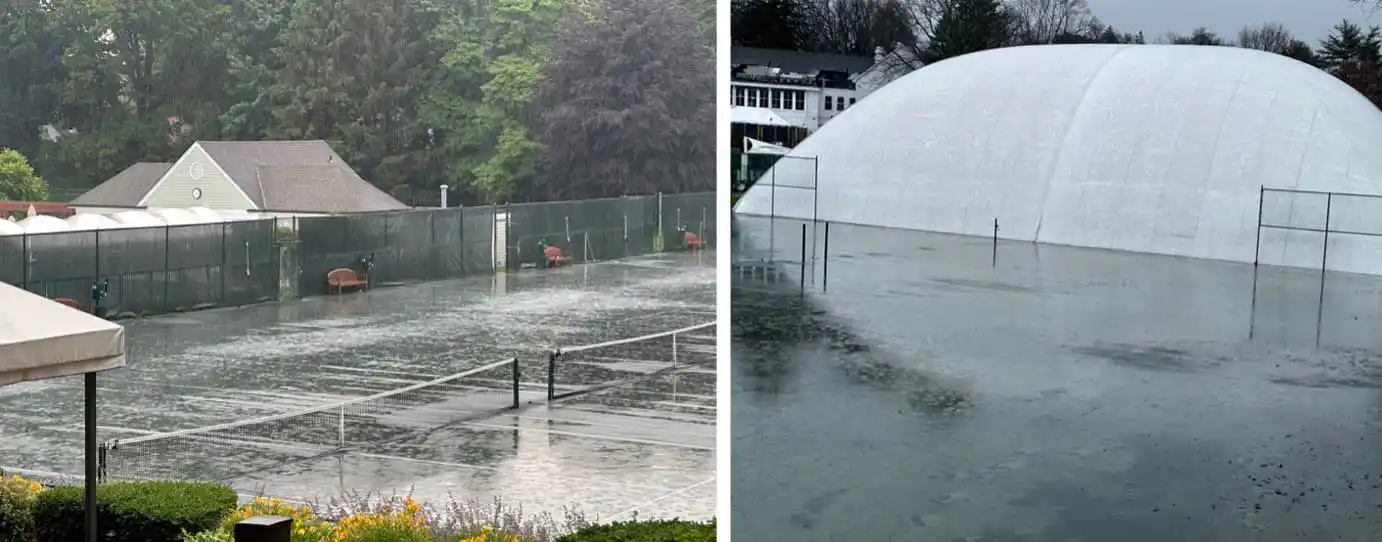
This is the result in Hunt’s Woods.
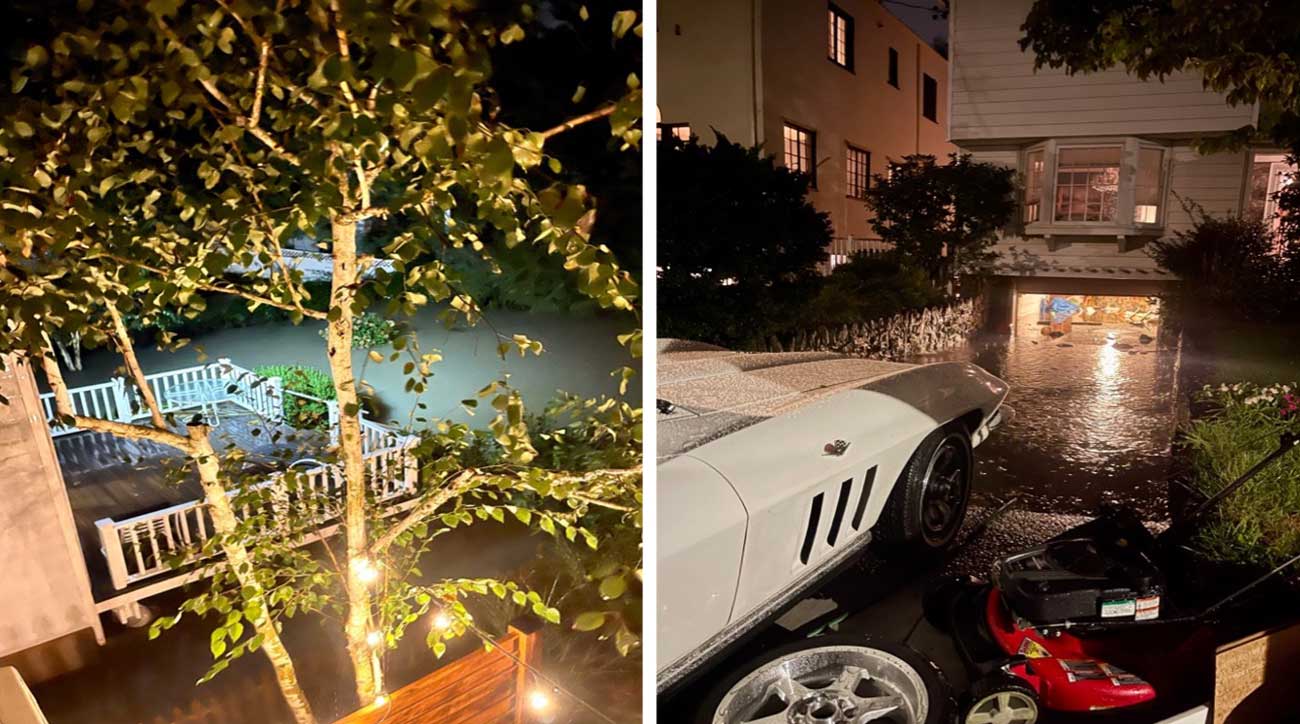
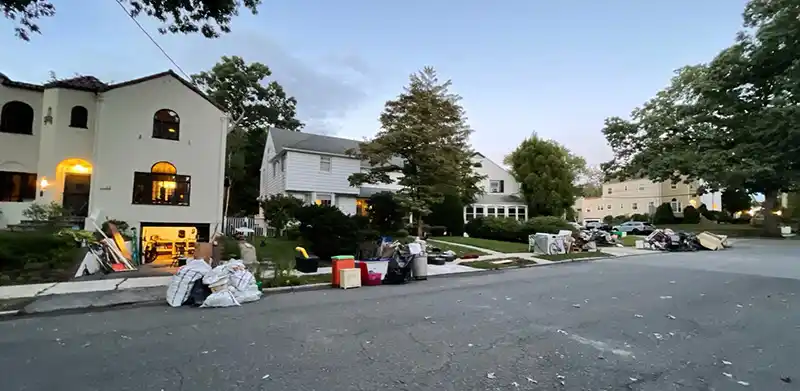
The neighbors have known for years. And they’ve complained for years. But, as invitations to play tennis, campaign donations, and other “perks” were handed out, those complaints fell on deaf ears.
Fast-forward to the Patterson-Howard administration, and things have gotten exponentially worse. In fact, as part of its terrible Comprehensive Plan, this administration attempted to bestow landmark status on the Club. Mount Vernon landmark status for a club that won’t even admit it is in Mount Vernon.
These are the people Mount Vernon residents are supposed to trust to protect our properties, lives, and interests.
We now have even more evidence that any such trust would be grossly misplaced.
How Mount Vernon Traded Its Residents for a Cheap Exit
Mount Vernon is on the verge of quietly surrendering in multiple lawsuits involving the Club’s draining of contaminated stormwater downhill into Mount Vernon neighborhoods. See the settlement document here.
After years of complaints, residents were finally heard by the City’s Planning Board, which denied the Club’s site plan application seeking to build even more structures on the property after reviewing evidence that included resident documentation, engineering analysis, and findings that unapproved stormwater structures on the Club’s property were affecting downstream areas.
So the Bronxville Field Club did what wealthy institutions do when they don’t like accountability.
They sued.
What followed was not one clean case, but a tangle of litigation:
- an Article 78 challenging the Planning Board’s denial,
- related appeals,
- and broader disputes over stormwater controls, land-use enforcement, and regulatory authority.
Instead of defending its own Planning Board—or litigating these issues in public—the City chose cowardice.
It negotiated a global, behind-closed-doors settlement that would:
- wipe out all pending cases at once,
- reverse the City’s enforcement posture,
- and bind future boards and officials to terms negotiated in private.
Residents who live with the flooding were not invited. They were not notified. They were not protected.
Which brings us to the deal itself.
What This Settlement is Really Doing
Strip away the legal varnish and this agreement is simple:
Unconditional surrender.
A three-case capitulation wherein the City walks away from:
- its own Planning Board’s denial,
- its litigation posture,
- any chance at judicial clarity,
- and meaningful public accountability for stormwater / land use enforcement.
The Bronxville Field Club gets:
- a pre-cleared path to approvals,
- binding limits on what the City and Planning Board may ever require,
- insulation from future enforcement or political change,
- and finality across multiple proceedings.
All for the low, low price of $450,000.
Money earmarked for stormwater work the City likely should have funded anyway. Money that does not explain why Mount Vernon is sitting on over $150 million in sewer and climate-resilience funding while claiming it needs Bronxville Field Club’s spare change to protect residents.
$450,000: A Number Without Meaning
Let’s talk more about the number at the heart of the City’s proposed settlement with Bronxville Field Club – $450,000.
That is how cheaply Mount Vernon can be bought. It cannot be remediation money – it doesn’t come close to being enough. It’s not restoration money. It’s not even “make-us-whole” money.
It’s chump change. And the City of Mount Vernon is the chump.
For perspective: Bronxville Field Club paid its “Director of Racquets” $465,022 in 2024—more than the amount Mount Vernon is willing to accept to kneecap itself and absorb downstream risk forever.
So where did $450,000 come from?
Nowhere serious.
There is:
- no cost analysis,
- no engineering estimate tied to downstream damage,
- no accounting of prior flooding losses,
- no valuation of future disruption,
- no assessment of public-safety risk.
The number simply appears in the settlement—fully formed—like a ransom note with better formatting.
And Hunt’s Woods neighbors? You’re the hostages.
This “settlement” isn’t mitigation calculated to solve a problem. It’s a price negotiated to make the problem go away.
Negotiated by people with no concept of real money, led by a mayor who imagines herself worth seven figures in private practice while needing a backdoor 40% raise to break $200,000 in public service.
Bronxville understands money.
Mount Vernon is just sliding Mr. Monopoly’s top hat across the board, hoping nobody notices that their money is pink.
What $450,000 Actually Buys
Read the document closely. This money doesn’t just “fund stormwater improvements.” It buys something far more valuable:
- the City agrees to cap impervious surface calculations;
- the City agrees not to require certain drainage disconnections;
- the City agrees that a wide range of reasonable Planning Board conditions will be treated as a “constructive denial”;
- the City agrees that if approvals don’t go through just so, the developer gets to resurrect litigation—while the public loses its administrative record.
That’s not environmental protection. That’s institutional surrender.
It is also not how a Planning Board is supposed to function. Boards exist to respond to evidence, to adjust conditions when facts change, and to protect downstream communities.
This agreement instead tells the Board: Stay inside the lines we drew, or we sue again.
SEQRA Rendered Moot
SEQRA—the State Environmental Quality Review Act—is New York’s core environmental safeguard. Its purpose is simple: to force government decision-makers to study environmental impacts before locking in outcomes, to consider alternatives, and to involve the public before harm is approved rather than after it occurs.
The settlement repeatedly claims nothing is predetermined.
That claim is a lie.
The mitigation ceiling is fixed.
The scope of review is capped.
The consequences of scrutiny are spelled out.
If approvals issue in lockstep with this agreement—and they almost certainly will—SEQRA becomes an after-the-fact fig leaf for decisions already made.
Courts don’t like that.
Residents shouldn’t tolerate it.
The Risk Locked In—For Mount Vernon Residents
Downstream residents—whose basements already flood, whose properties already suffer, whose quality of life is already degraded—are not parties to this settlement.
They don’t get notice. They don’t get a seat at the table. They don’t get compensation. They just get more risk, locked in by contract. And if the “mitigation” doesn’t work? If flooding continues? If conditions worsen? Too damned bad.
This settlement ensures the City will have already bargained away much of its ability to respond.
Cowardice Dressed Up As Pragmatism
This settlement reads like a government desperate to avoid the discomfort of doing its job.
Instead of defending its Planning Board, enforcing its own stormwater standards, and standing behind documented violations, the City chose the easier path: payoff, retreat, and silence.
And to add insult to injury, it did so for an amount that wouldn’t cover a serious drainage redesign, a multi-year monitoring program, or the cumulative damage already inflicted on surrounding neighborhoods. So, once again, Mount Vernon is sacrificing its residents at the altar of risk aversion, so City Hall can declare a “resolution” while the shit continues to flow downhill.
Literally.
Hunt’s Woods neighbors – ask yourselves:
- How was $450,000 calculated?
- What damage has already occurred that isn’t accounted for?
- What happens when the next storm hits?
- And why were the residents most affected excluded from negotiations entirely?
This document makes one thing abundantly clear: the settlement was never about the Hunt’s Woods community—the people who bear all the risk and receive none of the protection. And it was only possible because those people were kept out of the room.
Side note: None of this was unforeseeable.
Hunt’s Woods resident Gabriel Thompson saw exactly where this was headed and moved to intervene in the case on August 5, 2025. That motion should have been decided promptly—precisely to prevent what followed.
Instead, Bronxville Field Club, aided by City Hall and indulged by Judge Maurice Dean Williams, allowed the motion to languish for nearly six months. Not because it was complex. Not because it required discovery. But because delay served the parties already at the table.
That delay had consequences. It created the breathing room necessary to negotiate—entirely behind closed doors—the trainwreck of a settlement now being presented, while the residents most affected were kept sidelined and silenced.
This outcome wasn’t accidental. It was manufactured.