
Op-Ed by Axel Ebermann
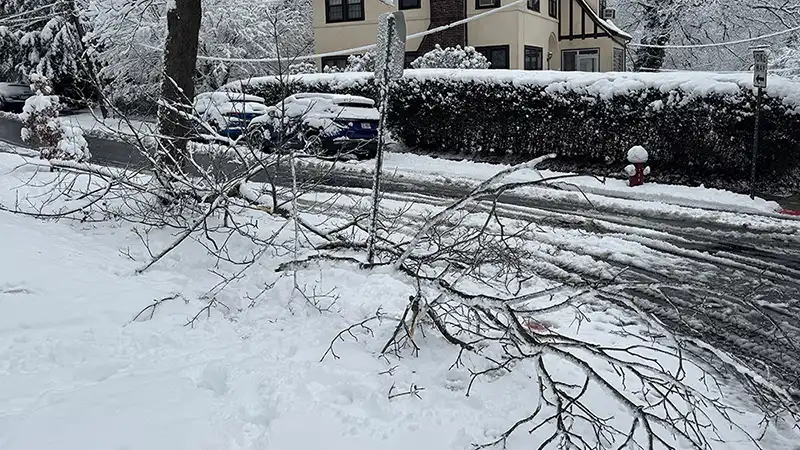
There is a large tree branch lying in front of my house — or rather, two large pieces of a branch that broke off during a winter storm about two weeks ago.
When it fell, it made a loud crash, narrowly missed my car, and completely blocked the street.
Shortly afterward, a snowplow came by. The driver stopped, got out, assessed the situation, and dragged the branch onto the sidewalk — which was now fully obstructed. Cars: 1. Pedestrians: 0. He climbed back into the truck and drove off.
I don’t fault the driver for prioritizing roadway safety. But it might have helped if someone had made a note that a sidewalk had just been rendered unusable. That part, apparently, was nobody’s job.
A Small Problem, Handled the Hard Way
The next day, armed with a small hacksaw, I cut away enough of the smaller branches so pedestrians wouldn’t have to step into traffic. I don’t usually mind cutting up fallen branches from city trees myself, but this one clearly required more manpower — and a chainsaw I do not own.
Maybe the plow driver had worked all night. Maybe forgetting to alert anyone was an honest oversight. Giving the benefit of the doubt, I took photos and reported the issue through the City’s CMVNY Connect app.
Mount Vernon, after all, has a very polished app for reporting problems. You take a photo, it automatically logs your location, and — at least in theory — sends the issue straight to City Hall.
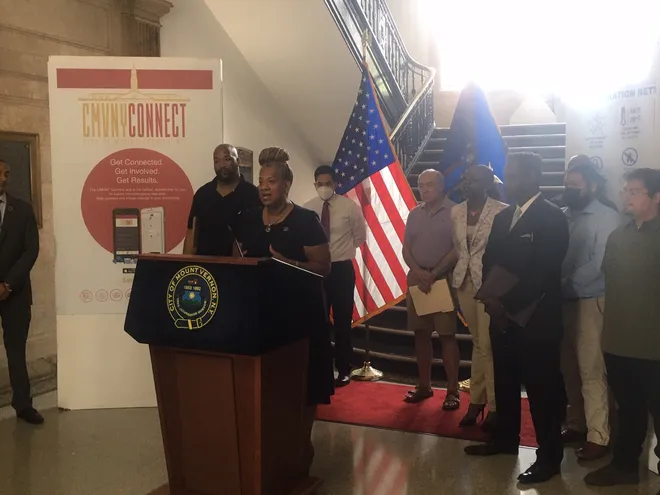
The app was rolled out in 2021 with much fanfare. There were press conferences. There were speeches. LoHud covered it. The vendor’s name, SeeClickFix, practically promises results. If only optimism were a municipal service.
When Eric Crump was sworn in as Director of Constituent Services, his role in rolling out the app was praised as a major accomplishment.
A Digital Graveyard
Unfortunately, Mount Vernon has become something of a graveyard for taxpayer-funded software — launched with enthusiasm, then quietly neglected. CMVNY Connect appears to be no exception.
I’ve had reports sit unresolved for hundreds of days, some long after the issue itself was fixed, lingering like digital fossils. More recently, City Council President Danielle Browne publicly wondered why the now-defunct app hadn’t been shut down yet.
At some point, the City added a disclaimer stating that reports submitted through the app do not constitute official notice.
In other words: the tool designed to report problems cannot actually be relied upon to report problems.
Unsurprisingly, my submission about the fallen branch went nowhere.
The Long Way Around
After three days, I called the Department of Public Works. No answer.
I followed up with an email explaining that the branch was too large to handle without a chainsaw. No response.
Another week passed. I called again and was told the issue would be taken care of.
Another week passed. The branch was still there.
When I called again — after several attempts — I finally reached someone who could hear the frustration in my voice. I was told, somewhat astonishingly, that this was the first time DPW was hearing about the issue. I explained again that this involved a large fallen branch requiring a truck and a chainsaw.
About an hour later, a small DPW truck arrived. The worker, a friendly veteran who told me he had been with the department for 20 years, took one look and said:
“Sorry — this is too big. I can’t take this by myself. You’ll need a few guys and a chainsaw.”
He assured me someone would come by after the weekend on Monday. That never happened.
Why This Matters
So why write about a branch?
Not because it’s the biggest problem in Mount Vernon. It isn’t.
But because it’s a nearly perfect case study in how things don’t work: how information fails to move, how responsibility dissolves, how everyone touches a problem and no one owns it. A city truck can block a sidewalk and nobody feels responsible for fixing the result.
It’s also telling that multiple DPW employees must have driven past that branch over the course of two weeks without stopping, flagging it, or asking a simple question.
And it reflects a broader pattern: glossy announcements and shiny technology standing in for functioning systems. We’re told there’s a lack of resources, even as time and effort are burned in endless loops of miscommunication.
This isn’t complicated. Cities across the country manage to track issues from report to resolution using basic tools and clear responsibility.
The Real Problem Isn’t the Branch
To be clear, this is not an attack on individual DPW workers. Most are hardworking people doing their jobs under difficult conditions.
The failure here is managerial and cultural — and it shows up again and again across City Hall.
What Mount Vernon needs is not more press conferences, slogans, or apps that quietly stop working.
It needs a culture of ownership, accountability, and follow-through.
Not more excuses.
Not more photo ops.
But systems that actually work.