

This week we went through the Comptroller’s second-quarter report, and it does not look good. Halfway through 2026 Mount Vernon had collected $77.65 million and spent $81.97 million, a $4.32 million deficit. Police overtime stood at $2.01 million against a $1 million annual budget, 201 percent of the year’s allowance with half the year still to go. The report calls this “an important early warning regarding the City’s financial trajectory.”
Mount Vernon is one of the few cities in New York that still elects its comptroller. In theory that is an extra safeguard. Voters get an independent official whose job is to protect taxpayer money and ensure financial propriety, someone the Mayor cannot fire for saying no.
This piece asks whether that safeguard actually works. In theory, and in practice.
Comptroller Darren Morton has already answered part of it himself. At his financial town hall last November, a resident asked him for his assessment of the risk that Mount Vernon would be put under a financial control board.
“We are definitely at risk of that,” Morton answered. “I think we’ve been at risk for some time.” He explained that a control board would need current audits to come in, which the city does not have. Then he went further. If the city does not change the trajectory of spending against revenues “in the next year or two,” he said, “it will put us in a place where, yeah, the question is that we would be in a place where we’d have to consider, are we really a city that needs to be declaring bankruptcy?”
That is the elected official responsible for Mount Vernon’s finances, in public, putting the word bankruptcy on a two-year horizon. The diagnosis is not in dispute. Whether the office protects anyone from it is a different question.
In theory: an independent check
Only six New York cities still elect an officer titled comptroller or city auditor: Mount Vernon, New York City, Buffalo, Syracuse, Albany and Utica. Four of the five others are larger. Most of the state’s 62 cities appoint the job, and the trend runs that way. Amsterdam converted its elected controller to a credentialed mayoral appointee in 2022. Dunkirk voters abolished their elected treasurer last November, 2,484 to 1,104.
Mount Vernon’s charter gives its comptroller a real assignment. Section 91 makes him responsible to “superintend the financial affairs of the City.” Section 70 seats him on the Board of Estimate and Contract, which fixes salaries and positions, awards contracts, designates the banks that hold city money, and adopts the annual budget estimate before it reaches the City Council. That board is where spending is authorized, and it is the only body on which the Comptroller casts a vote. Section 85-b requires a roll call on every act, each yea and nay recorded by the City Clerk, so a dissent would be permanent and public.
Then count the seats. Three. The Mayor chairs the board. The City Council President holds the second. A comptroller who votes no loses two to one.
It is worse than the arithmetic suggests, because of where the board sits in the process. Every item arrives requested by a city department, which is to say by the administration the Mayor runs. And most of the significant ones have already cleared the City Council.
Of the 240 matters the board acted on this year, 132 also went to the City Council. The Council adopted every one of them. In 118 of those 132 cases the Council voted first, a median of six days before the item reached the board where the Comptroller sits.
So by the time the Comptroller is asked to vote, the department has requested it, the Mayor’s administration has moved it, and the Council has usually already passed it. His vote is the last stop on a track that has already been cleared. The design hands him a microphone, not a veto.
In practice: 828 to nothing
He has not used the microphone either.
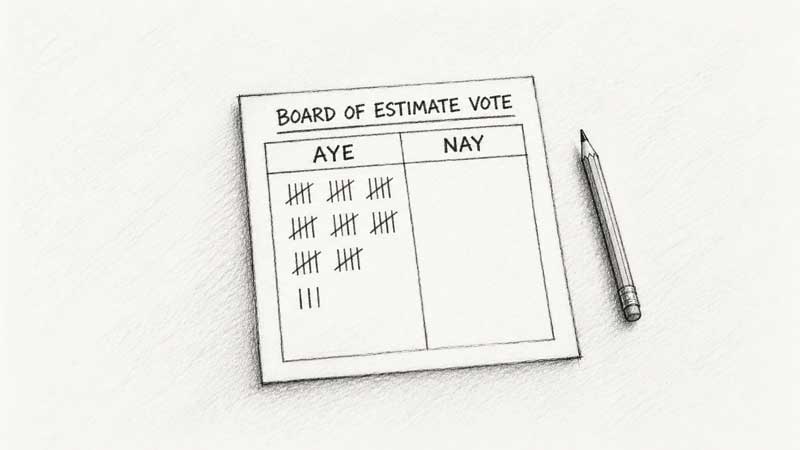
The board met 14 times between January 20 and August 18 and worked through 526 agenda lines. Twelve of those meetings have final minutes. They record 277 roll calls.
Not a contract, not a budget transfer, not a salary resolution, not a tax settlement. Three abstentions in eight months, all Morton’s, and he seconded all three before abstaining. The clerk’s column for nays has been empty since January.
He is not quiet. The minutes put him on the record on 47 numbered items this year, asking about costs, travel, staffing and reimbursements. Six were held. On the other 41 he voted yes 39 times and abstained twice. He cites this himself as evidence of oversight, telling the town hall, “If you go back and look again at any of the board estimates, you’ll often find me asking a question around whether this is reimbursable.”
He is right that the questions are there. So are the votes. At this board they are the same act.
He called it, and voted for it anyway
At that same November town hall, a councilman-elect pressed him on whether the city would hit the revenue targets in the 2026 budget. Morton started to hedge. The councilman-elect cut in: “Is this a yes or no?”
He said he had communicated his concerns to the Mayor. In the same session he warned that “we ought to be concerned about the overtime budgets going into 2026.”
Both calls were right. Red light camera revenue, budgeted at $550,000, came in at zero through June, and police overtime hit 89.1 percent of its annual budget in the first quarter alone. On January 20 the Fire Department asked to move money inside its 2025 budget; Morton objected that “the overtime is very high,” and the item was held. Two weeks later it came back and passed. Between that objection and the June 30 close, the board met 13 more times and approved everything in front of it.
A resident named the problem out loud
Late in the town hall, after Morton described emailing department heads about spending, a resident stopped him. Department heads, he pointed out, do not report to the Comptroller. “You got to make that point to this lady here,” he said, with the Mayor in the room, “the chief executive officer.” Then he added that the City Council President should hear it too, “since that person is a board of estimate.”
Morton did not dispute it. “City council president is always included,” he said. “Yes.”
That is the whole structure in thirty seconds. The Comptroller can email, recommend, warn and publish. Compliance belongs to the two people sitting on either side of him, and they outvote him. His own fourth-quarter report says as much: a temporary spending restriction run by the Mayor’s office “did not yield significant results,” and the austerity framework he proposed next will work only “if there is full compliance and strong fiscal protocol implemented by the City leadership.”
Taxpayers cannot pick up the slack either. No 2026 Board of Estimate and Contract agenda included a public comment period, and across 526 agenda lines the minutes record no member of the public speaking on anything. Residents get exactly one guaranteed chance a year to address this board. Section 81 requires it to hold a public hearing on the annual budget estimate no later than November 19, before it adopts that estimate and sends it to the City Council. State auditors counted how many days past that deadline each hearing actually took place. For the 2021 budget it was 70 days late. Then 66 days for the 2022 budget, 22 for 2023, seven for 2024 and 15 for 2025. The notices telling residents the hearing was coming ran later still, by as much as 90 days. The board adopted each of those budgets late as well.
The state put the consequence plainly: when the board does not keep to the budget process, it “decreases taxpayer transparency.”
What the safeguard has protected
Morton’s own town hall slides trace the city’s fund balance from $19,246,243 at the start of 2016 down through five straight years of losses to negative $28,892,978 by the end of 2020. The next line reads: “A current Fund Balance is undetermined until audits are updated.” Two slides later: “The City does not have a Bond Rating or available Fund Balance.” With no reserve to cover gaps, the city borrows against uncollected taxes “to maintain payroll, pay vendors, and ensure uninterrupted services.”
The state’s ledger, as of December 12, 2025: annual financial reports for 2021 through 2024 unfiled, between 225 and 1,321 days late. Independent audits for those four years not completed. Internal audits done for five of the city’s 19 departments. Recommendation 5 of the state’s follow-up is addressed to the Board of Estimate and Contract by name, telling it to follow the charter’s budget process. Not implemented. Auditors projected the fund balance deficit at $32.4 million by the end of 2024. Mount Vernon has filed no data in time to receive a state fiscal stress score for any year since 2016, nine years running.
We have covered each stage: the case for a state financial monitor, the austerity budget that wasn’t, the fiscal emergency we brought to Assemblyman Pretlow, and the state’s confirmation of years of financial failure. Every one of those stories ran while an independently elected comptroller sat on the board approving the spending, unanimously, twice a month.
The fix that never reached the ballot
The 2024-25 Charter Review Commission studied this. Its draft report carried two ballot questions, both of which would have dissolved the Board of Estimate and Contract. The second would have replaced the elected Comptroller with an appointed Commissioner of Finance holding a CPA license or comparable credential, effective January 1, 2030.
On July 16, 2025, the commission voted not to adopt its own report. Under Section 268, the questions would have gone straight to voters through the City Clerk, with no City Council vote required. Killing the report was what kept them off the ballot.
Morton was re-elected that November with 5,973 votes, unopposed. The nearest write-in got 209. On 1,195 of the 7,398 Mount Vernon ballots cast, the comptroller line was left blank.
Handing the job to a mayoral appointee would not obviously fix this. It would remove the last finance official in Mount Vernon who does not serve at the executive’s pleasure.
But the safeguard taxpayers are told they have is not working as one. It is a third vote on a three-member board, cast last, on items the administration requested and the Council has usually already passed. The Comptroller told a room full of residents the city is at real risk of a control board and could face the question of bankruptcy within two years. He told them he did not believe the revenue projections. He told them to worry about 2026 overtime. He was right three times, and then voted aye 828 times on the spending those warnings were about.
The city’s own audits page still stops at fiscal 2020. Its filing history with the state stops there too. It has had no credit rating since 2019 and borrows short-term to make payroll. That is what the safeguard has protected taxpayers from so far, and nobody on the board has voted against any of it.