

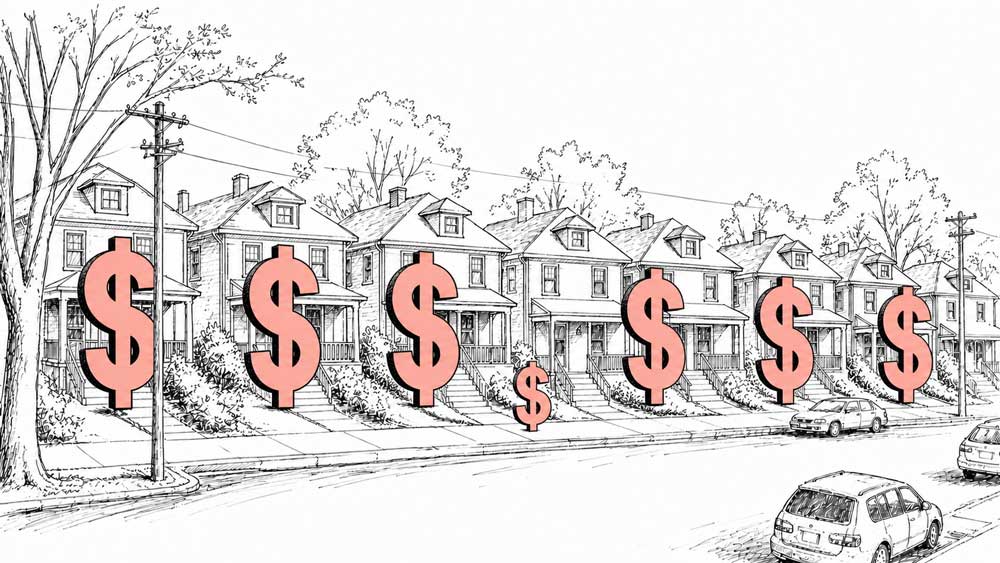
One Mount Vernon homeowner pays $37,000 a year. On a different block, a politically connected family pays less in property tax than houses worth half as much. A few miles north, a city commissioner pays nothing at all.
We were talking with a Mount Vernon homeowner about the 2 percent school tax increase that voters rejected on May 19. He was against it. He was not arguing against schools. He was arguing because of what 2 percent does to his bill.
“If you were paying $37,000 a year in property taxes on a single-family home,” he said, “2 percent would bite you too.”
He is not unusual on his street. Many Mount Vernon homeowners pay $20,000, $25,000, $30,000 a year on homes that would sell for half what comparable homes sell for in Bronxville, a few hundred feet away.
And here is the thing that makes the tax bills extra soul-crushing: the school district the taxes fund is, by the State Comptroller’s own measurement, the most financially distressed in the entire state of New York. Last year, the district closed three schools. The State Education Department has placed the district under a state monitor.
It is fair to ask if tax dollars are being put to good use, especially as the school district is asking for more.
It is also fair to ask whether everybody is paying their fair share of taxes in Mount Vernon.
Both questions are timely. City property taxes are due this week.
The $59M Gorilla in the Room
Let’s start with some property owners that are not paying at all.
City Comptroller Dr. Darren Morton has been straightforward about this much. In December 2024, his office published the city’s delinquent property tax list. More than 600 parcels were behind on their taxes. Some of those owners had not paid in decades. The total amount owed to the city: roughly $59 million.
Mount Vernon has not foreclosed on a single property for tax delinquency in more than ten years. The message: In Mount Vernon you can just stop paying your property taxes with impunity.
In January 2026, Morton’s office filed the first round of foreclosure proceedings in years. Whether that effort goes anywhere remains to be seen. The city’s track record on collecting what it is owed is, to put it mildly, not good.
Some homeowners pay much less than they should
There are also property owners who pay significantly less than their neighbors.
Hint: it helps to have friends in high places.
Mount Vernon’s property tax system makes this kind of disparity hard to see. Most Westchester communities, including Bronxville and Pelham right next door, did what is called a revaluation years ago. They went parcel by parcel, looked at what each home was actually worth on the market, and set the assessment to match. If your house is worth $800,000, it is assessed at $800,000. Anyone can do that math.
Mount Vernon does not do this. The city uses an antiquated system that assesses the average home at about one and a third cents on every dollar of actual market value, then the State translates that back through a published ratio each year. A house worth $800,000 sits on the city’s rolls for something like $10,800. This makes the tax rolls hard to understand by anybody who is not an expert.
We decided to look anyway.
What we found on one block
Second Avenue South is a long residential street in Mount Vernon’s south end. It has 131 one-, two-, and three-family homes on it.
On one seven-home stretch of the block, four homes have received a documented assessment cut since the 2020 roll. The other three have not. The home with the highest Zillow market estimate on that block, at 254 Second Avenue South, ended up with the lowest tax bill among the homes that don’t qualify for senior exemptions.
The Brewingtons live at 254. Their home is worth roughly $906,500, according to Zillow. Their total annual property tax bill is $8,327. Their next-door neighbor at 250 pays $17,912. The home at 234 pays $20,808. The home at 214 pays $23,018. Setting aside 222, which qualifies for a senior tax exemption, the block’s median property tax bill is around $19,600.
The Brewingtons pay about forty percent of what their neighbors pay on a home that, by Zillow’s estimate, is the most valuable on the block.
Why are the Brewingtons paying so much less?
This is the question we kept coming back to. Some possibilities:
The Brewingtons could have filed a successful grievance with the city’s Board of Assessment Review. That mechanism is open to every Mount Vernon homeowner.
The Assessor’s office could have made an administrative change for an inventory correction, a building permit, or a clerical fix. That route does not require the Board.
Or something else happened that we cannot see from the public record.
Whichever it was, it has happened at least twice.
The city’s online tax portal shows one cut. The Brewington assessment dropped from $6,550 to $5,500 on the 2024 roll, a 16 percent reduction. The portal’s history reaches back to the 2021 roll and shows the assessment holding steady before that. Long-time observers of the property told us there had been earlier reductions. Until this month, we could not verify that from any public source.
Now we can. In July, MVCIP obtained the city’s official final assessment rolls for 2020, 2021, and 2023 under FOIL. The final roll is the signed legal record of every assessment in the city, the document the portal is supposed to reflect. The 2020 Final Roll lists 254 Second Avenue South at $7,500. So does the 2021 Final Roll. On the 2023 roll, the number is $6,550.
Somewhere between the 2021 and 2023 rolls, the Brewington assessment was cut 13 percent. The portal’s public history shows no trace of that cut. It displays the lower number as if it had always been there, including for 2021, a year when the signed official roll says otherwise.
Add the two cuts together and the Brewington assessment has fallen 27 percent since 2020, from $7,500 to $5,500. Over roughly the same period, the city raised its tax rate by about 26 percent. For most homes on this street, rising rates meant rising bills, year after year. That did not apply to the Brewingtons.
There is one roll we cannot check, the one that would show exactly when the first cut landed. The city says the 2022 assessment roll file is corrupted. More on that below.
Then there is the street as a whole. In five years of records, 117 of the 131 homes on Second Avenue South, 89 percent, saw no assessment change at all. Checking the FOIL’d official rolls against the portal turns up nine homes with documented cuts, eleven separate reductions among them, including cuts the portal’s public history never shows. Four of the nine sit on the Brewington block.
residential parcels sit
on the Brewington block
assessment cuts, 2020–2025,
sit on the Brewington block
The cuts bunched in time. The 2025 roll, the most recent, produced zero cuts across all 131 homes. The 2024 roll produced four. Two of those four were on the Brewington block. The documented cuts ranged in size from 6 percent to 40 percent. None of the seven owners whose cuts appear in the portal appealed any further. There are no court filings naming any of them in the New York courts electronic filing system, which is where appeals of denied grievances would show up.
Either every one of those cuts went through the Board of Assessment Review cleanly, with the Board granting the reduction the owner asked for. Or some of them came from administrative changes the Assessor made without the Board being involved at all. We cannot tell which from the public record, because Mount Vernon does not publish either kind of record.
Who the Brewingtons are
Curtis L. Brewington Sr. has chaired the Mount Vernon Board of Ethics since at least January 2022. The Board of Ethics is the city body that is supposed to receive complaints about misconduct or conflicts of interest by Mount Vernon’s officers and employees.
Kathie J. Brewington has been President of the Mount Vernon NAACP, Branch #2161, for more than two decades. She is also a Mount Vernon city employee. Public salary data lists her as a “General Employee” earning $13,712 in 2025, a figure consistent with a part-time or stipended role. She is also active in the ministry at Macedonia Baptist Church.
City Comptroller Dr. Darren Morton, the official whose office signs the city’s delinquent property tax lists and files foreclosure petitions, is the pastor at Macedonia Baptist Church. He was re-sworn for a second term as Comptroller in January 2026.
So the chair of the Board of Ethics is married to a city employee, who attends the church whose pastor is the elected official responsible for collecting property taxes. And the family home of that couple has now received two documented assessment cuts that took their tax bill to roughly forty percent of what their neighbors pay.
What about the rest of Mount Vernon?
To check, we ran the same five-year history pull for two other Mount Vernon streets: Magnolia Avenue in Oakwood Heights (50 single-family homes), and Elmsmere Road in Chester Heights (18 single-family homes). Chester Heights is the wealthiest of the three neighborhoods. The median home on Elmsmere sits on the rolls with a city-assigned market value above $1 million.
On Elmsmere Road, every single one of the 18 homes saw its city tax rise by 9.3 percent from 2024 to 2026, exactly the citywide rate increase. Not one Elmsmere parcel had its assessment cut in that window. Their owners pay what their assessments say they should pay.
Oakwood Heights: 17 Magnolia Avenue
There is another way to live in Mount Vernon without paying city property tax.
17 Magnolia Avenue is a 3,700-square-foot single-family home in the Oakwood Heights neighborhood, with a city-assessed market value of $1.6 million. A non-exempt homeowner with that assessment would owe roughly $45,000 a year in combined city, county, and school taxes. The 2026 city tax bill at 17 Magnolia is $225, which is just the flat refuse fee. There is no city property tax. There is no school tax. The household pays only $1,325 in county tax.
The owner of record on the 2025 assessment roll is Allen Memorial Church of God in Christ. The pastor of Allen Memorial is Carlton C. Spruill. Spruill is also Mount Vernon’s Water Commissioner, an appointed position with a city salary of $125,000 a year according to public payroll data. Eight people are registered to vote at the address, including the commissioner, indicating it serves as the household residence.
The arrangement is legal. New York Real Property Tax Law section 462 exempts residences owned by religious organizations and used to house their clergy. The provision turns a $1.6 million home into a property that pays roughly the same total tax as a small vacant lot.
The Spruill family has deep ties in Mount Vernon. Carlton Spruill’s father, Dr. Larry Spruill, served for years as the city’s official historian, an appointment made by the mayor. The position of the water commissioner that his son holds is also a mayoral appointment.
The records the city won’t show
Every property owner can challenge their property taxes. The Mount Vernon Board of Assessment Review has three members appointed by the City Council, who meet on the third Tuesday in June each year to hear grievances.
State law requires the Board to keep minutes of its hearings and file them with the City Clerk’s office. State law requires the Board to deliver to the Assessor a written list of every assessment change it has approved. State law requires each Board member to disclose, in writing, any interest they have in any property whose assessment they are reviewing.
None of those records are published on the city’s website. The Board is not listed on the city’s Agenda Center, where the Planning Board, the Zoning Board, the City Council, and the Board of Ethics all post their agendas and minutes. There is no annual report. The master list of changes the Board has approved each year is nowhere a resident can find it.
To that list, add the 2022 assessment roll itself. When MVCIP requested the official final rolls for 2020 through 2023 under FOIL on July 6, the city produced three of the four. On the 2022 roll, the city’s FOIL office first said the file was corrupted and promised it by July 20. On July 21, the promise moved to August 21, with the Assessor’s Office “awaiting information from a third-party vendor.” The explanation may turn out to be mundane. As of today, the only year of the city’s assessment records that cannot be located is the year that would show precisely when the Brewington assessment was first reduced.
The portal does not fill the gap. As documented above, the portal’s public history displays a 2021 assessment for the Brewington home that contradicts the signed 2021 Final Roll. Whatever the portal is showing residents, it is not a reliable record of what the city actually assessed.
We will FOIL the rest of the relevant records, and share what we find.
Who is paying for all this?
Mount Vernon residents have absorbed more than 40 percent in cumulative property tax increases over the past five years. Since 2012, the City Council has overridden the New York State tax cap every year it could, by a cumulative 34.73 percent. Since 2001, Mount Vernon property taxes have risen 44 percent faster than inflation.
It seems that not everyone is paying these increases equally.
They have not landed on 254 Second Avenue South, whose assessment has been cut twice since 2020 and whose bill is about forty percent of what neighbors in comparable houses pay. They have not landed on 17 Magnolia Avenue, the residence of Water Commissioner Spruill, which pays $1,550 a year on a $1.6 million home because the property belongs to a church.
Coincidentally, both addresses we identified as outliers happen to be home to Mount Vernon city employees.
They have not landed on the more than 600 owners on the December 2024 delinquent list, some of whom have not paid in decades, from whom the city has not foreclosed in more than ten years.
They have landed on the homeowner from the lead of this article paying $37,000 a year. They have landed on the eighteen Elmsmere Road homeowners whose bills rose 9.3 percent in two years. They have landed on hundreds of households across Mount Vernon without a political connection, without a clergy exemption, and without the option of simply not paying.
The story of property tax in Mount Vernon is not really about one family on one block, or one house in Oakwood Heights. It is about a system that has been allowed to drift for decades while making it impossible for outsiders to see how the favorable outcomes are getting handed out. The families named here are examples. There are almost certainly others.
The bills are rising. They are being paid by the people who don’t have an angle.
Send us your tax story. If your bill jumped suddenly, if you fought a re-assessment, if you know of a property in Mount Vernon where the numbers don’t seem to add up, we want to hear from you.
Email us at mvcip.org/contact. Anonymity available on request.
We pulled five years of property tax bill records for every residential parcel on three Mount Vernon streets: Second Avenue South (131 one-, two-, and three-family parcels, south end), Magnolia Avenue (50 parcels, Oakwood Heights), and Elmsmere Road (18 parcels, Chester Heights). 199 homes in total, in three different parts of the city. All data came from the city’s own online portal at infotaxonline.com. For each home we cross-referenced the assessment, the New York State Office of Real Property Tax Services’ published equalization ratio, and the actual 2026 tax bill. We searched the New York State courts electronic filing system for any property tax appeals filed by owners whose assessments dropped.
In July, we filed a FOIL request for the city’s official final assessment rolls for 2020 through 2023, the signed legal record of every assessment in the city, and checked the portal’s history against them. The city produced the 2020, 2021, and 2023 rolls.Axel It has not produced the 2022 roll.
All underlying numbers are on public city, state, or court websites, or in records the city released under FOIL.
Disclaimer: We take care to verify and back up our work, and welcome corrections and additional information.
City of Mount Vernon Final Assessment Rolls for 2020, 2021, and 2023, obtained under FOIL in July 2026, and FOIL correspondence with the City of Mount Vernon Law Department (July 2026). Info-Tax Online (infotaxonline.com) for parcel-level assessment and tax data on Second Avenue South, Magnolia Avenue, and Elmsmere Road. The 2025 Final Assessment Roll for the City of Mount Vernon. NY State Comptroller’s Office, Fiscal Stress Monitoring System report (January 2026). NY State Office of Real Property Tax Services, Residential Assessment Ratios for Westchester County (2026). City of Mount Vernon Comptroller’s Office, December 2024 delinquent property tax list and January 2026 In Rem foreclosure filing (Westchester Sup. Ct. Index No. 2500/2026). New York Focus, “New York’s School Districts Are Shrinking, But Their Financial Problems Aren’t” (May 2025). Mount Vernon City School District public records. Public salary data via GovSalaries. News coverage of Kathie Brewington’s NAACP role via Black Westchester (February 2025) and the Rockland/Westchester Journal News (July 2025). NY Real Property Tax Law §§462, 523, 525, 526 and Mount Vernon City Charter §226-a (Local Law 4 of 1990). Westchester County voter registration records. Zillow market value estimates as of May 2026 (presented as estimates, not appraisals).