

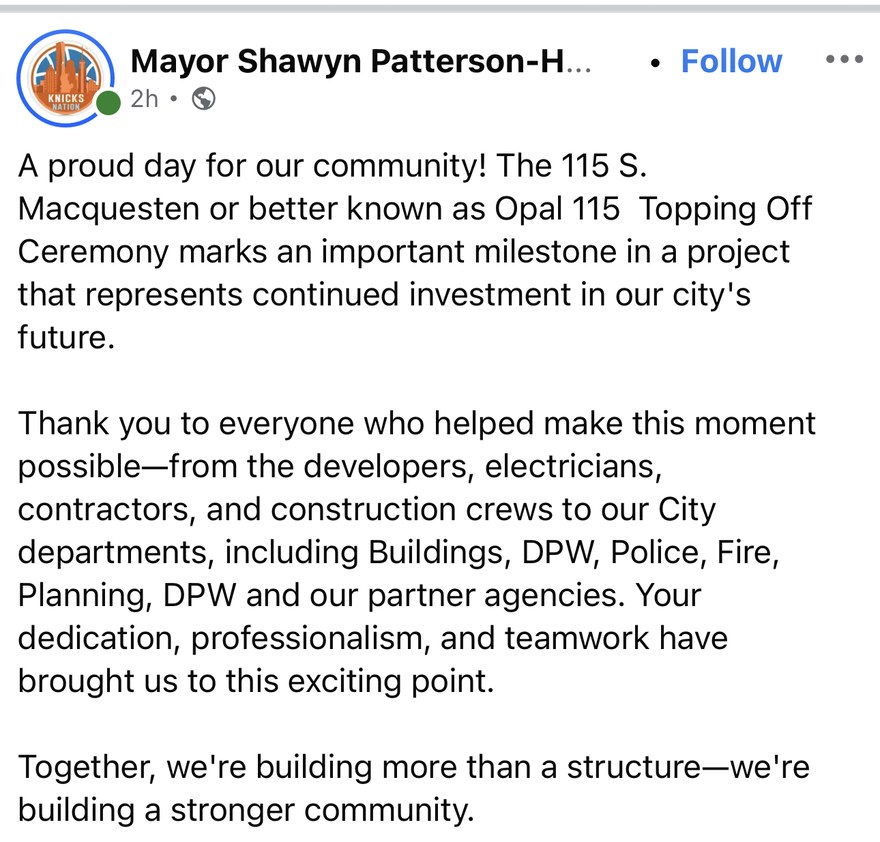
This week Mayor Shawyn Patterson-Howard posted this to her Facebook page, marking the topping-off ceremony at 115 South MacQuesten Parkway, the 315-unit building marketed as Opal 115.

−$5.8M to the city · −$26M to the schools
The mayor celebrates. The community pays. That is the corrected price of this deal over its 30-year tax break, from the study the IDA itself commissioned.
Two months before the hard hats came out, a consultant hired by the city’s own Industrial Development Agency finished a study of this same project. It found that Opal 115 will leave the City of Mount Vernon $5.8 million short and the Mount Vernon school district $26 million short over the life of its tax break.
None of that appears in the post. It does not mention that the mayor chairs the agency that approved the tax break, that she voted for it, or that one of the partners on the project is Kenneth Plummer, her chief fundraiser and the operator who ran her 2023 re-election campaign.
Let’s start with the agency that approved it:
An Industrial Development Agency, or IDA, is a public agency with one purpose: to grow the local economy. It does that mostly by handing developers tax breaks, called PILOTs, short for Payments In Lieu Of Taxes (aka ‘tax breaks’), on the theory that the buildings, jobs, and spending that follow will pay the city back many times over.
In Mount Vernon, that is not what happened. The city’s IDA has become a hotbed of dysfunction and cronyism, approving tax breaks that run as long as 30 years for politically connected developers while the growth it promised never showed up.
The clearest sign is the cash register. Mount Vernon’s sales tax revenue, the simplest measure of how much business a city is actually doing, has fallen, down about 7 percent since 2023, even as the IDA kept giving exemptions away. Over the same years, sales tax in neighboring communities like New Rochelle kept climbing. The gap between the two cities widened from $9.3 million in 2016 to $15.7 million in 2025. If the tax breaks were working, that gap would be shrinking.
So why has the Mount Vernon IDA not worked out? That is the question the agency finally put to an outside firm, the consultants at Urbanomics, asking them to put numbers to its own track record. The study just landed, and the findings are damning.
They were not always going to be. An earlier financial analysis by the IDA had reported that the city’s two newest tax breaks would benefit Mount Vernon. The biggest, Opal 115, looked like a winner, with the city roughly $10.9 million ahead.
The number was wrong. Not a rounding difference. A basic error, and it ran in one direction. The direction happened to favor the deals the IDA had already approved.
The corrected calculation, prepared for the IDA by the consulting firm Urbanomics lands somewhere very different. Over the life of the PILOT, the tax-break agreement, 115 MacQuesten leaves the city $5.8 million short and the school district $26 million short. The report’s own summary states that the deficits persist for both municipal and district services.
What the error was, in plain terms
A PILOT payment is split three ways. The city keeps about 32 cents of every dollar. The school district gets about 60 cents. The county gets about 8. Three pockets, set by the tax rates.
The earlier analysis compared the entire PILOT payment to the city’s costs alone. It credited the city with money that belongs to the schools and the county, then declared a surplus. Run the real city share against the real city costs and the surplus disappears. What looked like a $10.9 million gain becomes a $5.8 million loss.
School board trustee Chris McDonough, who holds the school district’s non-voting seat on the IDA, caught the error and walked the board through it. The corrected report uses the math he laid out.
This is the deal the mayor’s fundraiser owns a piece of
Opal 115 has been a photo opportunity from the start. In December 2024 the mayor and Kenneth Plummer stood together at the groundbreaking, in hard hats branded with the project’s name, holding golden shovels. This week’s topping-off ceremony is the same cast on the same site, one floor further along.

Plummer is not a bystander on this project. He is an equity owner, through his firm Forward Thinkers Development. He was also the mayor’s chief fundraiser, the operator who ran her 2023 re-election campaign, and the person her campaign paid for fundraising services. The mayor chairs the agency that handed the project a 30-year tax break, and she voted on it, even after residents asked her at a public hearing to recuse herself.
The sequence is this. An agency controlled by the mayor paid for an analysis. The first version made her fundraiser’s project look like a gain for taxpayers. The error survived until the math was checked. The corrected version shows the project losing the city and the schools more than $31 million combined.
Call it a mistake if you like. A mistake this size, caught this late, is its own verdict. At best it shows ineptitude, an agency that cannot run the arithmetic on the tax breaks it gives away, and a government that does not check its own work before handing out public money. The timing is the rest of the story. The IDA approved this 30-year tax break in January 2024 and closed it that October, and construction was underway long before anyone noticed the math ran backwards. Correcting a figure on paper in 2026 changes nothing on the ground. Kenneth Plummer, the mayor’s fundraiser and an equity owner on the project, already has his deal. He is laughing all the way to the bank.
The schools were right
For years, the Mount Vernon school district has said the same thing about these tax breaks: they do not cover their costs, and the schools absorb the worst of it. The district sued in 2018 just to win a non-voting seat at the IDA table. It passed a resolution in 2025 stating that only an elected school board should have the authority to give away school tax revenue. It was told, in effect, to wait.
The IDA’s own consultant now agrees with the district. On the projects already built, the report finds the same pattern.
In the consultant’s own words, past PILOTs grossly underestimated municipal and school district costs and produced significant net deficits for both. That is not an outside critic. That is the report the agency paid for.
Why were the numbers this wrong?
An honest mistake lands on both sides. Sometimes it reads too high, sometimes too low. This one did not. Every error in the earlier analysis pushed the same direction, and that direction made the deals the IDA had already approved look profitable. A report that wrong, tilted that consistently, stops looking like chance.
Then there is who benefits. The developers who come before this agency are among the mayor’s most generous campaign donors. Parties tied to the 115 MacQuesten deal alone gave $25,050 to the mayor’s committee, documented in state Board of Elections filings. The mayor chairs the IDA. The IDA hired the consultant. The consultant’s first draft made the donors’ project look like a win for the city. None of that is illegal. All of it is on the record. You are allowed to ask why the only version that flattered these deals came out first.
The cost is real
The buildings go up. People move in. They call 911, set out the trash, enroll their kids. Those services cost money, and the corrected report confirms the tax breaks do not pay for them. The gap gets covered one of two ways. Everyone else’s taxes rise, or services get cut.
Should this agency be approving anything?
Step back from one report and look at the record. In 2014 the State Comptroller found the IDA approved projects with no cost-benefit analysis, could not produce basic project documents, and imposed no penalties when developers missed their job promises. In 2026, the city’s own consultants confirmed what residents suspected all along: The Mount Vernon IDA is undermining the finances of the City and the School district.
An agency that cannot run its own arithmetic, cannot collect what it is owed, and cannot say no to the people who fund the mayor’s campaigns is not in a position to hand out 30-year tax breaks. Before the IDA approves one more PILOT, it owes Mount Vernon an explanation of how it got this one so wrong.