
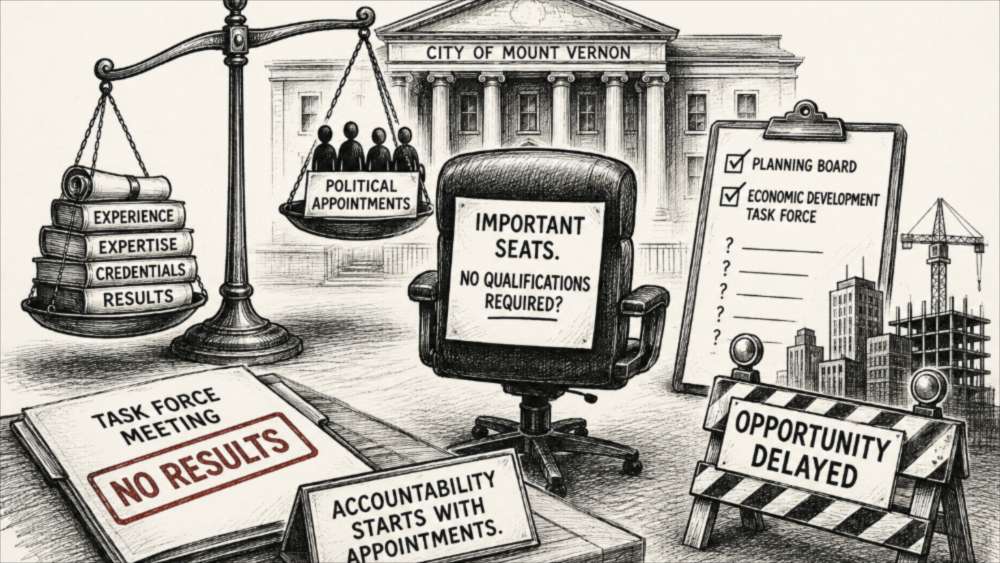
The short version: At its June 2, 2026 meeting, the Mount Vernon Planning Board swore in two new members without a single word about their qualifications — and then voted the same night on a special permit application that the board’s own counsel warned lacked a required legal certification and “potentially could be subject to challenge as beyond the scope of the authority of the board.” The Planning Board has real legal power: its approvals and denials shape the city’s physical future, bind property owners and developers, and can expose the city to litigation. Who sits on it — and what they know — is not a formality. The Economic Development Task Force tells a related story: the official resolution appointing one member, a woman twice convicted of federal fraud for steering city contracts, describes her as having “demonstrated commitment and expertise in economic development.” A council member appointed to a task force seat resigned from the Mount Vernon Public Library board after the State Board of Regents initiated removal proceedings against her for neglect of duty. The task force has no binding authority, but the planning board does — and the city fills both the same way.
Mount Vernon faces real challenges: a constrained tax base, businesses that have left, infrastructure that has aged without adequate investment. Addressing those challenges requires the right people in the right roles. The Planning Board is one of the few city bodies with actual legal authority over development — the power to approve, deny, or impose conditions on projects that shape the city’s physical and economic future. The public record of recent appointments shows a consistent pattern: qualifications are not stated, credentials are not disclosed, and some appointees carry public records that would disqualify them from similar roles elsewhere. Whether this reflects a deliberate choice or an absence of standards, the result is the same: positions that should be filled based on expertise appear to be filled without regard to it..
The Planning Board
At its June 2, 2026 meeting, the Mount Vernon Planning Board swore in two new members: Jada Pickett and Eileen Lambert. Neither their professional backgrounds nor qualifications for the role were mentioned at any point during the meeting. No motion described what expertise they bring. No remarks were offered by the mayor’s office. They were called forward, sworn in, and the meeting moved on.
New York State’s Department of State guidance on planning board composition is explicit: effective boards require knowledge of land use law, architecture, engineering, real estate, environmental planning, and urban design. The state recommends municipalities actively seek members with professional backgrounds in these areas. That standard was not applied at the June 2 meeting — or if it was, the public was given no reason to believe so. What happened later that same evening shows why it matters.
The Vote That Followed
After Pickett and Lambert were sworn in, the board took up a pending special permit application: Rising Ground, a nonprofit organization, was seeking approval to operate a special education preschool program at the Sinai Free Synagogue on North Columbus Avenue, in an R1 single-family residential district. The case had been tabled from the prior month for further review.
The application had a specific and unresolved legal problem. Mount Vernon’s zoning code, Section 267-32A, is explicit: an institution seeking a special permit to operate as a private school “shall be chartered by the Board of Regents of the State of New York.” Rising Ground is not a purely educational corporation — it provides a range of social services — and cannot obtain a Board of Regents charter under New York State law, a fact the applicant’s attorney acknowledged directly. The board’s own counsel stated that approving the application “potentially could be subject to challenge as beyond the scope of the authority of the board since that is an enumerated factor that is listed as a literal requirement in order to approve this application.” Counsel described the applicant’s argument as asking the board to look past the literal text of the code and find an “equivalency” instead.
Commissioner Zamor made the clearest argument on the record: the code says the applicant “shall be chartered by the Board of Regents,” that requirement is explicit, and approving an application that doesn’t meet it is impermissible regardless of whether the program is worthy — the same way driving without a license is illegal regardless of how well you drive. Commissioner Lambert, one of the two members sworn in that same evening, offered a counter-analogy: that it was more like driving with a learner’s permit, which is legal under certain conditions. The comparison does not hold. A learner’s permit is a state-issued credential that legally authorizes driving — the activity at issue in Zamor’s example — so no equivalency needs to be found. Here, the law explicitly requires a state charter to operate a school in an R1 zone. If 4410 licensing were like a learner’s permit, there would be no need for an equivalency analysis; the licensing would authorize the activity, albeit with limitations, like a learner’s permit. It does not. But rather than applying the code as written — as competent professionals would have done — this Planning Board accepted the argument that it could substitute its own equivalency analysis for a requirement the code expressly states “shall” be met. In effect, it treated 4410 licensing as the functional equivalent of a Regents charter, even though the zoning code says no such thing.
More pointedly, it was clear from the trajectory of the discussion that the board intended to approve the application, despite Commissioner Lambert’s assertions that “nothing has been decided.” And that is what happened, with Commissioner Zamor abstaining. No commissioner who voted yes offered a documented legal basis for their position. The motion was made and seconded, and the ayes carried.
It is worth noting that the merits of the Rising Ground program are not in question here — the organization serves children with significant disabilities who have few placement options, and the public record shows broad community support for its mission. The question this post addresses is narrower: how a planning board evaluates a legal question, applies a code requirement, and weighs its counsel’s input is entirely a function of why its members were appointed in the first place. Members appointed for professional expertise bring it to the dais. Members appointed for other reasons bring something else.
In Mount Vernon, this is not an isolated pattern. As MVCIP documented in its reporting on the IDA, Mount Vernon’s Industrial Development Agency operates with a board appointed entirely by the mayor, serving entirely at her pleasure, with no City Council confirmation and no independent check — by design, the weakest governance structure of any comparable IDA in New York State. The Planning Board operates under a similarly concentrated appointment structure: mayoral appointments with no confirmation requirement..
The Economic Development Task Force is a variation: council members hold two of the seats and have a say in the appointments process, but the council itself has shown — in the appointments documented below — that it applies the same standards (or lack thereof) the mayor does.
And in each case, the question of who gets appointed, and why, is answered behind closed doors.
The Economic Development Task Force
The city’s Economic Development Task Force was created in December 2023 under Chapter 22 of the City Code to drive investment and growth. The ordinance was written to ensure professional expertise — to put qualified people in the room: a business leader from the local business community, a manufacturing or industrial business owner, a Chamber of Commerce representative, a nonprofit professional with economic development experience, professionals from educational or workforce development organizations, city residents, and two City Council members. What the city actually did with those seats is the story.
The Constance G. Post Appointment
On February 26, 2025, the City Council voted on three task force appointments in quick succession. The first, designated Item 12 on the evening’s agenda, was the appointment of Constance Gerrie Post to a two-year term running from February 26, 2025 through February 25, 2027.
The resolution passed by the Council that night is a public record. It states that Post “demonstrated commitment and expertise in economic development and community engagement.” The Council voted 3-1 to adopt it, with Council President Danielle Browne, Councilmember Caithlin Gleason, and Councilmember Derrick Thompson voting in favor. Councilmember Edward Poteat was absent. Councilmember Jared Boxhill voted no — the only member present to oppose the appointment.
Post’s public record does not support the resolution’s characterization.
According to a November 2015 press release from the U.S. Attorney’s Office for the Southern District of New York, Post and her associate Wayne Charles were convicted of conspiracy to commit mail fraud and mail fraud for diverting more than $1.2 million in federal HUD funds administered by the Mount Vernon Urban Renewal Agency. She steered a city computer services contract to a company Charles secretly owned — concealing that he had no computer expertise, no employees, and no ability to perform the work — ultimately costing the city and HUD more than twice what direct employment would have cost. She separately helped conceal the $250,000 unpaid balance on a $500,000 HUD loan Charles had received. During the scheme, Charles paid Post $30,000. Post had previously been convicted on the same charges and had that conviction overturned before being convicted again in 2015 — requiring taxpayers to fund two full federal trials. The crimes were committed while Post served as Commissioner of Planning and Community Development and Executive Director of the Urban Renewal Agency: the precise kind of economic development role the task force is meant to perform.
The City Council’s official resolution, passed 3-1 by members who are now themselves serving on or appointing members to the task force, formally and publicly characterized this individual as having expertise in economic development. No member who voted yes has offered a coherent public explanation.
The Council Seats
Also on February 26, 2025 — as Item 13 on the same agenda — the Council appointed Council President Browne to a one-year term and Councilmember Poteat (who had been absent for the Post vote and who was, quite notoriously, often absent for council business) to a two-year term on the task force. Neither appointment came with any stated rationale for why either individual’s background made them suitable for an economic development advisory body.
In June 2026, both Browne and Poteat were replaced by Councilmembers Caithlin Gleason and Cynthia Turnquest-Jones. The referral letter, a public document, cites only the code provision requiring council representation. No professional qualifications for economic development work were stated for either member.
Councilmember Gleason has served on the Mount Vernon City Council for years — years during which the city’s economic position has continued to deteriorate by nearly every measurable indicator. Her public record in a governance role also raises direct questions about fiduciary accountability.
In February 2022, the New York State Board of Regents voted to commence formal removal proceedings against Gleason — then serving as Cathlin Gleason-Boncardo — and four other trustees of the Mount Vernon Public Library. The State Education Department’s petition, a public record, charged the trustees with neglect of duty and failure to carry into effect the library’s educational purposes. The specific charges: failure to complete mandatory library registration despite training and direct assistance from state officials; failure to submit an approvable 2020 annual report, causing the library to forfeit over $100,000 in state and construction funding; and failure to maintain accurate financial records (an accounting firm the board retained in July 2021 identified 1,408 transactions not recorded in the general ledger over a seven-year period and noted “questionable transactions that are not consistent with a library’s normal course of business”). Moreover, the accounting firm’s weekly reports show that correspondence about the library’s missing bank statements was routed specifically to Trustee Gleason for her review and signature. Gleason resigned from the library board before the removal proceedings were formally concluded.
What specific expertise Councilmember Gleason brings to economic development planning is not in the public record. What is in the public record? Her record as a councilmember in a city the comptroller says is two years from bankruptcy, and the fact that she resigned before being removed for neglect of fiduciary duties on the last public board on which she served.
So it is fair for the community to ask — what criteria for service on an economic development task force is this appointment fulfilling?
The March 2025 Amendment and Appointments
On March 19, 2025, Mayor Shawyn Patterson-Howard sent the City Council a letter requesting an amendment to the task force ordinance: the addition of a URA Director seat (a seat she appoints), a City Comptroller seat, and an additional resident seat. The Council passed the amended ordinance on March 26, 2025.
On the same day, the Mayor sent a separate letter naming five new appointments. That letter reveals how seats were being used.
The Mayor’s letter lists Kyle Munoz as a “Resident” appointment. But Munoz had previously been identified as filling the Manufacturing/Industrial seat. The March 2025 amendment had just created an additional Resident seat — a slot that should have gone to a community member with no prior role on the task force. Instead, it was used to recycle Munoz, freeing the Manufacturing/Industrial seat for Dan Casterella of American Christmas.
The Mayor’s other March 2025 appointments do include members with relevant professional backgrounds. Dan Casterella fills the Manufacturing/Industrial seat Munoz vacated. Robert Potack, of Unitex/Med-Apparel Services, fills a second manufacturing seat. Onolder “OJ” Yizar represents the Westchester-Putnam Workforce Development Board in the Educational/Workforce seat. Pamela Tarlow, the city’s Director of the Urban Renewal Agency, fills the newly created URA Director seat (as of August 23, 2026, Tarlow is no longer listed as a member).
No meetings. No minutes. No record.
The amended ordinance is explicit in Section 6: the task force “shall meet at least quarterly,” and those meetings “shall be open to the public.” Section 5 requires an annual report to the City Council.
Until July 14, 2026, the city’s Agenda Center did not even include the Economic Development Taskforce on its list of public bodies. The task force was created in December 2023 but did not meet or produce minutes until more than two and a half years later, and more than a year after the quarterly meeting requirement became law. Their only documented output are meeting minutes from the July 14, 2026 meeting.
What the City’s Website Tells You
The city’s website lists 13 current task force members by name only. No titles. No professional backgrounds. No explanation of why any individual was selected or which statutory seat they fill. No indication that Browne and Poteat have been replaced.
Residents have no way of knowing from the city’s website who these people are, what they do, or why they were chosen. For Constance G. Post, that absence is particularly striking: a search of her name takes seconds to surface her federal conviction record, but the city lists her without any context whatsoever.
How Other Westchester Municipalities Do This
Mount Vernon competes with New Rochelle, Yonkers, and White Plains for investment, businesses, and residents. Those cities structure their appointments differently.
Yonkers requires that a majority of its Workforce Development Board members be business representatives, with mandatory representation from organized labor, apprenticeship programs, and sector-specific fields. Members’ credentials are publicly documented. New Rochelle’s IDA draws from finance, real estate, and law. Westchester County’s economic development bodies are populated by people with documented records in the industries they’re meant to support — and their meetings are public, their minutes are published, and their decisions are on the record.
The New York State Department of State’s guidance on planning boards recommends that appointing authorities treat these seats as professional positions, not political ones. A body that meets in private, produces no public record, and fills its seats without stating qualifications is not a professional body. It is providing the appearance of one.
The Cost of Getting This Wrong
A planning board that lacks land use expertise is more likely to approve projects it shouldn’t, deny projects it should approve, or expose the city to legal challenge — as the Rising Ground vote illustrates. An economic development task force that doesn’t meet publicly, doesn’t publish its work, and formally characterizes a twice-convicted federal fraudster as having economic development expertise is not positioned to drive growth. It is producing the appearance of activity.
Mount Vernon has real assets: a transit hub, proximity to New York City, a large and diverse workforce, and significant underdeveloped real estate. Other cities have turned less into more. The difference, in large part, is that those cities put qualified people in these roles — and hold them publicly accountable for the results.
The questions that deserve an answer: The City Council voted 3-1 to appoint someone twice convicted of federal fraud for steering city contracts — and its official resolution described her as having expertise in economic development. The task force’s ordinance requires quarterly public meetings; two and a half years in, there is no public record of a single one. Two planning board members were sworn in without stated qualifications and voted the same night on a legally contested application over the objection of the board’s own counsel. Either the people making these decisions don’t know what the law requires or what the appointees’ records show — which is a serious failure of due diligence — or they know and have chosen not to consider or disclose it. Neither explanation reflects well on accountability in Mount Vernon’s city government.
This post is based on: the transcript of the Mount Vernon Planning Board meeting of June 2, 2026, including deliberations on Case PB26-4 (Rising Ground special permit); Mount Vernon City Code Chapter 22 (Economic Development Task Force), including the ordinance as amended March 26, 2025; the City Council agenda and resolutions from the February 26, 2025 meeting; the Mayor’s appointment letter of March 19, 2025; the amendment request letter of March 19, 2025; the city’s publicly posted task force membership list; the city’s Agenda Center; the November 2015 press release from the U.S. Attorney’s Office for the Southern District of New York regarding Constance G. Post; and the New York State Education Department/Board of Regents Verified Petition in the Matter of the Trustees of the Mount Vernon Public Library (February 2022), a publicly filed state proceeding available through the New York State Education Department. MVCIP does not make determinations about individuals’ personal qualifications; our analysis is limited to what was — and was not — disclosed in public proceedings and filings.