
The Mount Vernon Civic Integrity Project is publishing the following letter because it raises substantive questions about the finances and governance of the Mount Vernon City School District that deserve public answers.
Whether one ultimately agrees with every conclusion reached by the author is beside the point. The issues raised involve matters of significant public concern, including the District’s reported surplus, fund balance, budget transfers, staffing reductions, class-size projections, tax levy increases, compliance with transparency requirements, and the role of the State Monitor in overseeing the District’s finances.
These are not trivial questions. They go directly to whether taxpayers and voters are being provided complete and accurate information as they are asked to make decisions affecting both their wallets and their schools.
Voters have already rejected a proposed tax increase once. Yet on June 16, the District will return seeking approval of another increase — reduced from 1.99% to 1.5%. But the percentage itself is not the central issue. . .
Public confidence depends on transparency. When residents encounter apparent inconsistencies between public statements, budget documents, financial reports, and meeting presentations, those concerns should be addressed openly and directly. Questions about the use of public funds should not be dismissed simply because they are uncomfortable.
As members of this community, we believe these questions are legitimate and necessary. When residents are being asked to approve higher taxes, they are entitled to understand the District’s true financial condition and the basis for the claims being made to voters. The District leadership, Board of Education, and State Monitor should welcome the opportunity to address these issues publicly and provide the clarity the community deserves.
The public has a right to understand how decisions are being made, how taxpayer dollars are being managed, and why additional taxes are being requested. Accountability begins with answering reasonable questions.
The letter follows in full.
* * *
From: Gabriel Thompson
Subject: Request for State Monitor review and reports before the June 16 budget revote
Date: May 28, 2026 at 12:40:08 EDT
GABRIEL THOMPSON
MOUNT VERNON, NY 10552
BETWEENTHEFRAME@ICLOUD.COM
05/28/2026
DR. KIMBERLY YOUNG WILKINS
STATE MONITOR, MOUNT VERNON CITY SCHOOL DISTRICT VIA EMAIL:
KYOUNGWILKINS@MTVERNONCSD.ORG
Dear Dr. Wilkins,
I am a resident and taxpayer in the Mount Vernon City School District. I’m writing because the matters below fall squarely within the duties you were appointed to carry out — keeping the District’s budget balanced and consistent with its financial plan, and notifying the Board of violations — and because the District has scheduled a budget revote for June 16 after voters rejected the original budget on May 19.
At your first public hearing you said, “Everything we do has to be transparent. Otherwise we work in a vacuum and that won’t work.” I’m holding that standard up to what I’ve found in the District’s own records, and I’m asking you to address it directly.
THE SURPLUS
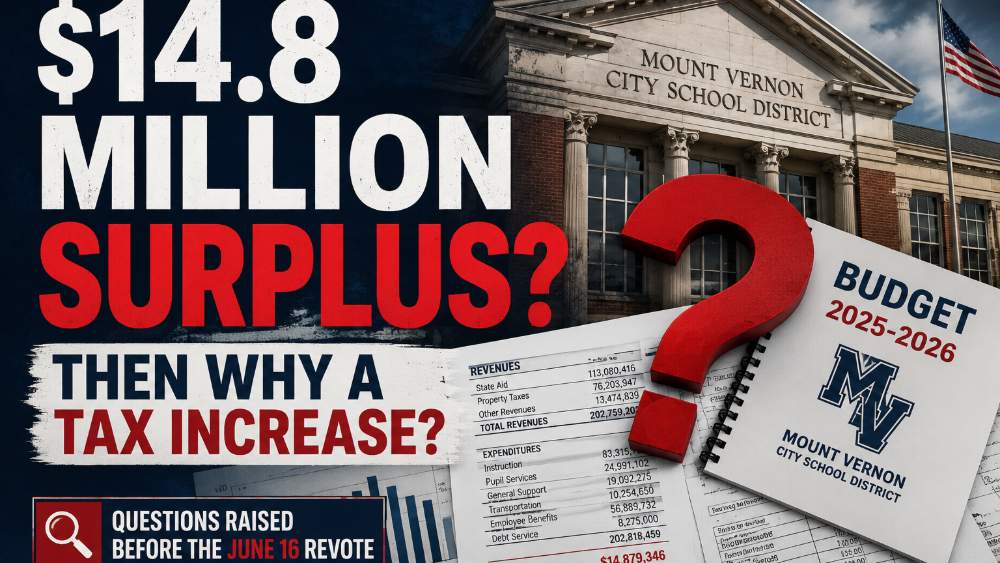
At the March 10 meeting, the District Treasurer, Mr. Lin, stated on video (around the 3:15 mark) that the District is projecting to end the year net positive by $14.8 million. He described this as a net positive position even while the District says it is paying down years of backdated invoices and carrying an $8 million tax anticipation note (TAN). A district that is simultaneously clearing old bills, servicing an $8 million TAN, and still projecting a $14.8 million net positive year-end result is not a district that lacks money.
For context, in this same fiscal year — the first operating with three fewer schools — the District both reduced expenses by a stated $16.9 million (per the April 30, 2025 community message) and raised the tax levy 3.3%, generating $4,486,255 in new revenue (per the adopted budget). New York’s 4% fund balance cap on a budget this size is roughly $10.9 million; a $14.8 million net positive position would put the District well over that limit, where the excess is owed back to taxpayers through a reduced levy — not collected again through a new increase. Later documents(4/6/26) show $23.7m available appropriations(see also attached-last page of agenda item 10.5 from 4/7/26 meeting)
I also found a $1.24 million calculation error in the April treasurer’s report presented to the Board on May 19. How do we have a fiscal monitor in place, yet a member of the public can look at three numbers and see that the totals are off by more than a million dollars — and that error still makes its way into a formal presentation to the Board? Aren’t these documents produced with software that should make arithmetic mistakes like this nearly impossible? If this is what reaches the public, what does it say about what isn’t being checked behind it?
And when the public watches a meeting and hears a $14.8 million net positive declaration(3:15) with no comment from the Board or the Superintendent — and then watches the May 19 meeting(2:07) where the District describes having $20.8 million more cash on hand this year than at the same point last year, again with no comment from the Board — it raises a basic question about your role. Is it not the State Monitor’s job to speak to the public and the Board about why we are seeing these numbers, to tell us plainly that this is good news, and to put it in context?
If those conversations are instead happening behind closed doors, that is exactly what the Open Meetings Law is meant to prevent. The law requires that the public see how the decisions/sausage are/is made — not that a finished result simply be presented to us on a plate-a fait accompli.
From where the community sits, watching these meetings, it does not appear that the business of the District is being conducted in the open the way the law requires. I would ask you, as the State’s representative in this District, to address that directly, not as you say, “in a vacuum.”
A CONTRADICTION THAT NEEDS RESOLVING
At the special board meeting called for May 26, 2026 to present the revised budget with the 1.5% levy increase, Board President Donna Marable stated(4:00-10:00) that there were no real staff layoffs or savings from closing the three schools — characterizing the reductions as essentially a janitor here or a principal there. That directly contradicts the District’s own April 30, 2025 community message, which announced the layoff of 84 certified staff and 40 civil service employees — over 120 positions — before this current school year, and credited those actions with $16.9 million in expense reductions. See here: LINK
Both statements cannot be true. Either the District laid off over 120 people and saved $16.9 million+\-, as it announced in writing, or it did not, as Ms. Marable suggested aloud. As State Monitor, you are positioned to establish which it is, and the public is owed a clear answer before being asked to approve a tax increase.
I would also note, respectfully, that in making these financial representations Ms. Marable indicated she understands accounting and “is an accountant by trade”. Her publicly available background describes a retired educator/administrator from the Mount Vernon and Newark school systems, and I have found no record that she is a licensed CPA. I raise this only because the public is being asked to accept her characterization of the District’s finances over the District’s own written figures, and her stated basis for that authority does not match her public record. I would welcome correction if I am mistaken.
THE APRIL 7 TRANSFERS
On April 7, the Board approved $26,184,467 in transfers across 377 line items at a work session where the second agenda item, before any public comment, was to suspend the rules. Administration stated the work had been underway since August, yet the package was signed and posted the day before the vote, described as “housekeeping,” with no detailed justification for the bulk of it.
What concerns me most is the timing and the pattern. Shifting more than $26 million in the closing months of the fiscal year — out of compensation lines and into reserves, retirement, BOCES, and contractual accounts — is a recognized way to draw down a fund balance on paper before the June 30 close. The effect, whether intended or not, is to make the surplus look smaller than it is, which relieves the
pressure to return excess funds to taxpayers and lets the District avoid exceeding the 4% unappropriated fund balance cap that state law imposes.
When a district sitting on a projected $14.8 million net positive position or more moves this much money this quickly, with this little explanation, days before a tax-increase budget vote by the board, the community is entitled to ask whether these transfers are about genuine operational need or about keeping the true size of the surplus out of public view. That is a question you, as State Monitor, are uniquely positioned to answer.
THE TRUE-UP AND THE CLASS-SIZE CLAIMS
At the same May 26 meeting, Dr. Strickland stated(10:40) that he had never done a “true-up” in the District — which he described as physically counting the actual children in each classroom to determine ratios and how classes might be combined. Minutes later, the District warned that if the budget does not pass, classes would balloon to roughly 35 students each and programs such as athletics would be cut.
I cannot reconcile those two statements. If the District has never counted how many children are actually in each classroom, it has no factual basis for predicting 30-35 students per class(12:20). One cannot credibly forecast a class-size catastrophe while admitting, in the same meeting, to never having measured class sizes, as well as sitting on millions of taxpayer dollars.
This is especially difficult to understand under a fiscal monitor. The District closed three schools after reporting that 14 of its 16 buildings were under 50% capacity — and indicated the State had advised it could close two or three more when gathering community input and support in 2024. Yet publicly reported figures (NYSED/NCES data) put the District’s student-teacher ratio at roughly 12 to 1, well below the statewide average and far from any 35-to-1 scenario. (I recognize student-teacher ratio is not identical to class size, which is precisely why an actual true-up matters — and why its absence is so concerning.)
How, under active State monitoring, was a true-up not among the first steps taken — particularly when enrollment and building capacity were the stated justification for closing schools?
THE MARCH 10 PRESENTATION AND YOUR STATUTORY REPORTING
The March 10 meeting was billed as your presentation on the budget the District was proposing. From the video, I could not find any portion showing you presenting or analyzing the budget — only the Treasurer’s roughly three-minute report stating he expected roughly $14 million in surplus at year end. Isn’t your report on the proposed budget statutory required?
Separately, I have been unable to locate any quarterly reports, or a semiannual/annual report, from you as State Monitor. My understanding is that your role carries statutory reporting obligations to NYSED and the public. Could you please point me to where these reports are published, and provide copies of any you have issued to date? If they have not yet been issued, I would appreciate knowing the schedule on which they will be and why not.
MY QUESTIONS TO YOU, AS STATE MONITOR:
1. Were you given advance notice of the April 7 agenda item to suspend the work session rules, and of the $26,184,467 transfer package, with the detail absent from the public materials?
2. Did you review and approve, object to, or take any position on those transfers before the vote?
3. Is the District’s projected $14.8 million net positive position consistent with the State-approved Academic Improvement and Financial Plan you are charged with monitoring?
4. Does the projected fund balance comply with the 4% statutory cap, and if it exceeds it, what is being done to return the excess to taxpayers?
5. How do you reconcile the Board President’s public statement that there were no real layoffs or savings with the District’s own written announcement of 120+ layoffs and $16.9 million in savings?
6. Did the District ever conduct a true-up of actual classroom enrollment, and if not, on what factual basis did it warn of 35 students per class and the loss of athletics if the budget fails?
7. Given that 14 of 16 buildings were reported under 50% capacity and the District’s student-teacher ratio is roughly 12 to 1, what supports the class-size warnings being made to voters?
8. Did you present a budget analysis at the March 10 meeting, and if so, where can the public view it?
9. Where are your required State Monitor reports published, and may I have copies?
10. In your assessment, is a 1.5% tax levy increase justified for a District projecting a $14.8 million net positive year-end position while paying down old invoices and an $8 million TAN?
11. Have you reported any of these concerns to NYSED or Commissioner Rosa? If not, will you?
I am not asking you to take my characterization on faith. I’m asking you to apply your own independent review to the District’s own numbers, on the record, before residents vote again on June 16.
Given that timeline, I respectfully request a written response, and I would welcome the opportunity to meet during one of your days in the District. I am also providing these concerns to the Office of the State Comptroller.
Thank you for your attention, and for the transparency standard you set for yourself publicly. The community is counting on it.
Finally, I want to give you context for the deep distrust in this community and in myself regarding this district. Over the course of several conversations, a sitting Board member, Christopher McDonough, told me — and has told other residents as well — that significant sums(millions in total were described) were overpaid to administrators, reportedly tied to staff on an 11-month schedule being paid for a 12th month or something of the sort, and that those overpayments were not recovered. He indicated the Board had been aware of the issue for roughly two years and had not acted on it. I am not in a position to independently confirm the amounts or the District’s characterization of them, which is exactly why we have sought the records.
A Freedom of Information Law request on 10/27/2025 was submitted to the District for documentation on this subject, and it has been delayed for months, with almost no responsive material provided. New York’s FOIL sets clear response timelines, and a delay of this length on a matter involving public funds is, by itself, cause for concern. The combination of what multiple residents have been told by a Board member and the District’s prolonged failure to produce records has led many of us to worry that unresolved financial issues may be among the other reasons there is more money in this year’s budget than the public has been told.
I am asking that you and Dr. Strickland ensure the District promptly meets its FOIL obligations, and that the underlying question — whether public funds were overpaid and, if so, whether they were recovered — be answered openly rather than left to rumor and delay. I have documentation of what I was told and am prepared to provide it to you and to the Office of the State Comptroller as appropriate.
Respectfully, (see attached)
Gabriel Thompson
Mount Vernon, NY 10552
betweentheframe@icloud.com
The work of the eyes is done. Go now and do the heart-work on the images imprisoned within you-Rilke