

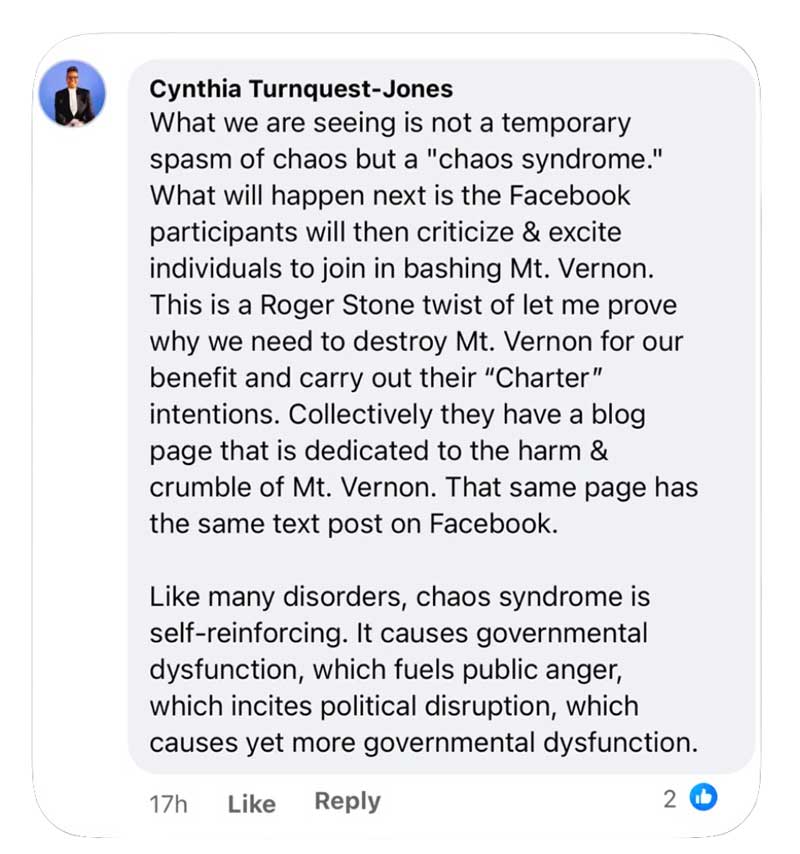
A sitting elected official recently responded to criticism of Mount Vernon government by describing it as a “chaos syndrome”: a supposed cycle in which residents publicly criticize dysfunction, which then fuels anger, which then creates more dysfunction.
The official went further, suggesting that people involved in civic reform efforts, online discussion, and charter reform advocacy are effectively trying to “destroy” Mount Vernon for political purposes.
That framing deserves serious attention because it reflects a deeply troubling view of public participation and democratic accountability.
Let’s be clear about something:
Criticizing government is not the same thing as attacking a city.
In fact, in a functioning democracy, criticism of government is one of the highest forms of civic engagement. Residents attend meetings, file FOIL requests, analyze budgets, challenge planning decisions, circulate petitions, and speak publicly because they care about what happens to their community, not because they want it to fail.
People do not spend countless unpaid hours immersed in local government because they want Mount Vernon to “crumble.” They do it because they believe Mount Vernon deserves better.
That distinction matters.
Unfortunately, there has been an increasingly common tendency among some local officials and political allies to conflate criticism of leadership with hatred of the city itself. If someone questions a budget, they are “negative.” If someone criticizes a development proposal, they are “anti-progress.” If someone raises ethics concerns, they are accused of causing division. If someone supports structural reform, they are portrayed as trying to destroy Mount Vernon.
That is not democratic leadership. That is narrative control.
And the irony here is difficult to ignore.
The same officials who insist public criticism creates “chaos” often preside over the very dysfunction residents are reacting to in the first place: political infighting, opaque decision-making, procedural irregularities, performative public engagement, conflicts of interest, financial instability, and institutional dysfunction that residents can plainly observe with their own eyes.
Residents are not inventing these issues. They are responding to them.
The suggestion that public discussion itself is the real problem flips accountability upside down. Under that logic, the issue is not governmental dysfunction. It is the people noticing it.
That is a dangerous mindset for any elected official to hold.
The comment also referenced a supposed “Roger Stone” strategy and implied that criticism of city government is part of some coordinated effort to destabilize Mount Vernon in order to advance charter reform.
But notably absent from the accusation was anything concrete:
- What false information was supposedly spread?
- What specific conduct “destroyed” the city?
- What exactly constitutes “incitement” here?
- Since when is advocating for governmental reform illegitimate in a democracy?
There is a profound difference between disagreement and sabotage.
Residents advocating for charter reform, greater transparency, different planning policies, stronger financial oversight, or structural changes to city government are participating in a process explicitly authorized under New York law. People may disagree with those ideas, strongly, but disagreement does not transform civic participation into some sinister conspiracy.
Nor does criticism become illegitimate simply because it is effective.
What this rhetoric really reveals is something else entirely: discomfort with losing control of the public narrative.
For years, many residents felt shut out of major decisions affecting the future of the city. Increasingly, people are speaking up, asking questions, reviewing documents, comparing statements to public records, and organizing around issues that matter to them. That is not “chaos syndrome.” That is civic engagement.
And frankly, elected officials should welcome it.
A healthy city is not one where residents remain silent out of fear of being labeled “negative” or accused of harming the community. A healthy city is one where people are informed, engaged, skeptical when necessary, and unafraid to challenge power.
Mount Vernon does not become weaker because residents ask hard questions.
It becomes stronger.