
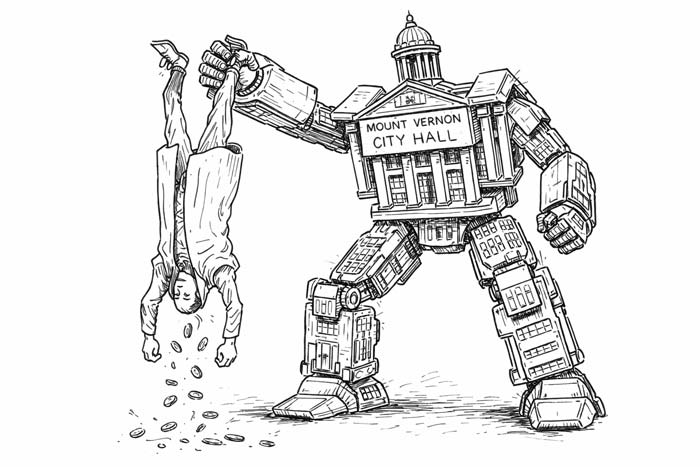
On March 19, 2026, Mayor Shawyn Patterson-Howard sent a letter to the Mount Vernon City Council asking them to initiate a home rule request to Albany. The ask: authorize Mount Vernon to impose a nonresident commuter earnings tax of 0.25% to 0.50% on wages earned within the city.
The letter frames this as a modest, well-structured proposal modeled on Yonkers. It lists fiscal pressures, mentions austerity measures already taken, and cites the Governor’s encouragement for cities to find new revenue. It even includes a brief section acknowledging potential downsides.
What the letter does not include is any discussion of whether this proposal is legal.
That’s a significant omission. Because there are real constitutional problems with what’s being proposed, and the mayor’s office either knows about them and chose not to mention them, or doesn’t know about them and didn’t bother to check. Neither option inspires confidence.
The Yonkers Comparison Is Wrong
The mayor’s letter leans heavily on Yonkers as a model. The implication is straightforward: Yonkers does it, it works, we should do it too.
There’s a problem. Yonkers does not have a commuter-only tax. Yonkers has a city income tax that applies to both residents and nonresidents. Residents pay an income tax surcharge of 16.75% of their New York State tax liability. Nonresidents pay a 0.50% earnings tax on wages earned in the city. Both groups pay. That’s the entire point.
What the mayor is proposing is something different: a tax that falls exclusively on nonresidents while residents pay nothing comparable. That distinction is not a technicality. It’s the difference between a tax structure that has survived legal challenge and one the U.S. Supreme Court has already struck down.
The Constitutional Problem the Mayor Didn’t Mention
In Austin v. New Hampshire (1975), the U.S. Supreme Court struck down New Hampshire’s Commuters Income Tax because it fell exclusively on the income of nonresidents and was not offset by comparable taxes on residents. The Court held that this violated the Privileges and Immunities Clause of Article IV of the Constitution, which prohibits states from discriminating against citizens of other states in their ability to earn a livelihood.
The parallel to what Mount Vernon is proposing is direct. A commuter tax that applies only to nonresidents, with no comparable income tax on residents, is the same structure the Court found unconstitutional in Austin. If a commuter from Connecticut or New Jersey working in Mount Vernon files a challenge, Austin is a direct bar. Full stop.
There’s a wrinkle worth noting. The Privileges and Immunities Clause protects citizens of other states, not necessarily residents of other municipalities within New York. So if the tax only hit commuters from, say, New Rochelle or White Plains, Austin‘s precise hook might not apply. But that doesn’t solve the problem. The Equal Protection Clause of the Fourteenth Amendment, and the New York State Constitution, would still require a rational basis for taxing commuters while exempting residents earning the same wages in the same city. Courts have generally been skeptical of pure residence-based distinctions in local income taxes, and for good reason.
None of this analysis appears in the mayor’s letter. Not a word about Austin. Not a word about the Privileges and Immunities Clause. Not a word about Equal Protection. The letter asks the City Council to formally request state legislation authorizing a tax structure with known constitutional defects, without disclosing those defects.
The State Authorization Problem
Before any of the constitutional analysis matters, there’s a threshold question: New York municipalities don’t have inherent taxing power. They can only impose taxes the state legislature explicitly authorizes. Yonkers has a city income tax because Albany gave Yonkers that authority. New York City has its structure because of its special charter and state law. Mount Vernon would need the state legislature to act first.
Albany has historically been reluctant to expand local income tax authority outside of New York City. The word from Albany, relayed by people who would know, is that this proposal is dead on arrival. The reasons are practical: authorizing one city to impose a commuter-only tax would set a precedent that any municipality in New York could follow. Every city, town, and village could start taxing workers who commute in from somewhere else. In a state where people routinely live and work in different municipalities, that’s an inflationary feeding frenzy nobody in state government wants to trigger, least of all Governor Hochul, who is running for re-election and has no interest in adding new taxes to an already crushing cost of living in the New York metro area.
There’s also the matter of representation. State legislators from New Rochelle, Yonkers, Bronxville, Pelham, and every other community whose residents commute into Mount Vernon would be voting on whether to let Mount Vernon tax their constituents. Good luck with that.
The Practical Problems
Set aside the legal questions for a moment. Even if this proposal were constitutional and Albany were willing, the policy itself is counterproductive.
Mount Vernon badly needs business development. The city needs employers to locate here, expand here, and hire here. A commuter tax tells every business considering Mount Vernon that their employees will face an additional payroll burden for the privilege of showing up to work. It tells every worker considering a job in Mount Vernon that they’d be better off taking the same job in New Rochelle or Yonkers or the Bronx, where no such tax exists. In a competitive labor market, that’s a self-inflicted wound.
Then there are the city’s own employees. A large percentage of Mount Vernon’s police officers, firefighters, and teachers live outside the city. A commuter tax on those workers would immediately become a labor relations issue. Public employee unions would demand salary adjustments to offset the tax, and they’d have leverage to get them. The net revenue gain to the city could be partially or entirely consumed by higher labor costs. You’d be taxing your own workforce to pay your own workforce more. It’s a fiscal hamster wheel.
And then there’s reciprocity. Thousands of Mount Vernon residents commute to jobs in surrounding communities. What prevents those communities from doing the same thing? If Mount Vernon can tax New Rochelle residents who work here, why can’t New Rochelle tax Mount Vernon residents who work there? The mayor’s letter doesn’t address this, probably because the answer is obvious and unhelpful.
Blaming Outsiders for an Inside Job
The underlying logic of the proposal raises additional questions. The framing goes something like this: Mount Vernon is being exploited by outsiders. Commuters come here, use our roads, benefit from our police and fire services, and take their money home to spend in their own communities. They’re profiting from Mount Vernon without paying their fair share.
This is a familiar political move: find an external group , blame them for fiscal problems they didn’t cause, and propose taking their money to fill a hole created by your own mismanagement. It’s the politics of scapegoating, and it has a long, ugly history at every level of American government.
Mount Vernon’s fiscal crisis was not caused by a New Rochelle resident who teaches at a Mount Vernon school. It was not caused by a Yonkers resident who works at a Mount Vernon business. It was caused by years of mismanagement, uncontrolled spending, nepotism, deferred maintenance, missing audits, and a political culture that treats the city budget as a patronage fund. We’ve documented this extensively.
The city has already raised property taxes. It has introduced garbage and sewer fees that were previously covered by property taxes. It has raised building department fees. Residents are paying more and getting less. Instead of addressing the spending side of the equation with real reform, city officials keep finding new pockets to pick. The commuter tax proposal is the latest entry in that pattern: don’t fix the dysfunction, just find someone new to pay for it.
What the Council Should Do
Before the City Council takes any action on this request, it should demand a legal opinion from the Corporation Counsel on the constitutionality of a commuter-only tax under Austin v. New Hampshire and the Equal Protection Clause. That opinion should be made public. If the mayor’s office already has a legal opinion, the Council should ask why it wasn’t included in the letter.
The Council should also ask a simpler question: has anyone in city government spoken with Assemblyman Pretlow or Senator Stewart-Cousins about whether this legislation has any realistic chance of passing in Albany?
Because spending political capital on a proposal that is both legally dubious and legislatively impossible is not governing. It’s theater.
Related Reading:
We Met with Assemblyman Pretlow About Mount Vernon’s Fiscal Emergency
The Austerity Budget That Wasn’t