

On March 23, at this week’s City Council work session, something came out that should stop everyone cold.
A resolution went out with Councilmembers’ signatures attached—including at least one who says he had no idea it was happening.
Not discussed in public. Not voted on. Just done.
Council Member Andre Wallace said it plainly: “Our signatures appear on it… I didn’t know about the resolutions that were being done.”
He wasn’t part of it. He didn’t approve it. He had to call around after the fact to figure out what had already been issued with his name on it.
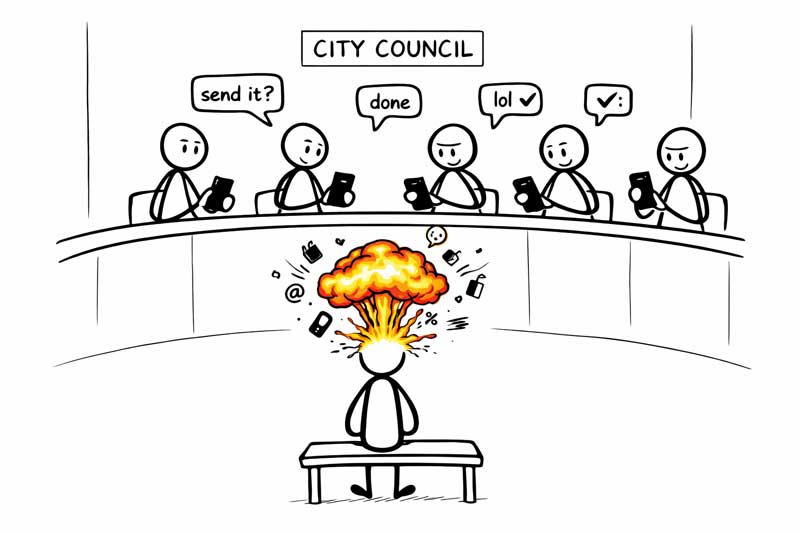
And the explanation wasn’t a meeting, or a conversation, or anything resembling a public process. It was a text thread. Wallace didn’t respond—and the resolution went out anyway.
That’s the part that matters.
A City Council resolution is not a casual document. It is an official act of government — meant to be introduced, discussed, and adopted in public, with each member’s position reflected transparently on the record. Names don’t appear on resolutions by accident. They represent the consent and participation of elected officials acting in their official capacity.
When a name is added without that person’s knowledge or approval, it is not a procedural shortcut. It is a false representation of agreement in a process that is supposed to be public, deliberate, and accountable.
And it undermines the integrity of the record itself.
On Wednesday, March 25, at the City Council’s legislative session, this issue was raised again when council members were asked to vote on a series of similar resolutions. Wallace stated that he wasn’t going to vote for any of the resolutions because his name had been used without his knowledge or consent. Council President Derrick Thompson did not dispute that the resolution had gone out or the failure of consent. Instead, he argued something remarkable – that this is standard practice—that when an outside organization makes a request (“an ask”), the Council fulfills it, sometimes using pre-submitted signatures, and that historically even blank proclamations were signed and later completed. He further suggested that notice through text messages or general awareness of events was sufficient. Notably, Councilmembers Boxhill and Turnquest-Jones confirmed they were not aware of—and had not approved—the resolution before it was issued.
Thompson’s explanation does not fix the problem. An external “ask” is not authorization. Silence is not consent. And placing a Councilmember’s name on an official act without their knowledge is not a harmless practice—it is a misrepresentation to the public of who actually participated in and supported that action.
Nor are these decisions supposed to be made by text message. City business—especially official acts like resolutions, that become part of Mount Vernon’s official record—is required to be conducted openly, with deliberation and transparency. That is not ‘optional’ or ‘best practice’ – it is the law. A text thread is not a public process.
What’s particularly troubling about this incident is that this wasn’t about anything urgent. It wasn’t legislation or oversight. One of the resolutions at issue praised the Mayor for “transparency,” “accountability,” and “effective leadership.” A lie that didn’t need to happen, didn’t have the required approval, and was forced into “legitimacy” by one man who decided he had the right to act for others.
Just as icing on the cake, all of those resolutions were for honoring people at events that had already taken place the previous week. Retroactive approval, so to speak.
You don’t get to talk about accountability while operating like this. Moreover, if this is how routine matters are handled, it raises serious questions about how Thompson’s council will handle more serious decisions.
Every part of how this happened was wrong, deeply unethical, and raises serious legal concerns. And “this is the way we’ve always done it” is not an explanation – it’s an indictment of a system that has been allowed to operate this way for far too long. It is why people don’t trust the process.
As Council President, Derrick Thompson is now responsible for that process. If he believes this is an acceptable way for a legislative body to conduct business, if he does not see a problem with what happened here, if the best explanation he can offer is “everybody else did it, too,” then he should reexamine his capacity to lead the Council.
Maybe he should reexamine his ability to serve at all.