

By Axel Ebermann
This is not about politics, personalities, or one anomalous budget year.
Mount Vernon is in a structural fiscal emergency, and pretending otherwise is no longer just dishonest – it’s dangerous.
For more than a decade, the City has stumbled from crisis to crisis, relying on tax hikes, expensive short-term borrowing, and accounting improvisation to paper over deeper failures. The result is a government that costs more every year, delivers less, and has lost the basic ability to manage its own finances.
At this point, the question is no longer whether Mount Vernon has a problem.
The question is: Why the State is still allowing it to continue?
Financial Distress – In Real Life, In Real Time
Let’s start with the basics.
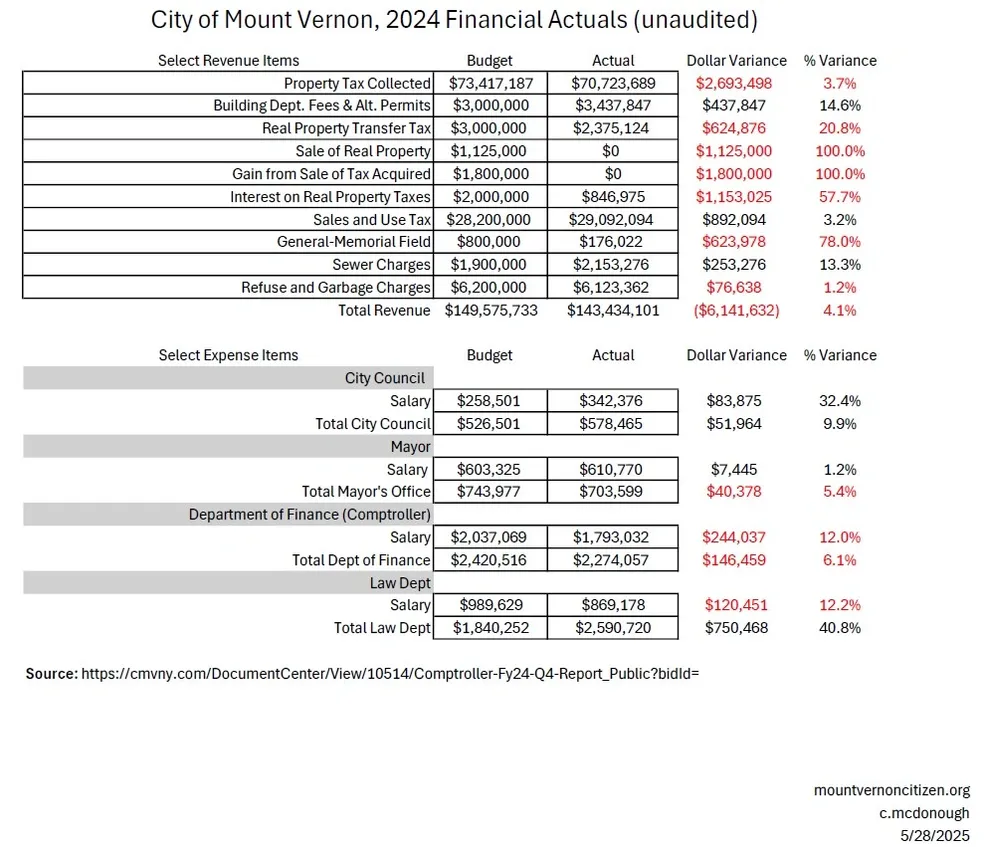
Large budget-to-actual variances are a classic warning sign of weak financial controls. When projections routinely miss reality by millions of dollars, budgeting stops being planning and becomes theater.
Mount Vernon’s 2024 Budget vs. Actuals reveal that revenues and expenses missed their targets across multiple major categories — not at the margins, but at levels significant enough to reshape the City’s fiscal picture.
The Collapse of the Fund Balance
Mount Vernon’s fund balance — the municipal equivalent of a rainy-day savings account — fell from a healthy surplus in the early 2010s to a deeply negative position by 2019–2020.
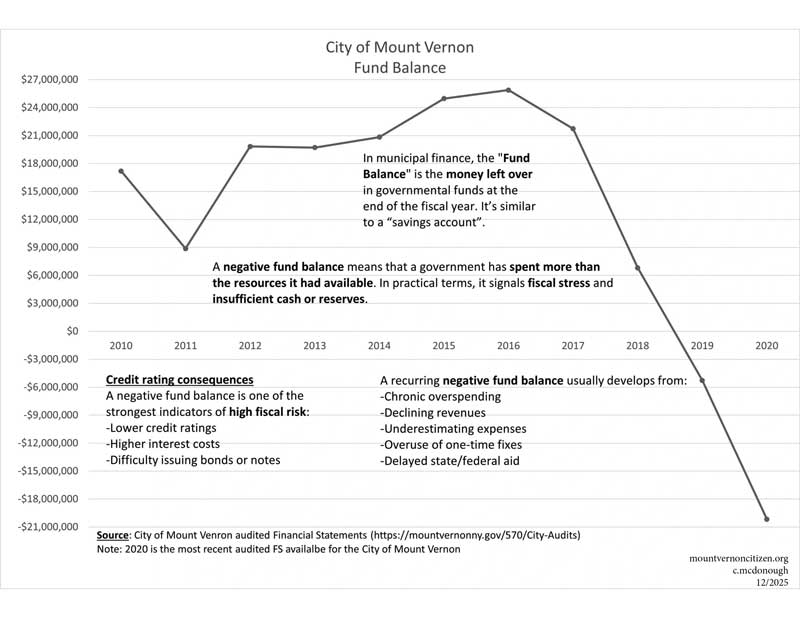
A negative fund balance means the City spent money it did not have — not as the product of a single bad year, a recession, or the pandemic — but as the predictable result of years of unrealistic budgets and weak controls in which the budgeting process ceased to function as a real planning tool.
Long-Term Liabilities vs. Net Position
As cash reserves disappeared, long-term obligations moved in the opposite direction.
Mount Vernon’s bonded debt, accrued benefits, and other long-term liabilities rose sharply over the same period that its net position flipped from positive to deeply negative — a clear signal of structural insolvency, not a temporary cash crunch.
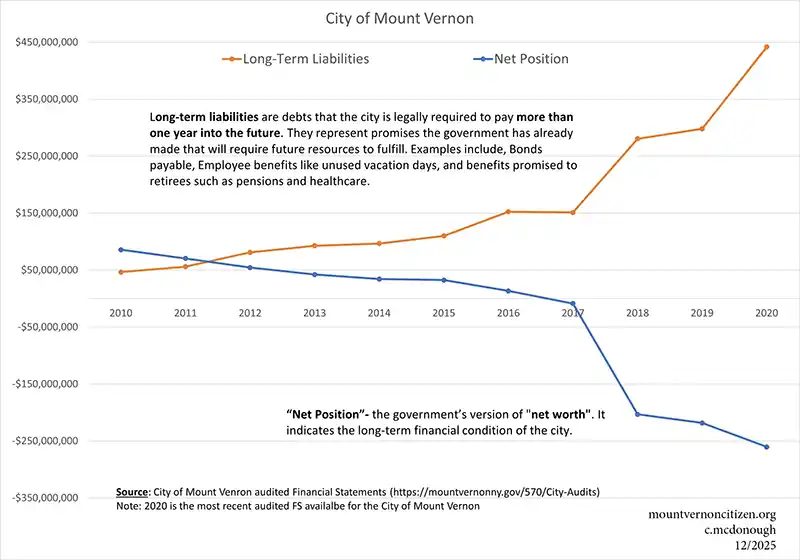
In plain terms: Mount Vernon owes far more than it owns, with no credible plan to close the gap.
Taxes Keep Rising, the System Keeps Failing, and the Numbers Don’t Add Up
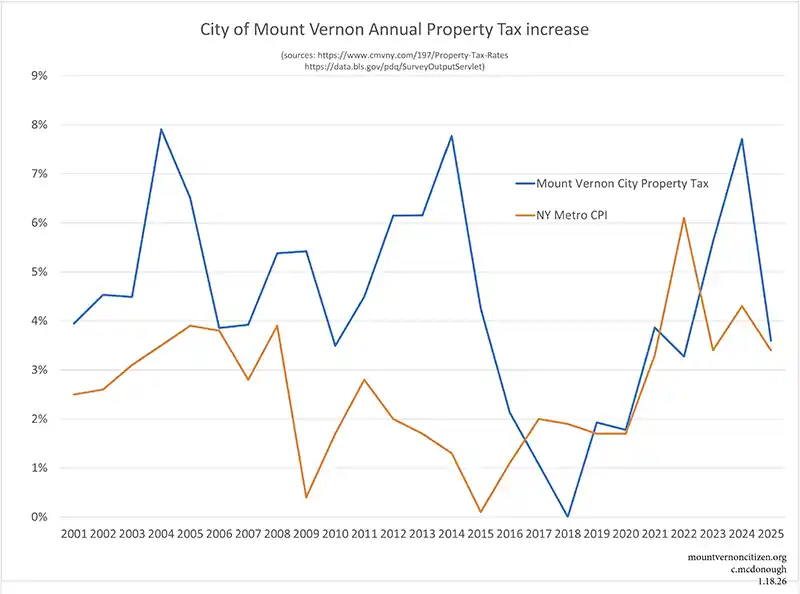
Years of outsized property tax increases have not stabilized Mount Vernon’s finances. They have concealed deeper failures while shifting more of the burden onto residents.
Since 2012, the City has routinely overridden the state tax cap, exceeding it by a cumulative 34.73%.
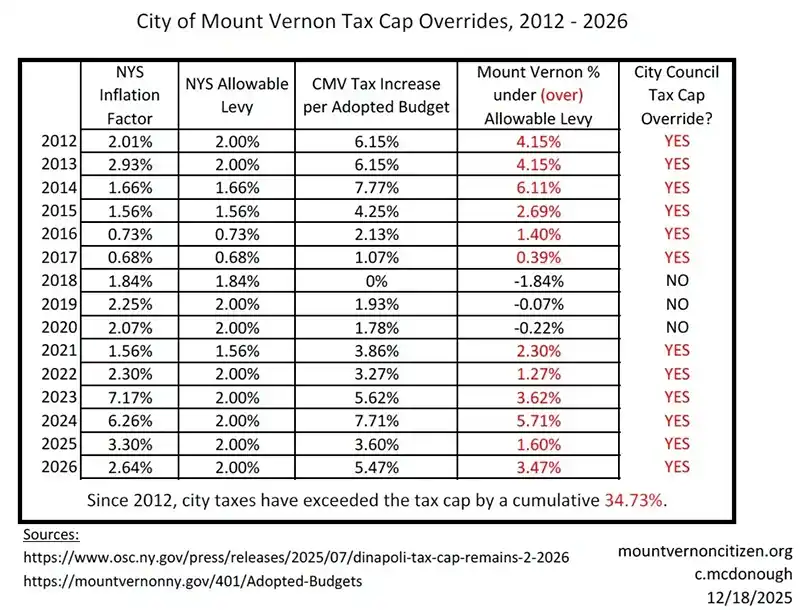
Over just the last five years, residents have absorbed more than 40% in cumulative tax increases, including add-on sewer and garbage fees.
Since 2001, Mount Vernon property taxes have risen 44% faster than inflation.
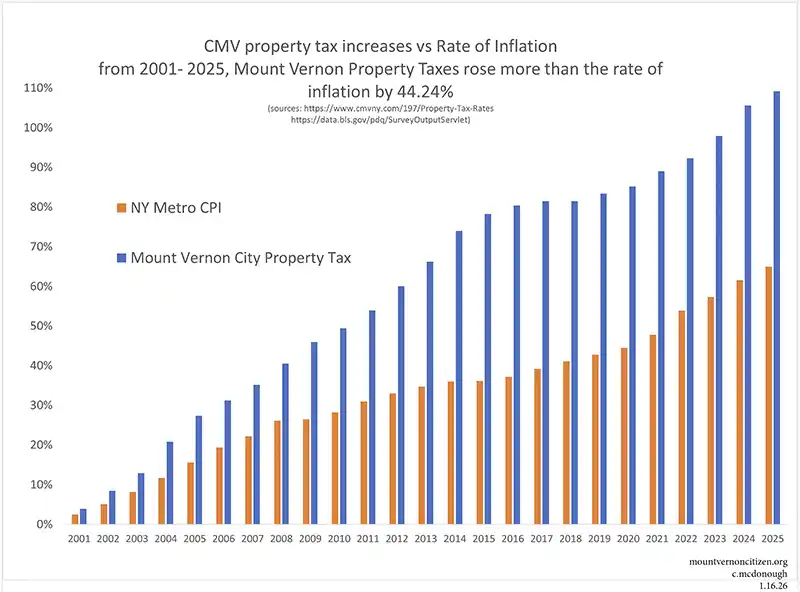
That is not a revenue problem. It is a governance problem.
Missing Bond Rating, Missing Discipline
Despite ever-higher taxes:
- Mount Vernon still has no bond rating
- It holds no meaningful reserves
- Audits after 2020 remain incomplete
- The City continues to rely on tax anticipation notes — essentially high-interest payday loans — just to operate
Higher taxes are not stabilizing the system. They are feeding a cycle of dysfunction.
The Economy Is Sending a Warning
The most overlooked red flag—and one of the clearest—is sales tax.
Over two years, Mount Vernon’s sales tax collections fell by 7%, even as neighboring cities continued to grow. That is not normal volatility — it signals economic stress and declining commercial activity.
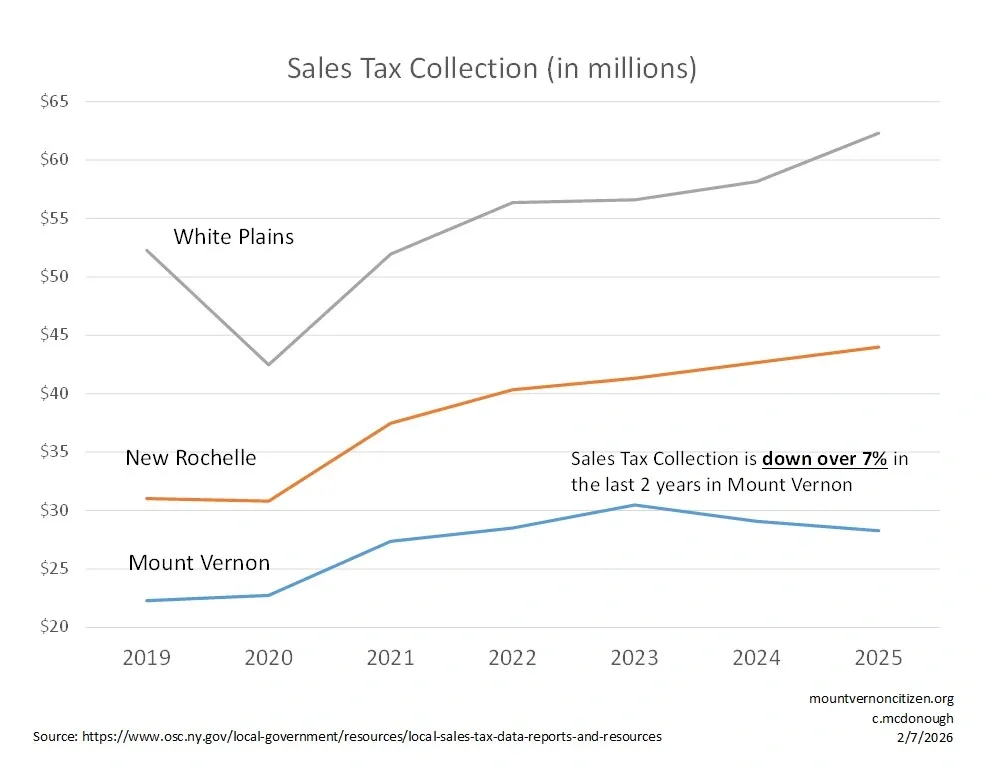
This makes Mount Vernon an outlier – and not in a good way.
Sales tax declines mean fewer transactions, fewer customers, and fewer businesses succeeding locally. It’s what happens when a city is unpredictable, poorly managed, and hostile to investment.
You cannot tax your way out of that.
Unpaid Taxes and Selective Enforcement Are Breaking The System
While residents are asked to pay more, the City is sitting on over $60 million in unpaid property taxes.
Repeated tax amnesties have failed. Standard enforcement tools — including foreclosure — have been applied inconsistently or avoided altogether.
The predictable result is a system in which compliant taxpayers subsidize chronic nonpayment, while leadership sidesteps politically difficult decisions.
The administration wants you to cloak its poor choices in the language of compassion; in truth, those decisions amount to fiscal malpractice.
A Missed ARPA Opportunity
The American Rescue Plan Act delivered $41 million to Mount Vernon — a once-in-a-generation chance to stabilize finances and rebuild trust after COVID.
Instead, Mount Vernon’s ARPA spending revealed the same patterns:
-
- Weak documentation
- Emergency-style decision making
- Minimal transparency
- Little connection between spending and measurable outcomes
Taken together, these patterns show a system that does not function the way a responsible government should.
That is why the debate cannot be limited to whether particular purchases were technically “allowed.” The real problem is that the City still lacked basic institutional financial controls when they were needed most.
MVCIP’s ARPA series explores how Mount Vernon squandered this opportunity.
Why a State Financial Monitor Is Necessary
Local self-correction is no longer credible.
A state financial monitor is not punishment — it is damage control.
Effective oversight would:
- Enforce timely audits and reporting
- Require a realistic multi-year financial plan
- Review risky borrowing and major contracts
- Mandate a serious tax enforcement strategy
- Restore credibility with residents, vendors, and markets
Oversight should be temporary, enforceable, and benchmark-driven — with clear exit conditions once the City proves it can govern responsibly.
The Time for “Wait and See” Is Over
Mount Vernon’s current trajectory is unsustainable — last-minute budgets, blown tax caps, and manufactured emergencies are not “governance.”
The State must act now: impose oversight, restore basic controls, and protect residents before a preventable crisis becomes irreversible.
*Figures shown are publicly available at mountvernoncitizen.org. Chris McDonough and mountvernoncitizen.org are not affiliated with the Civic Integrity Project.