
By Axel Ebermann
If you’ve ever sat through a Mount Vernon City Council meeting, you already know the rhythm.
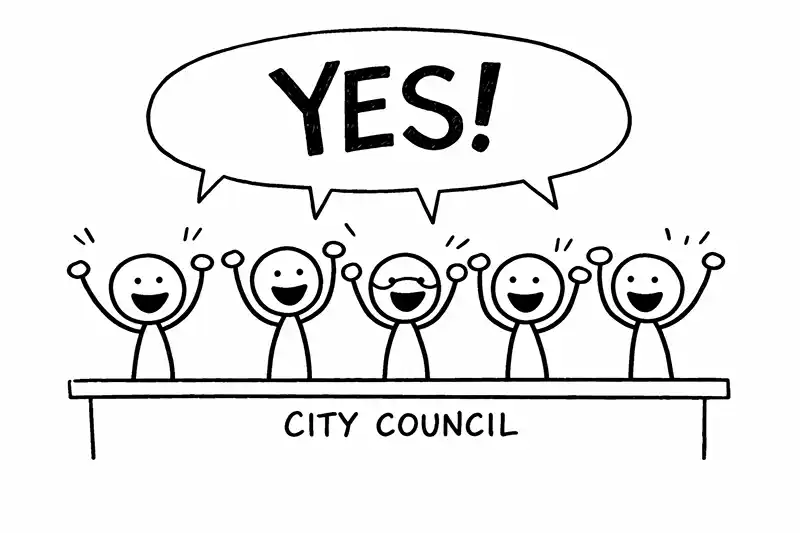
An item is introduced. There is little to no discussion. “On the question: none. Response: none.” A roll-call vote is taken. Everyone votes yes. Next item. Repeat.
If you’ve felt like the whole thing is theater – that the decisions have already been made before anyone walks into the chamber – we now have the numbers to prove it.
MVCIP analyzed every single roll-call vote recorded in the official 2025 City Council meeting minutes. All 33 meetings. All 497 votes. Every “aye,” every “nay,” every abstention, every absence.
What we found is a legislative body that approves virtually everything put in front of it.
The Numbers Don’t Lie
Let’s start with the headline: 98% of everything the Mount Vernon City Council voted on in 2025 was approved. Out of 497 recorded roll-call votes, 487 passed. Only 2 items were defeated the entire year – both at the same meeting (August 13), when only 3 of 5 members showed up and 2 were absent.
One was TMP-1474, a street closure permit for the “Wakanda Complete” event, which all three present members voted to deny. The other was a retroactive travel reimbursement for a First Responders Summit, which Gleason voted down citing her objection to approving expenses after the fact.
That’s it. Those are the only two “no” outcomes the council produced in an entire calendar year of legislating – and both involved a reduced quorum on a single night.
When four or more council members were present, not a single piece of legislation was voted down in all of 2025.
Every contract, every appointment, every budget amendment, every zoning change, every resolution the administration put before this council sailed through. For the entire year.
But the passage rate alone doesn’t capture how uniform the agreement was. Dig one layer deeper and the picture gets worse:
- 93% of all votes were fully unanimous – not a single member dissented, not a single member abstained.
- Only 35 votes out of 497 had any “nay” or abstention at all – and even those still passed.
That means in the rare instances when someone did break ranks, it made no difference. The item passed anyway. Every single time.
A Council That Never Breaks Ranks
The individual voting records are just as striking.
| Member | Yes Votes | No Votes | Abstentions | Yes Rate |
|---|---|---|---|---|
| Thompson | 492 | 1 | 1 | 99.6% |
| Poteat | 356 | 0 | 2 | 99.4% |
| Boxhill | 489 | 3 | 5 | 98.4% |
| Gleason | 482 | 9 | 6 | 97.0% |
| Browne | 388 | 4 | 10 | 96.5% |
Read that again.
Poteat cast zero “no” votes all year. Not one. Out of 358 votes cast, he voted yes 356 times and abstained twice. That is a 99.4% agreement rate with whatever was put in front of him.
Thompson voted yes 492 times out of 494 votes cast. His single “no” was part of a unanimous denial – meaning even his one act of dissent was in lockstep with everyone else.
Councilperson Gleason, cast the most “nay” votes ( nine in total) – and even she voted yes 97% of the time. Her dissent never changed a single outcome.
Where the Deliberation Should Be
New York State’s Open Meetings Law exists for a reason. Its legislative declaration could not be more clear:
“It is essential to the maintenance of a democratic society that the public business be performed in an open and public manner and that the citizens of this state be fully aware of and able to observe the performance of public officials and attend and listen to the deliberations and decisions that go into the making of public policy.”
The key word is deliberations. The law does not merely require that the public be allowed to watch votes happen. It envisions that the public will witness how decisions are reached – the questioning, the pushback, the weighing of alternatives, the negotiation.
In Mount Vernon, that process is functionally invisible. The minutes are filled with “On the question: none. Response: none.” Item after item passes without a word of public discussion from the members who are supposed to be scrutinizing it on behalf of over 72,000 residents.
This is not deliberation. It is ratification.
The Slate System: Built to Produce This Result
None of this happens by accident.
In Mount Vernon, city council candidates frequently run on the same electoral ticket as the mayor. They share donors. They share Political Action Committees backing them. They use the same campaign staff, the same lawyers, the same mailers.
They are elected together, funded together, and once in office, they vote together.
Mount Vernon operates under a “strong mayor” form of government. The mayor is the chief executive. She appoints every commissioner. She controls the day-to-day operations of the city. The City Council – the legislative branch, the body that holds the power of the purse – is supposed to serve as a check and balance on that executive power.
A 98% passage rate is not a check. It is a rubber stamp.
This is not a Mount Vernon problem alone. Political scientists have studied this dynamic extensively. The University of Illinois at Chicago has tracked Chicago’s City Council for decades, documenting how mayors from Richard M. Daley to Rahm Emanuel maintained near-unanimous support through political discipline and patronage – what researchers called the “rubber stamp city council.” It took a major political realignment to bring that unanimity rate down and push the council toward functioning as an independent legislative body.
Mount Vernon’s 2025 numbers are worse than what Chicago had under Daley.
What This Costs You
So what? Everyone agrees. What’s harm?
The harm is that you have no functioning legislative oversight of the executive branch of your city government.
Every contract the mayor’s office proposes gets approved. Every appointment goes through. Every budget line item is ratified. The council asks no hard questions – at least not on the record – and no legislation is sent back for revision based on dissent.
When the body that controls the purse strings never says no, there is no accountability. There is no mechanism to catch bad deals, no institutional pressure to negotiate better terms, no public record of anyone asking “is this really the best we can do?”
And Mount Vernon residents are living with the results. The infrastructure failures. The flooding. The broken sewers. The opaque contracts. The settlements negotiated behind closed doors. The tax increases approved in minutes.
These are the outcomes the current system produces.
The council’s job is not to agree with the mayor. The council’s job is to represent you – to ask the questions you would ask if you were in the room, to demand the answers you deserve, and to vote no when the answer isn’t good enough.
That is not happening.
The Predetermined Vote Problem
Here is what may be the most telling pattern in the data. When a council member does occasionally vote no or abstain, the outcome never changes. The remaining members always have enough votes to pass the item anyway.
This raises a serious question: Are the rare dissenting votes genuine acts of independence, or are they permitted precisely because the outcome is already assured?
In political science, this is known as “managed dissent” – allowing individual members to cast a symbolic “no” vote to maintain the appearance of independence, while the group ensures that the item passes regardless. It gives a council member something to point to at election time (“I voted against that!”) without ever threatening the administration’s agenda.
If the votes are truly independent, you would expect to see at least occasional close calls – items that pass 3-2, amendments that get proposed, legislation that gets sent back to committee. None of that happened in 2025.
What Can Be Done
Here is what residents can do:
Call it Out. Acknowledging and calling out the problem is the first step.
Show up. Empty council chambers send a message that no one is watching. Fill the seats. Bring your neighbors. When officials see an engaged public, it changes the calculus.
Demand recorded deliberation. Ask council members, on the record, to explain their votes – especially on contracts, appointments, and budget items. If they cannot articulate why they voted yes, call them out.
Click here to learn more about our research and analysis.