

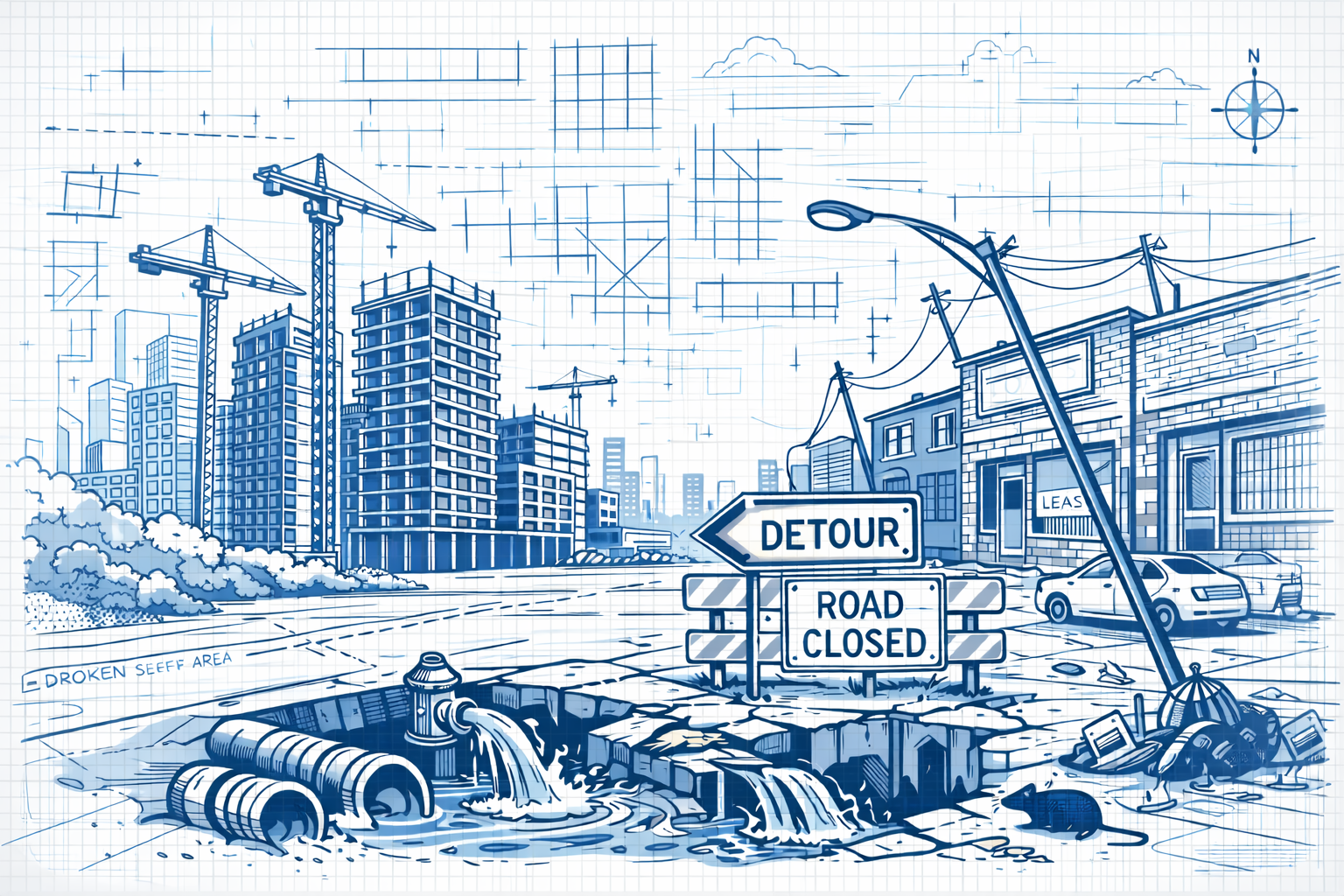
Across the city, residents brace for heavy rain not with confidence, but with pumps, quick dams, and towels at the ready—hoping their basements won’t flood with stormwater or raw sewage. Roads are crumbling and, in some places, unpaved. Parking shortages are constant. Buildings sit neglected for years—just look at Mount Vernon City Hall. Streetlights don’t work. Infrastructure fails under routine stress. Meanwhile, City expenses continue to rise, and the only reliable revenue source remains property taxes.
Against this backdrop, City Hall has produced a so-called Comprehensive Plan that addresses none of these realities.
After years of work and more than $600,000 in public funds, the plan does not fix flooding, drainage, roads, parking, or failing utilities. Instead, it functionally abolishes single-family zoning without any assessment whatsoever of whether Mount Vernon’s infrastructure can withstand the resulting impacts, and without any analysis of how the City would pay for those impacts without further burdening the homeowners whose neighborhoods the plan would fundamentally dismantle.
This is not comprehensive planning. It is a dangerous abstraction untethered from reality.
Density Is Not Our Goal — It Is Our Crisis
The plan repeatedly invokes “density” and “diversity” as virtues to be pursued. That framing is fundamentally flawed.
Mount Vernon is already one of the most densely populated and demographically diverse cities in New York State. Diversity here is not a future aspiration—it is our lived condition. Density is not an opportunity—it is a strain on infrastructure that is already failing.
The only things Mount Vernon truly needs more of are competence, infrastructure investment, and accountability.
Repackaging density as progress, without first fixing basic systems, is not visionary. It is irresponsible.
“As-of-Right” Means No Public Safeguards
Under existing law, building multi-family housing in a single-family zone requires a variance or special permit. That process is not a technicality—it is the public’s only line of defense. It requires:
- Notice to neighboring property owners
- A public hearing
- Review by the Zoning Board of Appeals
- The ability to impose conditions to mitigate harm (parking, drainage, traffic, design)
Making these uses as-of-right eliminates every one of those safeguards. No hearing. No community review. No enforceable mitigation.
In a city already suffering from flooding, traffic congestion, parking shortages, and failing infrastructure, removing public oversight is not reform. It is deregulation with foreseeable consequences.
You cannot preserve “neighborhood character” while abolishing the zoning rules that define it. Neighborhoods are not just façades; they are systems—of ownership, traffic flow, runoff, and stability. A triplex may resemble a single-family home from the street, but it brings more cars, more waste, more stormwater, and more pressure on systems that already fail every time it rains.
Environmental Review Should Not Have Been Optional
A Generic Environmental Impact Statement (GEIS) is not red tape. It is the tool New York law requires when a city proposes policies that will reshape how land is used across entire neighborhoods. Its purpose is simple: to force the city to look honestly at cumulative impacts—on flooding, drainage, sewer capacity, traffic, parking, schools, and neighborhood stability—before those impacts are locked in.
That obligation is triggered by what a decision actually does, not by how it is labeled. When a government action increases density, changes permitted uses, or intensifies demands on already-strained infrastructure, the law requires a hard look up front—not after damage is done and residents are left to deal with the consequences.
Skipping that step is not a judgment call. It is a failure to follow the law.
And this matters because, under General City Law, zoning must be in accordance with the comprehensive plan. The plan is not a harmless policy document or a wish list; it is the foundation for every land-use decision that follows. Claiming that a plan with citywide zoning consequences has “no environmental impact” is not just implausible—it defies both logic and law.
Real-World Consequences Expose the Fiction
These concerns are not theoretical. Homes adjacent to City-approved developments have already suffered severe damage due to poor oversight and inadequate planning. One such case is that of Dina Perriello, whose home has been destabilized as a result of nearby construction approved and overseen by the City (check out our story about the impacts of the 214 Gramatan project here:
The occurrence of such damage from a single project directly contradicts the conclusion that similar development on a citywide scale would result in no significant adverse environmental impacts.
When residents raise concerns and are met with indifference or hostility rather than remediation, it underscores the deeper problem: a government that cannot manage even small-scale development safely has no business orchestrating citywide land-use change.
A Pattern of Disregard for Law and Process
This failure is not confined to planning and zoning. It is consistent with a broader pattern: delayed budgets, reliance on short-term debt to pay basic bills, slow or stalled permitting, and an inability to perform routine municipal functions competently or on time.
A city that struggles to manage its finances, oversee construction, or maintain infrastructure cannot credibly claim the capacity to manage a generational redevelopment strategy—especially one that intensifies density without first repairing what is broken.
Mount Vernon deserves better than slogans, buzzwords, and paper plans.
Any serious planning effort must begin with reality, comply with the law, and put residents—not developers—first. That means honest environmental review, meaningful public participation, and infrastructure investment before zoning changes that permanently alter neighborhoods.
Without those fundamentals, a comprehensive plan is not a roadmap. It is a liability.
If you want to read the Comprehensive Plan, you can download it here
(Fair warning, it is 473MB and 413 pages long)