
Five minutes and seventeen seconds.
That is how long it took the Mount Vernon City Council to pass a 5.47% property tax increase for 2026, override New York State’s 2% tax cap by supermajority vote, and approve a so-called “declaration of necessity” by the Mayor – a maneuver that was presented as somehow making this entire exercise legal.
The vote took place in a hastily scheduled “Special Meeting” on a Tuesday afternoon at 4:30 p.m., a time when it would be difficult for most working residents to attend. The date was December 18, less than one week before Christmas.
This is not where the process started.
In the weeks leading up to the vote, residents were told the increase would be 5.47%, then 6.09%, then closer to 8%, and only days before the final vote were told it would be again – 5.47%. By the time the gavel came down, the process had become a blur of shifting figures, rushed meetings, and improvised explanations – all culminating in a decision that permanently raises taxes for thousands of Mount Vernon households.
The Mayor held the public hearing on the tax cap override law at 9.45am on December 30 – twelve days after the City Council had passed it.
One Day’s Notice for a Permanent Tax Increase
On December 17, 2025, residents learned – via a City Facebook post — that the City Council would hold a special meeting the very next day, December 18 at 4:30 p.m., to vote on a tax cap override and the FY 2026 budget.
One day’s notice.
Overriding the state tax cap is not routine. Under New York law, it is an extraordinary act meant to be used sparingly and only with heightened public notice, deliberation, and transparency.
In Mount Vernon, according to analysis by the blog Mount Vernon Citizen, exceeding the New York State property tax cap has become the norm, not the exception.
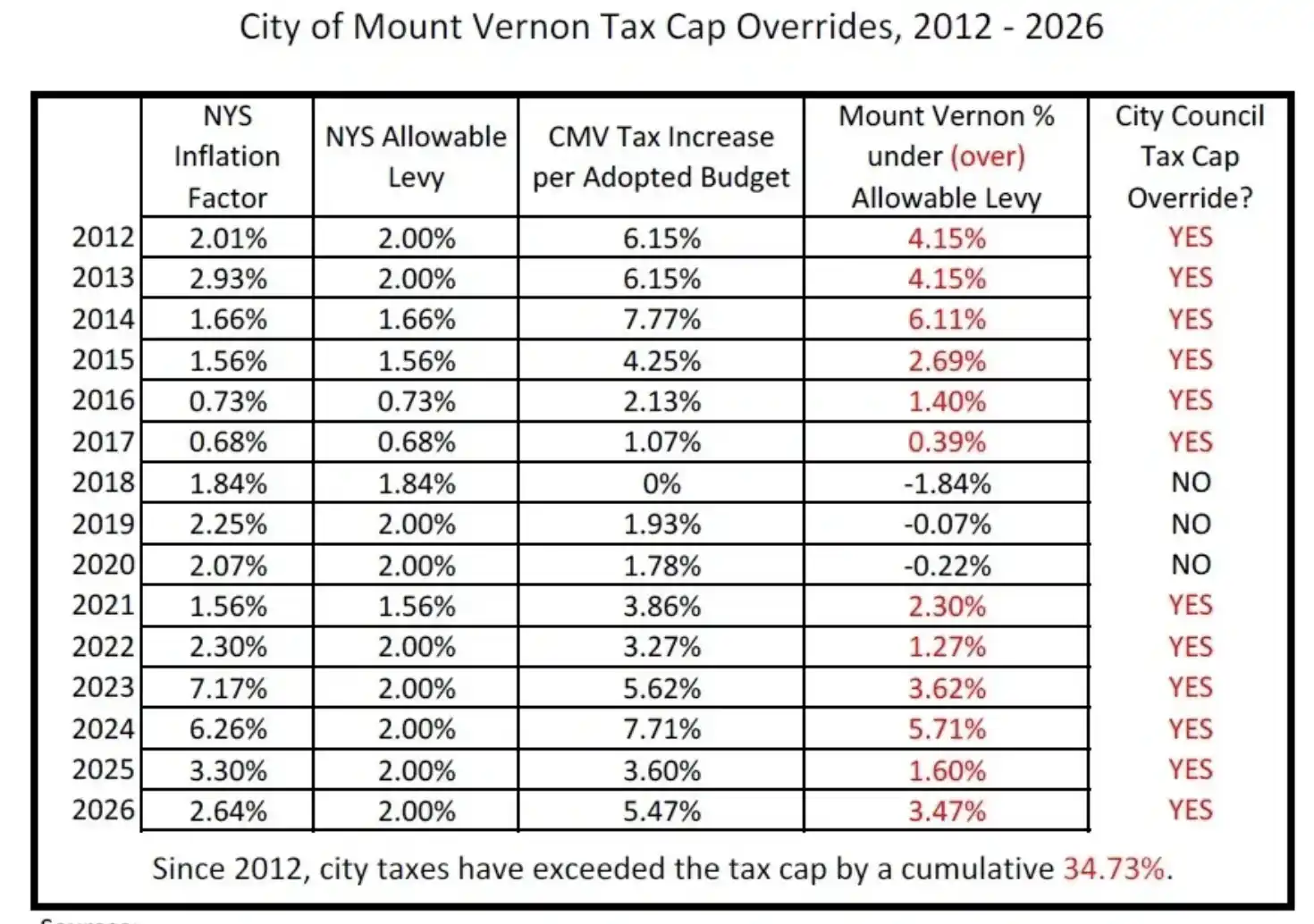
Here is the rub: overriding the tax cap requires the City Council to pass a law, not just a simple ordinance – with significantly more stringent notice and public hearing requirements. The Mayor circumvented that process through a same-day “declaration of necessity,” effectively declaring an emergency despite the absence of any actual emergency or sudden fiscal shock.
There was no natural disaster. No unexpected revenue collapse. No new information that had not already been known for months – or years.
The only urgency was getting the vote done before the cash-strapped City ran out of money due to an absence of sound financial planning. By late 2025, the City had already taken out a $6.5 million Tax Anticipation Note – the equivalent of a high-interest payday loan – after running out of cash before the end of the fiscal year. Before the year was over, on December 31, the City Comptroller announced publicly that 2026 tax bills had already been mailed and were available online, encouraging residents to pay promptly.
Mount Vernon is an outlier as far as constantly overriding the New York State tax cap is concerned. Our surrounding communities usually stay below it – and did so this year:
Westchester Comparison: Mount Vernon as an Outlier
| City | Increase (%) | Fiscal Year Notes |
|---|---|---|
| White Plains | 2.49% | 2025/26 budget |
| Yonkers | 2.8% | 2025–26 budget |
| New Rochelle | 2.46% | Fiscal Year 2026 |
Paying More, While Existing Taxes Go Uncollected
This vote did not happen in isolation.
Over the past five years, Mount Vernon residents have absorbed nearly 40% in cumulative tax increases and add-on fees, while living with:
-
- Perpetually poor service quality
- Visible deterioration across major corridors
- Departments failing basic performance standards
- Chronic delays in required audits
At the same time, the City carries approximately $52 million in unpaid property taxes. Roughly 1,200 of the City’s 12,000 properties were recently eligible for foreclosure. The City has not foreclosed on a single property in more than a decade. Instead of collecting what is owed, City Hall repeatedly returns to the same solution: raise taxes on the residents, who already pay.
A Budget Without Reform Is Just a Bill
The 2026 budget contains no credible structural reform plan. There is no multiyear financial strategy. No explanation for why revenue projections should suddenly be trusted. No plan to revive commercial corridors. No roadmap connecting higher taxes to improved outcomes.
The New York State Comptroller has documented these failures for years: unrealistic budgeting, incomplete audits, underbudgeted expenses, overestimated revenues, and an inability to plan beyond the next fiscal year. Raising taxes without fixing the system that mismanages them is not governance – it is governmental malpractice.
The Charter Was Ignored – Again
Mount Vernon’s City Charter exists to prevent exactly this kind of rushed, opaque decision-making. In a December 2025 follow-up letter, the New York State Comptroller explicitly warned that Mount Vernon continued to disregard Charter-mandated budget procedures – deficiencies that remained only partially corrected. Despite that warning, the City once again compressed the process, introduced key legislation at the last minute, and pushed through a tax cap override under conditions that undermined transparency and meaningful public participation.
This is no longer ignorance. It is willful repetition of an unlawful practice.
The Outcome Was Decided Before the Public Spoke
Residents showed up. They demonstrated with signs in front of City Hall. The chambers were full. Speakers raised detailed objections: about legality, process, numbers, and trust. None of it mattered. The votes were locked in. Two Council members phoned it in remotely via Zoom. Public participation was permitted – but functionally meaningless. This is not how democratic decision-making is supposed to work.
Predictable. Preventable. Repeated.
City officials say they had no choice. That is not true.
This outcome was the foreseeable result of years of poor decision making: treating tax cap overrides as routine, delaying audits, ignoring Charter deadlines, failing to collect existing revenue, and papering over structural problems with short-term fixes.
Unless Mount Vernon stops governing by crisis and starts governing by rules, residents will be back here next year – having the same fight, with a bigger bill.